
Dec 17, 2025 | AC Installation
Deciding whether to repair your existing air conditioning system or invest in a new one can be a daunting task. As a homeowner, you want to ensure comfort and efficiency without incurring unnecessary expenses. Many factors come into play, including the age of your current system, the frequency of repairs, and your energy bills. At North HVAC Services, we strive to make these decisions clearer by offering expert insights grounded in real-world experience. Let’s explore how you can determine the best path forward for your air conditioning needs.
Assessing the Age of Your Air Conditioning System
The age of your air conditioning system is a critical factor in deciding whether to repair or replace it. Most air conditioners have a lifespan of about 10 to 15 years. If your system is within this age range, it might be time to consider a replacement, especially if it’s been experiencing regular issues.
For instance, a unit nearing the end of its lifespan may struggle to maintain efficiency, leading to higher energy bills. If your air conditioner is over a decade old and you’re noticing a decline in performance, it might be more cost-effective to install your air conditioner than to frequently pay for repairs. Newer models are often more energy-efficient, which could result in significant savings on your utility bills.
On the other hand, if your system is relatively young but has encountered a few hiccups, it may be more sensible to opt for air conditioning repair. Addressing minor issues early can extend the lifespan of your unit without the need for a full replacement.
Real-World Scenario
Consider a homeowner in Marin County with a 12-year-old air conditioner that’s starting to show signs of wear. They’ve noticed an increase in energy bills and occasional breakdowns. In this case, North HVAC Services might recommend an evaluation of the system’s overall health. If repairs are becoming frequent and costly, transitioning to an air conditioning replacement could be the more economical choice in the long run.
Frequency and Cost of Repairs
Another important consideration is the frequency and cost of repairs. If you find yourself constantly calling for ac repair services, it may be a sign that your system is on its last legs. Consistent breakdowns not only disrupt comfort but also add up financially.
A general rule of thumb is the 50% rule: if the cost of repairs approaches 50% of the value of a new system, replacement becomes a more logical option. Investing in a modern, efficient system can prevent frequent repairs and improve overall comfort.
Real-World Scenario
A family in Sonoma County might experience regular issues with their air conditioner, each repair costing a few hundred dollars. After calculating the expenses, they realize these costs are approaching the price of a new unit. North HVAC Services could then advise them to get ac installed to avoid further financial strain and improve their home’s cooling efficiency.
Energy Efficiency and Utility Bills
Noticeable increases in your energy bills can indicate an inefficient air conditioning system. Older units typically consume more energy, especially if they haven’t been maintained properly over the years. Upgrading to a modern, energy-efficient system can significantly reduce electricity usage and lower bills.
For those interested in sustainable living and reducing their carbon footprint, newer systems offer advanced technology designed to consume less power while maintaining comfort levels. If your current unit isn’t meeting these standards, exploring air conditioning replacement options may be beneficial.
Real-World Scenario
A couple living in Marin County might notice their summer electricity bills are rising despite no changes in usage patterns. North HVAC Services could conduct a thorough evaluation and find that the air conditioning system is operating inefficiently. By installing a new, energy-efficient model, the couple could enjoy cooler indoor temperatures and reduced utility bills.
Evaluating Comfort and Air Quality
Your air conditioning system plays a vital role in maintaining indoor comfort and air quality. If you’re experiencing uneven cooling or humidity issues, these could be signs of a struggling system. Poor air quality can also result from an outdated unit that fails to filter pollutants effectively.
A modern air conditioning system can improve indoor air quality by incorporating advanced filtration technologies. If your current system isn’t providing the comfort you desire, it might be time to consider a replacement. This can lead to a healthier living environment and increased home satisfaction.
Real-World Scenario
A family in Sonoma County might experience discomfort due to uneven cooling across different rooms. After a consultation with North HVAC Services, they learn that their system’s design is outdated, leading to inefficiencies. By opting to install a new air conditioner, they can enjoy consistent temperature control and improved air quality throughout their home.
Making Your Decision
Ultimately, the decision to repair or replace your air conditioning system depends on a careful assessment of the factors discussed above. By considering the age of your unit, the frequency and cost of repairs, energy efficiency, and comfort levels, you can make a more informed choice.
North HVAC Services is committed to guiding you through this process with expert advice and personalized solutions. Whether you’re looking to fix your air conditioner or explore replacement options, our team is here to help you achieve optimal comfort and efficiency in your home.
Ready to take the next step? Contact North HVAC Services today to schedule a consultation and ensure your home remains cool and comfortable all year round.
Nov 28, 2025 | AC Installation
Commercial air conditioning systems operate under fundamentally different parameters than residential systems. They sustain longer operational cycles, accommodate higher occupancy loads, and require industrial-grade components designed for continuous duty. When commercial AC systems fail, the consequences extend beyond discomfort to measurable revenue loss, regulatory compliance issues, and workforce productivity decline.
North HVAC Services has specialized in air conditioner installation in Santa Rosa, CA, for commercial clients since 1988. We have observed costly mistakes that occur when business owners approach commercial HVAC with residential expectations. This guide addresses those critical distinctions.
You will learn why commercial air conditioning installation requires specialized expertise, how to select appropriate systems for your specific business application, what California Title 24 compliance entails, and how to identify contractors with genuine commercial credentials. Most importantly, you will understand how strategic planning prevents emergency failures during peak business periods.
Commercial Systems Require Industrial-Grade Engineering
Many business owners mistakenly assume commercial AC represents merely scaled-up residential equipment. This misconception leads to systemic problems requiring extensive remediation.
Commercial Operating Parameters Exceed Residential Standards
Commercial facilities operate 12 to 18 hours daily compared to residential systems, which average 8 to 10 hours. Your restaurant, retail establishment, or office requires cooling during peak afternoon temperatures when residential properties remain largely unoccupied.
Occupancy density, commercial lighting, and process equipment create thermal loads that residential systems never encounter. Retail spaces may accommodate 50 customers during peak hours, each generating approximately 400 BTUs of metabolic heat. Commercial lighting generates three to five times the heat output of residential applications. Restaurant kitchens operate high-BTU cooking equipment throughout service hours, while office buildings house server infrastructure requiring around-the-clock cooling.

These combined factors fundamentally alter system sizing requirements for proper air conditioner installation. Commercial load calculations must account for extended operating hours, elevated occupancy density, and equipment heat generation that residential methodology ignores entirely.
System Failure Creates Immediate Financial Consequences
Residential AC failure creates discomfort. Commercial AC failure generates measurable revenue loss and operational disruption.
| Business Type |
Revenue Impact |
Operational Consequences |
| Retail Establishment |
Substantial |
Customer exodus, reduced transaction time, negative review generation |
| Food Service |
Severe |
Health code violations, critical reviews, kitchen safety concerns |
| Office Environment |
Moderate |
Productivity degradation, increased error rates, employee dissatisfaction |
| Medical Facility |
Significant |
Appointment cancellations, patient complaints, regulatory scrutiny |
Retail customers leave stores more quickly when temperatures become uncomfortable, resulting in fewer purchases. Food service establishments face negative reviews and health inspector scrutiny. Office environments experience a measurable productivity decline when temperatures fall outside comfortable ranges.
California Title 24 Establishes Non-Negotiable Standards
California Title 24 energy efficiency standards impose stringent requirements on all commercial construction and renovation. The California Energy Commission enforces compliance through mandatory permitting and inspection protocols.
New installations must satisfy minimum efficiency thresholds. Systems exceeding 5-ton capacity require economizer controls. Ductwork must meet specific insulation standards and pass pressurization testing.
The building department mandates permits for virtually all commercial AC installations in Santa Rosa, CA. Permit processing typically requires 2 to 3 weeks. Business operations cannot commence until final inspections pass and occupancy certificates are issued.
Engaging Residential Contractors for Commercial Projects Creates Risk
The consequences of hiring residential contractors for commercial work are well-documented throughout the HVAC industry. Property managers and business owners frequently make this mistake, attracted by lower pricing and strong residential reviews without verifying commercial credentials.
Three Critical Failure Points:
- Improper Load Calculations
- Residential contractors apply the Manual J home methods instead of the required Manual N commercial methodology.
- Systematically misses commercial-specific heat loads, including high-wattage display lighting, elevated occupancy density, and solar heat gain through commercial glazing.
- Result in undersized equipment incapable of meeting actual building demands.
2. Code Compliance Failures
- Lack of familiarity with California Title 24 commercial requirements.
- Installations fail inspection due to missing economizer controls, inadequate duct insulation, or improper control configurations.
- Delays occupancy permits and requires expensive remediation.
3. Premature Equipment Failure
- Improperly sized systems deteriorate rapidly under commercial duty cycles.
- Equipment designed for residential intermittent operation fails under continuous commercial runtime.
- Compressor failures, refrigerant breakdowns, and control malfunctions occur within three to five years instead of the expected fifteen to twenty-year lifespan.
Commercial applications demand specialized load calculation methodology, in-depth building code knowledge, and industrial-grade equipment selection that residential experience does not provide. Contractor selection based on residential reputation without verified commercial credentials creates predictable, expensive failures.
Selecting Appropriate Systems for Commercial Applications
Three primary system configurations dominate commercial installations, each optimized for specific applications and building characteristics.
1. Rooftop Package Units Represent the Commercial Standard
Rooftop package units integrate all system components within a single weatherproof enclosure mounted on the building roof. This configuration includes a compressor, a condenser, an evaporator coil, and an air handler with ducted distribution to conditioned spaces.
Commercial buildings predominantly utilize rooftop units for practical and economic reasons. They consume no rentable interior space, eliminating opportunity cost. Installation occurs on the roof with minimal disruption to ongoing business operations. Maintenance personnel access equipment from the roof rather than through occupied spaces.
2. Split Systems Provide Ground-Level Alternatives
Split system configurations separate the outdoor condensing unit from the indoor air handling equipment. Commercial split systems employ heavy-duty components engineered for extended duty cycles exceeding residential specifications.
Ground-mounted systems are appropriate when rooftop installation is impractical or prohibited. Historic structures frequently restrict rooftop equipment for architectural preservation. Some buildings lack adequate structural capacity for rooftop loads. Ground installation also facilitates maintenance access in certain applications.
3. Ductless Systems Deliver Zone-Level Control
Ductless mini-split systems connect a single outdoor condensing unit to multiple indoor air handlers. Each indoor unit independently controls temperature within its designated zone.
These systems offer distinct operational advantages. They eliminate ductwork installation through finished spaces, reducing construction costs and timeline. Each zone maintains independent temperature control, accommodating varying occupancy patterns and thermal preferences. Single systems provide both heating and cooling functionality year-round.
Food service establishments benefit from maintaining distinct temperatures in dining versus kitchen areas. Mixed-use properties allow independent tenant control without inter-tenant disputes. Server rooms receive dedicated cooling independent of general office conditions.
The U.S. Department of Energy reports that duct losses can account for more than 30% of energy consumption for space conditioning, making ductless systems considerably more efficient by eliminating this energy waste entirely.
| System Type |
Installation Duration |
Optimal Applications |
Design Life |
| Rooftop Package Unit |
3 to 4 days |
Retail, food service, office buildings with flat roofs |
15 to 20 years |
| Commercial Split System |
3 to 5 days |
Historic buildings, ground-floor applications |
15 to 18 years |
| Multi-Zone Ductless |
4 to 7 days |
Mixed-use properties, tenant spaces, data centers |
15 to 20 years |
Proper System Sizing Determines Performance and Longevity
Accurate capacity calculation is critical to system performance. Both undersized and oversized equipment create operational problems and accelerated component failure.
Commercial Load Calculations Employ Specialized Methodology
Residential contractors utilize Manual J calculation procedures designed for single-family housing. Commercial applications require the Manual N methodology, accounting for parameters absent in residential contexts.
Commercial calculations incorporate actual occupancy density during peak business periods. Retail establishments may accommodate one customer per 100 square feet during promotional events. Food service dining areas operate at substantially higher density during meal service. Each occupant contributes metabolic heat, requiring system removal.
Business-Specific Variables Affect Calculation Accuracy
- Retail establishments experience varying occupancy and high-wattage display lighting, while frequent door openings let in unconditioned air, and heat gain occurs from large windows.
- Food service operations have high cooling demands due to extreme kitchen temperatures and the need for makeup air as exhaust systems remove conditioned air, especially during peak dining times.
- Office environments need continuous air conditioning to counteract heat from desktop computers, with surges in occupancy during meetings and dedicated cooling for server infrastructure.
- Medical facilities require precise temperature control for both patient comfort and equipment operation, handling variable occupancy in examination rooms and concentrated heat loads from diagnostic and sterilization equipment.
Identifying Contractors with Commercial Competency
Contractor selection represents the most critical decision affecting installation success and long-term system performance.
Verify Essential Credentials and Qualifications
Begin with California C-20 contractor license verification through CSLB.ca.gov. Verify license status, bond coverage, and insurance before engaging any contractor.
Examine documented commercial project experience with verifiable references. Residential experience does not equate to commercial competency due to fundamental differences in equipment, calculations, and code requirements. Manufacturer certifications and EPA Section 608 certification demonstrate proper training and compliance.
Essential Questions Reveal Contractor Capability
How many commercial air conditioner installation service projects have you completed in Santa Rosa within the past three years? Local experience indicates familiarity with building department procedures and permit timelines.
Verify experience with your specific industry. Food service contractors understand kitchen loads. Office expertise differs from retail knowledge. Medical facilities require a specialized understanding of patient comfort and equipment thermal loads.
Request and contact commercial references directly. Confirm who manages permit applications. Warning signs include predominantly residential portfolios, inability to provide commercial references, and unfamiliarity with Title 24 requirements.

Comprehensive Proposals Demonstrate Professional Standards
Professional proposals provide detailed specifications, including exact equipment, efficiency ratings, and capacity calculation explanations. Timelines should include equipment procurement (2 to 6 weeks) and permit approval (2 to 3 weeks in Santa Rosa).
Evaluate proposals holistically, considering equipment quality, warranty coverage, contractor experience, and realistic scheduling alongside price.
North HVAC Services maintains Diamond Authorized Dealer status with Mitsubishi and Authorized Factory Dealer status with Trane and Day & Night, ensuring ongoing factory training, priority parts access, and extended warranty coverage for our customers.
Installation Process and Quality Assurance
Being aware of the installation protocols helps you plan for operational continuity and recognize quality workmanship.
Pre-Installation Planning Prevents Problems
Professional air conditioner installation begins with a complete site inspection. Contractors evaluate existing conditions, spatial constraints, and building characteristics over 2 to 4 hours. Rooftop installations require a structural engineering review to confirm roof capacity.
Equipment procurement follows design approval, with lead times ranging from 2 to 6 weeks, depending on availability. Your contractor manages permit applications through Santa Rosa’s building department without client involvement. Installations are typically completed during regular business hours, though after-hours or weekend scheduling minimizes operational disruption.
Typical Installation Timeline and Procedures
Single rooftop unit installation typically requires 3 days. Complex systems or multiple units may require 4 to 7 days.
| Installation Phase |
Primary Activities |
Observable Impact |
| Day one addresses preparation and existing equipment removal. |
Existing equipment removal, roof preparation, electrical infrastructure |
Roof access requirements, moderate noise, brief power interruption |
| Day two handles equipment delivery and installation. |
Crane equipment delivery, unit placement, system connections |
Early morning crane operations, rooftop activity |
| Day three encompasses system startup and performance verification. |
System startup, performance testing, control programming |
System operational testing, technician zone verification |
Quality Assurance Testing Prior to Completion
Quality air conditioner installation services include rigorous testing before project completion. Refrigerant charge must be precisely accurate to prevent performance degradation. Airflow measurements verify each zone receives design volumes. Temperature differential testing confirms systems demonstrate 15 to 20 degree differentials between return and supply air.
The American Society of Heating, Refrigerating, and Air-Conditioning Engineers publishes detailed commissioning standards that professional contractors follow. You receive complete documentation, including equipment warranty registration, maintenance schedules, and permit closure proving regulatory compliance.
Making Informed Decisions for Your Commercial Facility
Professional air conditioner installation in Santa Rosa, CA, for commercial applications requires strategic planning and specialized expertise. Your decisions today affect operational comfort, energy efficiency, and system reliability throughout the 15 to 20-year equipment lifecycle.
Commercial systems face fundamentally different demands than residential applications. Extended operating hours, elevated occupancy loads, and process equipment heat generation require proper commercial calculation methodology and industrial-grade equipment. California Title 24 standards and Santa Rosa building codes establish non-negotiable compliance requirements.
Select contractors based on documented commercial expertise rather than residential reputation. Verify California licensing, contact commercial references thoroughly, and evaluate proposals holistically, considering equipment quality, contractor experience, and realistic timelines. Implement proactive planning rather than waiting for system failure to force hurried decisions.
Schedule Your Commercial HVAC Inspection Today
North HVAC Services has provided air conditioner installation services for commercial clients throughout Sonoma County since 1988. We understand your HVAC system protects revenue, supports regulatory compliance, enables workforce productivity, and maintains business continuity.
Call (415) 845-6910 or email northhvacservices@gmail.com to schedule a full facility inspection for air conditioning installation in Santa Rosa. We provide detailed proposals with transparent timelines and maintenance programs engineered for commercial reliability. Let us help you make ideal decisions, protecting your business investment.
Oct 13, 2025 | AC Installation
Air conditioning is no longer a luxury in Santa Rosa, where summer heat waves and wildfire smoke make cooling and indoor air quality essential for comfort and health. Yet many homeowners assume that installing a new system is as simple as picking a model and scheduling a quick appointment. The reality is far more complex.
Professional AC installation in Santa Rosa, CA, is never a one-size-fits-all service. Each home has unique demands shaped by square footage, insulation quality, duct design, and even the microclimate of its neighborhood. A cookie-cutter approach leads to poor performance, wasted energy, and shorter system life. This is why choosing certified contractors matters.
North HVAC Services, Inc Heating & Air Conditioning, a trusted name among the HVAC companies in Santa Rosa, CA, specializes in custom system design. By using advanced load calculations, compliance with California codes, and local climate expertise, the company makes sure that every installation maximizes comfort and minimizes long-term costs.
Why Cookie-Cutter Installs Fail
Some installers treat air conditioning installation like a routine swap-out: remove the old unit, slide in a new one, and hook up existing ducts. While this approach might get the system running, it rarely delivers desired results.
Common problems from cookie-cutter installs include:
| Problem |
Cause |
Financial Impact |
| Short cycling |
System too large for home |
Higher energy bills, faster wear on parts |
| Hot and cold spots |
Poor duct design or wrong unit size |
Uneven comfort, homeowner complaints |
| High humidity |
Improper airflow balance |
Mold risk, discomfort |
| Reduced lifespan |
System overworked |
Replacement needed years earlier than expected |
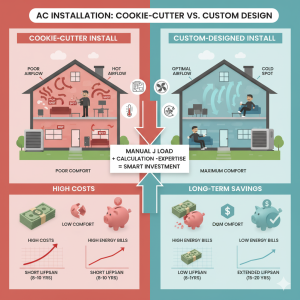
Infographic: Side-by-side comparison of “Cookie-Cutter Install” vs. “Custom Design,” showing airflow, comfort, and cost differences.
Custom AC Installation: What It Really Means
True customization begins before a single piece of equipment is installed. A professional contractor performs a detailed Manual J load calculation, which accounts for:
- Square footage of the home
- Number and size of windows
- Orientation to the sun
- Insulation levels
- Air leakage points
- Local climate data
This calculation determines the precise system size required for your home. Installing a unit that is too large wastes energy and causes short cycling. A unit that is too small runs constantly without ever reaching set temperatures.
North HVAC Services technicians conduct these calculations for every project. This guarantees that air conditioning installation in Santa Rosa delivers the right balance of comfort, efficiency, and longevity.
Local Climate and Why It Matters
The region’s Mediterranean climate brings mild winters but increasingly hot and dry summers. Add in the smoke season from wildfires, and the demands on a cooling system are unique compared to other regions.
- Summer heat waves: Outdoor temperatures can soar past 100°F, straining undersized systems.
- Smoke events: Homes need advanced filtration, such as MERV 13 filters or duct sealing, to protect air quality.
- PG&E electricity rates: At an average of 31 cents per kWh, nearly double the national average (EIA Source), inefficiency costs homeowners substantially more here than elsewhere.
Choosing HVAC is not only about cooling. It is about designing a system that can handle seasonal extremes while keeping utility bills under control. North HVAC Services uses local climate data to recommend systems optimized for these exact conditions.
Risks of Improper Installation
The dangers of poor installation go beyond discomfort. Improperly designed systems carry long-term financial risks:
- Short cycling: Oversized units switch on and off frequently, using more energy and wearing out compressors faster.
- High utility bills: An incorrectly charged refrigerant line or leaky ducts reduce efficiency by up to 30%.
- Moisture problems: Poor airflow balance causes humidity issues, increasing the chance of mold and indoor air quality complaints.
- Premature breakdowns: Systems may last only 8–10 years instead of the typical 15–20 when installed poorly.
North HVAC Services emphasizes correct design and precision installation to prevent these costly scenarios.
Custom Design vs. Standard Install: Cost Analysis
To highlight the difference, consider this cost comparison:
| Installation Type |
Upfront Cost |
Annual Operating Cost |
Expected Lifespan |
Long-Term Value |
| Cookie-Cutter Install |
$6,000 |
$1,200 |
8–10 years |
$18,000+ in replacements and energy waste |
| Custom Load-Calculated Install |
$7,000 |
$900 |
15–20 years |
$30,000+ in savings and extended comfort |
While a custom design may cost slightly more upfront, the reduced energy use and longer lifespan save homeowners thousands. Professional AC installation in Santa Rosa, CA, is an investment, not an expense.
Why Only Certified Contractors Should Handle Installation
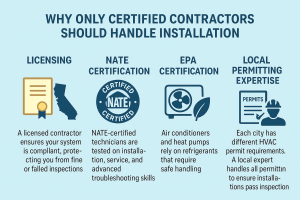
The quality of your AC installation does not depend only on the equipment itself. It depends heavily on the training and expertise of the professionals installing it. In Santa Rosa, where homes range from historic craftsman bungalows to modern builds in new subdivisions, every property has different electrical, ductwork, and insulation requirements. Installing the wrong system or cutting corners during setup can be an expensive mistake. That is why only certified HVAC contractors should ever handle AC installation.
A. Licensing
California has some of the strictest building and energy efficiency codes in the nation. The California Energy Commission (CEC) enforces Title 24 standards, which require systems to meet specific efficiency ratings and installation practices. A licensed contractor ensures your system is compliant, protecting you from fines or failed inspections. According to the U.S. Energy Information Administration, energy efficiency improvements reduce the amount of energy required for homes and businesses, lowering utility costs and demand on the grid.
B. NATE Certification
The North American Technician Excellence (NATE) certification is considered the gold standard in the HVAC industry. NATE-certified technicians are tested on installation, service, and advanced troubleshooting skills. Homeowners who hire NATE-certified contractors report considerably fewer warranty claims compared to those who do not (NATE.org data). North HVAC Services employs technicians with NATE training to ensure every project meets the highest technical standards.
C. EPA Certification
Air conditioners and heat pumps rely on refrigerants that require safe handling. The Environmental Protection Agency (EPA) mandates certification for all technicians who work with refrigerants. Without it, an installer may expose your home to environmental risks or violate federal law. With EPA-certified professionals, North HVAC Services guarantees safe and legal refrigerant management during every air conditioning installation.
D. Local Permitting Expertise
Sonoma County requires HVAC permits for most installations, and each city may have additional regulations. An unlicensed installer may skip permits, leaving homeowners with hidden liabilities when they try to sell their property or apply for rebates. Local expertise matters. North HVAC Services, a leader in HVAC in Santa Rosa, CA, handles all permitting to ensure installations pass inspection the first time.
The Role of HVAC Companies in Rebates and Incentives
California’s transition toward electrification is reshaping how homeowners invest in HVAC systems. Rebates and incentives are designed to ease the upfront cost of high-efficiency installations, but only professional contractors know how to navigate the process. Without the right paperwork or installation standards, rebates can be denied.
For homeowners, choosing experienced Santa Rosa, CA, HVAC companies like North HVAC Services can make the difference between receiving hundreds of dollars back or missing out entirely.
Sonoma Clean Power Rebates
Sonoma Clean Power offers rebates of up to $1,000 for qualifying energy-efficient systems. These rebates often target ductless mini-splits and heat pumps, which not only cool efficiently but also provide heating in winter.
TECH Clean California Incentives
The state’s TECH Clean California program provides incentives for replacing older gas or inefficient electric systems with new heat pumps.
PG&E Programs
Pacific Gas and Electric (PG&E) frequently runs seasonal rebate programs for smart thermostats, duct sealing, and high-SEER equipment..
North HVAC Services installs the right system and handles rebate paperwork with accuracy. This allows Santa Rosa homeowners to benefit from available incentives right away while also reducing utility costs over time.
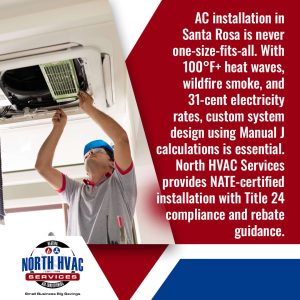
When to Consider Air Conditioning Installation in Santa Rosa
While repairs can keep an older system running, there comes a point when replacement is the smarter choice. In Santa Rosa, where summers are growing hotter and PG&E rates are among the nation’s highest, continuing to operate an inefficient system is costly.
Here are the key signs that air conditioning installation should be considered:
1. System Age Over 15 Years
The average AC lifespan is 12–15 years. After this point, breakdowns become frequent, and efficiency drops noticeably.
2. Repair Costs Exceed Half of Replacement Value
The “50% Rule” is an industry guideline: if a repair costs more than half of a replacement, installing new equipment is the better long-term decision.
3. Rising Energy Bills Despite Maintenance
If your bills keep increasing even after tune-ups, your system is losing efficiency. In Sonoma County, where rates are nearly double the national average, these costs add up quickly.
4. Frequent Breakdowns Disrupt Comfort
Multiple service calls each summer not only cost money but also disrupt daily life. A new installation provides peace of mind during Santa Rosa’s hottest days.
5. Poor Indoor Air Quality and Humidity Issues
Older systems may struggle with airflow and humidity control, leading to stuffy or damp indoor conditions. With wildfire smoke becoming a seasonal concern, investing in a new system with advanced filtration is often the healthiest choice.
North HVAC Services, recognized among the top Santa Rosa, CA, HVAC companies, offers free in-home evaluations to help homeowners decide whether repair or replacement is the most cost-effective path.
Free In-Home System Evaluation
One of the biggest barriers homeowners face is uncertainty. They worry about making the wrong investment or being sold a system that does not truly fit their home.
That is why North HVAC Services offers a free in-home system evaluation. This consultation includes:
- Load calculation and system sizing
- Duct inspection
- Energy efficiency assessment
- Rebate eligibility review
This no-obligation evaluation provides the confidence homeowners need to make an ideal decision about their next installation of HVAC in Santa Rosa.
Schedule Your AC Installation with North HVAC Services
Every home in Santa Rosa has unique needs. Avoid the risks of a cookie-cutter install and invest in a system designed for your comfort and budget.
North HVAC Services is the trusted local expert for air conditioning installation in Santa Rosa, CA. With certified technicians, rebate expertise, and climate-specific knowledge, the company ensures that every project delivers maximum value.
Call (415) 845-6910 or email northhvacservices@gmail.com today to schedule your free in-home evaluation. Serving Santa Rosa and nearby areas with precision HVAC solutions.