Your heating system works quietly in the background for most of the year, easily forgotten during Northern California’s mild seasons. Then, December arrives with its first cold evening, you adjust the thermostat, and nothing happens. Or worse, strange sounds echo through your home, utility bills spike unexpectedly, or only half your rooms receive adequate warmth. These scenarios happen more often than homeowners realize, particularly in Sonoma County, where systems operate intermittently rather than continuously.
Recognizing the early warning signs of furnace failure protects you from emergency breakdowns during the coldest weeks of winter. While Santa Rosa’s climate remains moderate compared to regions with harsh winters, cold snaps between December and February create genuine discomfort when heating systems fail. Holiday gatherings, family visits, and daily routines all depend on reliable warmth. This guide identifies five critical indicators that your system needs professional attention before complete failure occurs, helping you avoid the stress and expense of emergency service calls when temperatures drop.
Why Even California Furnaces Fail During Cold Weather
Northern California presents unique challenges for heating systems that differ significantly from cold-climate regions. Systems in Santa Rosa and the surrounding Sonoma County areas operate intermittently rather than continuously throughout the winter months. This pattern allows developing problems to remain hidden during mild weather, only revealing themselves when homeowners activate their systems during cold snaps.
Dormant issues that caused no problems during months of inactivity suddenly prevent proper operation when demand increases. Components that deteriorate slowly over time reach critical failure points precisely when you need reliable performance. Systems aging beyond 15-20 years face increased vulnerability to breakdown. Wear accumulates on motors, heat exchangers, and ignition components.
Mild weather creates maintenance complacency among homeowners who don’t perceive immediate threats, yet seasonal temperature swings still stress equipment. Understanding these patterns helps explain why proactive attention to warning signs prevents costly emergencies and the need for furnace repair in Santa Rosa, CA.
Warning Sign #1: Strange Noises Coming From Your Furnace
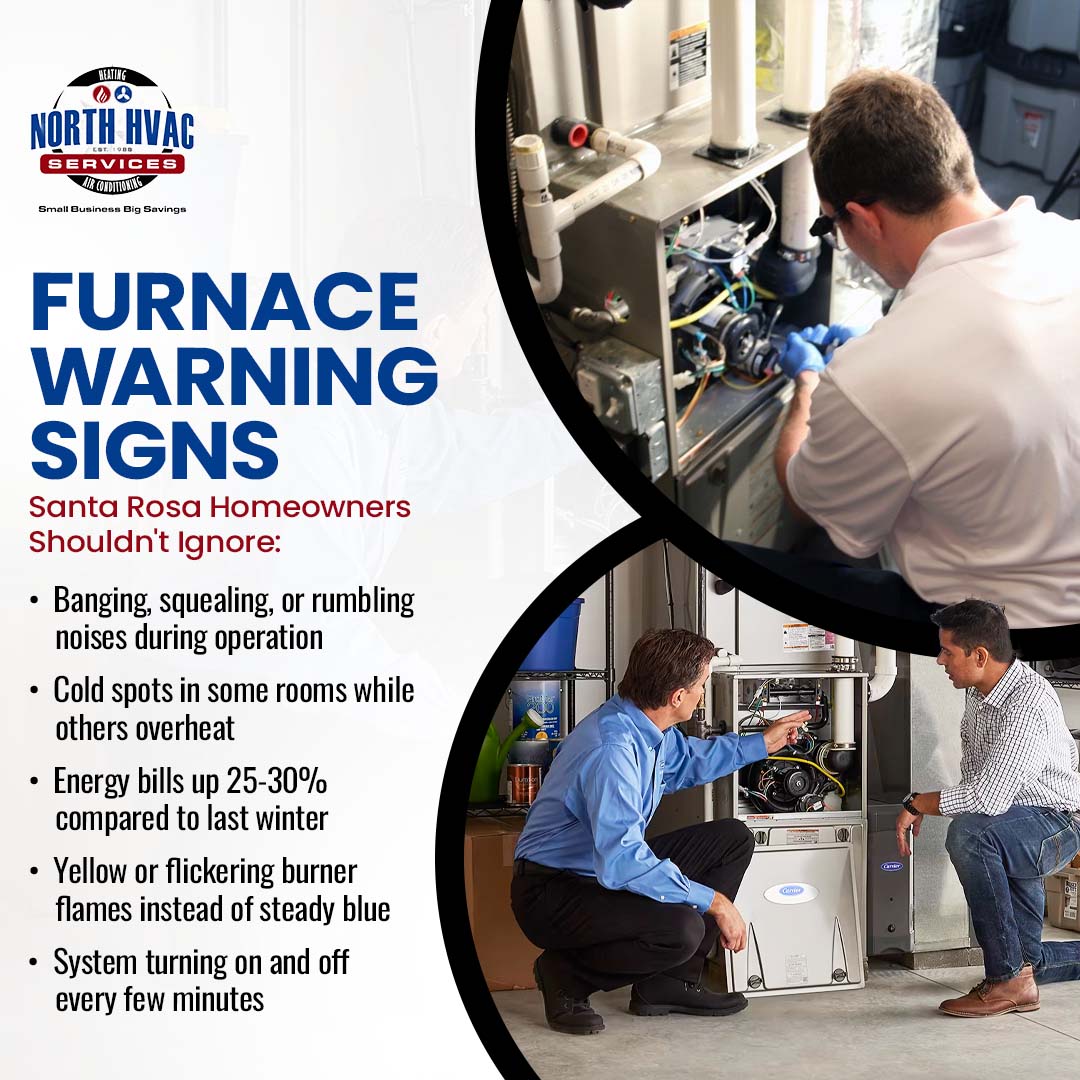
Modern heating systems operate quietly during normal function. When unusual sounds emerge from your equipment, they signal specific mechanical problems requiring professional diagnosis. Different noises indicate distinct issues:
Banging or popping sounds typically result from delayed ignition or ductwork expansion. When gas accumulates before ignition, combustion creates small explosions rather than smooth ignition. Metal ductwork expanding from temperature changes produces similar sounds, though less concerning.
Screeching or squealing noises point to blower motor problems or worn belts. These components require lubrication and proper tension. When maintenance lapses, friction increases, and parts fail. Continuing operation with these sounds causes additional damage.
Rumbling after shutdown suggests burner issues or flame sensor problems. Proper combustion stops immediately when your thermostat signals satisfaction. Continued rumbling indicates incomplete fuel burning or control failures.
Not all sounds require emergency response, but none should be ignored. Homeowners in Fountaingrove, Rincon Valley, and throughout Santa Rosa should document when sounds occur and their characteristics. When searching for heating repair near you, choosing qualified technicians who use this information to diagnose problems accurately during inspection makes the difference between temporary fixes and lasting solutions.
Warning Sign #2: Inconsistent Heating or Cold Spots Throughout Your Home
Balanced temperature distribution throughout your living space indicates proper system function. When certain rooms remain cold while others overheat, several problems may exist:
- Thermostat calibration errors causing incorrect temperature readings
- Ductwork leaks, losing heated air before reaching the intended spaces
- Failing blower motors, unable to circulate air adequately
- Zoning system malfunctions in homes with multiple heating zones
- Blocked vents or registers restricting airflow
This problem develops gradually, making it easy to dismiss as normal variation. Homeowners adapt by closing doors, wearing extra layers in cold rooms, or adjusting individual vents. However, uneven heating wastes substantial energy while indicating system deterioration.
The U.S. Department of Energy reports that ductwork problems and inefficient operation can cause substantial heating energy loss in poorly maintained systems. In typical Santa Rosa home layouts, whether single-story ranch designs or two-story craftsman styles common throughout the area, this represents significant utility expense and reduced comfort.
Early intervention addresses these issues before complete system failure. Professional inspection identifies root causes, from simple filter changes to complex ductwork repairs. Addressing inconsistent heating promptly extends equipment life and maintains comfort. North HVAC Services provides comprehensive heating services that address both immediate concerns and underlying system inefficiencies.
Warning Sign #3: Spike in Energy Bills Without Increased Usage
Your heating costs should remain relatively consistent from year to year, accounting for rate changes and weather variations. When bills increase 25-30% compared to previous winters without corresponding usage increases, your system struggles with efficiency problems.
Failing furnaces work harder to maintain desired temperatures, consuming more fuel or electricity while delivering less heat. Common efficiency-killing problems include:
- Dirty or clogged air filters restricting airflow
- Deteriorating heat exchangers unable to transfer heat effectively
- Poor combustion efficiency from dirty burners or improper air mixture
- Ductwork leaks, distributing heated air to attics or crawl spaces
- Aging components requiring more energy to achieve the same results
Research confirms that aging heating systems suffer from substantial performance decline, resulting in wasted energy and higher operational costs.
Baseline Efficiency Decay: The DOE indicates that a 20-year-old furnace typically wastes at least 22% of its energy consumption. While older furnaces often have much lower annual fuel utilization efficiency (AFUE), many newer condensing models achieve considerably higher AFUE ratings.
Maintenance and Airflow Gains: Technical research highlights that routine professional cleaning of HVAC components can reduce blower energy consumption by 41% to 60% while simultaneously increasing supply airflow by up to 46%.
Impact of Component Wear: Mechanical wear on components like motors and heat exchangers often forces systems to run longer cycles, which can cost owners up to 20% to 50% more in monthly bills compared to maintained high-efficiency units.
Forthcoming Regulatory Mandates: To address these efficiency gaps, the DOE has finalized standards requiring nearly all residential gas furnaces manufactured after December 18, 2028, to reach a minimum 95% AFUE. Additionally, as of October 6, 2026, new commercial gas storage water heaters must meet a 95% thermal efficiency requirement.
For Sonoma County residents facing PG&E rate structures, these efficiency losses translate to substantially higher annual heating costs. A system operating at 70% AFUE wastes 30 cents of every dollar spent on heating, while a well-maintained modern system at 95% AFUE wastes only 5 cents per dollar. For systems nearing the end of their 15–20 year expected life, furnace installation with modern equipment can convert nearly all consumed fuel directly into heat, significantly reducing waste.
Monitoring utility bills provides early warning of developing problems. When unexplained increases occur, scheduling a professional inspection prevents further efficiency loss and potential system failure.
Warning Sign #4: Yellow or Flickering Burner Flame
The appearance of your furnace’s burner flame provides direct insight into combustion quality and system health. Proper operation produces a steady blue flame with minimal yellow coloring. When flames appear predominantly yellow, flicker excessively, or roll out from the burner area, serious problems exist.
Yellow flames indicate incomplete combustion, typically caused by:
- Dirty burners restricting proper gas flow
- Cracked heat exchangers, allowing air mixture problems
- Insufficient combustion air from blocked intake vents
- Gas pressure irregularities from supply or valve issues
Incomplete combustion raises carbon monoxide concerns. This colorless, odorless gas poses serious health risks when present in living spaces. While modern furnaces include safety mechanisms, deteriorating components compromise these protections.
The Centers for Disease Control and Prevention (CDC) reports that carbon monoxide claims the lives of hundreds of people every year in the United States, with heating equipment representing a significant source. Carbon monoxide detectors provide important protection, but they serve as backup warning systems rather than primary prevention.
Observing yellow or flickering flames requires immediate professional attention. EPA-certified technicians possess the equipment and training to diagnose combustion problems safely. If you’re searching for heat repair near you, due to flame concerns, schedule service immediately rather than continuing operation, and ventilate your home if your carbon monoxide detector alarms activate.
Warning Sign #5: Frequent Cycling or System Won’t Stay Running
Normal heating operation follows predictable patterns: your system activates when the temperature drops below the thermostat setting, runs until achieving the desired warmth, then shuts off for an extended period. Short cycling, turning on and off every few minutes, signals serious problems:
Common causes of short cycling include:
- Oversized systems producing too much heat too quickly
- Failing limit switches incorrectly detecting overheating
- Severely clogged filters preventing proper airflow
- Thermostat placement or calibration problems
- Dirty flame sensors causing ignition cycle interruptions
Systems should complete several cycles per hour during active heating periods without excessive on-off patterns. More frequent cycling damages equipment through repeated startup stress, increases energy consumption, and often precedes complete failure.
Sonoma County’s moderate climate means systems should run less frequently than in cold-climate regions. When cycling becomes excessive, or your system fails to complete normal heating cycles, a professional diagnosis identifies root causes before breakdown occurs.
In some cases, short cycling indicates that replacement makes more economic sense than repair. Systems approaching 20 years old with frequent cycling problems may benefit from modern, properly-sized equipment rather than continued repairs to aging components. North HVAC Services offers both heating services for immediate repairs and heat pump installation for homeowners ready to transition to more efficient systems.
When to Call for Emergency Service vs. Scheduling Regular Maintenance
Understanding the difference between emergency situations and urgent-but-not-emergency issues helps you respond appropriately:
Immediate emergency service required for:
- Complete heating failure when outdoor temperatures drop below 50°F
- Gas odors near the furnace or throughout the home
- Carbon monoxide detector activation
- Visible flames or smoke from heating equipment
- Electrical burning smells or sparking
Urgent service within 24-48 hours for:
- Loud mechanical noises from the furnace
- Yellow burner flames or flame rollout
- Short cycling that developed suddenly
- Rooms remaining unheated despite system operation
Schedule regular maintenance for:
- Seasonal tune-ups before heating season
- Gradual efficiency decline
- Minor noises or performance changes
- Annual inspections and filter replacements
Research shows that emergency repairs cost 2-3 times more than scheduled service, averaging $300-800 for emergency calls compared to $150-300 for preventive maintenance visits. Beyond cost considerations, emergency situations create stress and discomfort that proactive maintenance prevents.
North HVAC Services operates throughout Marin and Sonoma counties, providing both emergency response and scheduled maintenance. Our EPA-certified technicians carry diagnostic equipment and common replacement parts, often resolving problems during initial visits. Regular maintenance services extend equipment life while preventing unexpected failures.
Protecting Your Comfort and Investment
Recognizing these five warning signs: strange noises, inconsistent heating, increased energy bills, yellow flames, and frequent cycling, enables you to address problems before they escalate. Most homeowners miss early indicators, attributing minor changes to normal variation or aging equipment. Professional inspection transforms vague concerns into specific diagnoses with clear action plans.
Even quality heating systems require periodic attention. Components wear, efficiency declines, and safety mechanisms need verification. Catching developing problems early prevents emergency situations during the coldest weeks of winter when service demands peak and wait times extend. When homeowners research the best furnace companies nearby, they discover that local, family-owned contractors often provide more personalized service and faster emergency response than national chains.
Schedule a professional heating system inspection before winter weather arrives. Early detection keeps your home comfortable, protects your equipment investment, and avoids the stress of unexpected breakdowns. Whether your system shows warning signs or you simply want seasonal peace of mind, qualified technicians identify issues and recommend appropriate solutions.
For immediate concerns about your heating system’s performance or to schedule a pre-winter inspection, contact North HVAC Services at (415) 845-6910 or visit our contact page. Our team provides comprehensive furnace repair and serves all manufacturers and models. We also offer furnace installation in Santa Rosa, CA, for systems beyond economical repair. When looking online for heating repair near you, most repair situations respond well to timely intervention, preventing minor issues from becoming major expenses.