When your air conditioner runs nonstop but still doesn’t cool your Santa Rosa home, it’s more than just a comfort issue. You may be facing a repair or replacement decision, and without understanding the cause of the warm air, you risk overspending on small fixes or postponing critical repairs that only get worse.
Warm air complaints represent one of the most common service calls we receive at North HVAC Services. After serving Sonoma County families since 1988, we’ve identified five primary causes that account for nearly all cooling failures. More importantly, we’ve helped thousands of homeowners navigate the repair versus replacement decision using a clear framework based on system age, repair costs, and long-term value.
This guide explains what actually causes air conditioners to blow warm air, provides real cost data for common repairs, and gives you a practical decision-making framework. You’ll learn which questions to ask contractors, how to recognize red flags in service recommendations, and when repair makes better financial sense than replacement.
Recognizing Why Air Conditioners Blow Warm Air: The 5 Root Causes
Refrigerant Leaks: The Silent Performance Killer
Your air conditioning system doesn’t burn refrigerant like a car burns gasoline. Instead, refrigerant circulates continuously through a closed loop, absorbing heat from your indoor air and releasing it outside. When this closed loop develops even a small leak, your system’s cooling capacity drops noticeably.
Most refrigerant leaks occur at copper line connections, in corroded coil sections, or at service port valves. Refrigerant leaks develop gradually in commercial systems due to vibration stress, corrosion, and normal wear over time. Even small leaks progressively degrade system performance and efficiency until properly diagnosed and repaired.
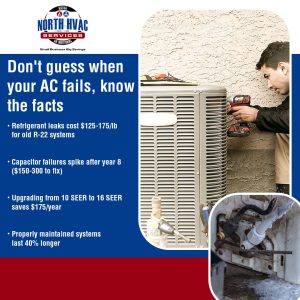
Here’s where Santa Rosa homeowners face a specific challenge. If your system was installed before 2010, it likely uses R-22 refrigerant, commonly called Freon. The EPA phased out R-22 production due to its ozone-depletion effects. Limited supply has driven R-22 costs to $145-250 per pound, compared to $50-100 per pound for the current standard R-410A refrigerant.
Some contractors offer to simply “top off” your refrigerant without locating and repairing the leak. This approach violates EPA Section 608 regulations and guarantees the same problem returns within months. Professional air conditioning repair services should always include leak detection using electronic sensors or tracer dyes, followed by proper repairs before recharging the system.
Refrigerant Repair Cost Reality:
Refrigerant Type
Approximate Cost per Pound*
Typical System Charge
Temporary Repair (No Leak Fix)
Full Recharge / Repair (With Leak Fix)
R‑22 (Freon)
$90 – $125
6–12 lbs
$500–$850
$800–$1,400
R‑410A
$50–$90
6–8 lbs
$240–$320*
$650–$1,200*
(Source: Today’s Homeowner). *Actual cost may vary depending on system size, leak repair requirements, and labor/service fees.
At North HVAC Services, our EPA-certified technicians use professional leak detection equipment to locate the source before adding any refrigerant. This approach costs more upfront but saves you from repeated service calls and wasted refrigerant.
Capacitor and Contactor Failures: The Electrical Weak Points
Air conditioning systems depend on multiple electrical components working in precise coordination. Capacitors store electrical energy and provide the power surge needed to start motors. Your system typically has two capacitors: one for the compressor and one for the outdoor fan motor.
When capacitors weaken or fail, motors struggle to start or run inefficiently. A failing capacitor often produces a distinctive humming sound from your outdoor unit without the fan actually spinning. Capacitor replacement typically costs $150-300, including labor.
The contactor acts as an electrical relay, controlling power flow to the compressor. When contact points pit or burn from repeated electrical arcing over the years, they fail to close properly. Contactor replacement runs $100-250, depending on your system size.
Frozen Evaporator Coils: The Misunderstood Problem
Here’s a cooling paradox: ice forming on your indoor coil actually stops your air conditioner from cooling your home. This happens because of airflow restriction, not because your system is working too hard.
Your indoor evaporator coil needs adequate air flowing across it to absorb heat properly. When airflow drops substantially, the coil temperature drops below freezing, moisture condenses and freezes on the coil surface, and ice buildup blocks remaining airflow completely.
Several conditions cause coil freezing beyond just dirty air filters. Low refrigerant levels reduce pressure and temperature in the evaporator. Blower motor failure prevents adequate air movement. Closed or blocked supply registers restrict return airflow, creating conditions that allow ice formation on evaporator coils.
Many homeowners try turning the system off and letting the ice melt. While this addresses the immediate symptom, it doesn’t solve the underlying cause. Repeated freeze and thaw cycles damage the thin aluminum fins on the coil and progressively reduce efficiency.
Compressor Failure: The Major Repair Decision Point
The compressor functions as the heart of your air conditioning system, pumping refrigerant through the entire loop. When a compressor fails, you face the most significant repair decision because compressor replacement often approaches half the cost of a complete new system.
Warning signs include hard starting, loud grinding or screeching noises, and circuit breakers that trip repeatedly. Most commercial-grade compressors are designed to operate reliably for 12 to 15 years under normal operating conditions with proper maintenance.
This is where the 50% rule becomes important for replacement decisions. If your repair cost exceeds 50% of replacement cost AND your system is over 10 years old, replacement typically makes better financial sense than continuing with repairs.
Thermostat and Control Issues: The “False Alarm” Diagnosis
Sometimes what appears to be a serious air conditioning problem turns out to be a simple thermostat or control board issue. These components control when your system runs and how it operates, so failures create symptoms that mimic more expensive problems.
Before assuming the worst, perform a simple calibration test. Place a separate thermometer near your thermostat for 20 minutes and compare readings. If temperatures differ by more than 3°F, you likely have a thermostat problem rather than an AC system failure.
When we diagnose cooling complaints at North HVAC Services, we always check the simplest and least expensive potential causes before recommending major repairs. This approach has kept us trusted in Sonoma County since 1988.
The Santa Rosa Climate Factor: Why Location Matters
Santa Rosa’s Mediterranean climate, classified byNOAA climate data, features warm, dry summers with temperatures reaching the high 80s and mild winters averaging the mid-50s. This moderate climate pattern subjects commercial HVAC systems to consistent seasonal cycling between heating and cooling modes.
While systems in extreme climates experience continuous operation in a single mode, Santa Rosa equipment cycles between heating and cooling throughout the year, affecting component longevity. Commercial systems in this climate zone typically require replacement consideration at 12 to 15 years rather than the 15 to 20-year lifespan possible in more stable climates.
Wildfire smoke season creates additional challenges. When smoke blankets our region, outdoor coils become contaminated with ash and fine particulates. Air filters clog much faster than normal. TheCalifornia Air Resources Board documented that during the 2018 Camp Fire, PM2.5 levels increased by more than 300 percent compared to average levels, creating extreme demand on HVAC filtration systems throughout Northern California.
We recommend pre-summer inspections specifically to address smoke damage from the previous season. Our indoor air quality analysis helps identify whether your current filtration adequately protects your system during poor air quality periods.
Repair vs. Replacement: The Decision Framework
The Age-Cost-Efficiency Triangle
Three factors intersect in every repair versus replacement decision: your system’s age, the repair cost you’re facing, and the efficiency difference between keeping your current system versus upgrading.
System Age and Repair Cost Evaluation:
System Age
Repair Cost:
< $500
Repair Cost:
$500-1,500
Repair Cost:
> $1,500
0-5 years
Always repair
Repair
Investigate warranty
6-10 years
Repair
Evaluate efficiency
Consider replacement
11-15 years
Repair if minor
Calculate 5-year costs
Lean toward replacement
15+ years
Repair only if under $300
Replace
Definitely replace
Older systems operate at 8-10 SEER (Seasonal Energy Efficiency Ratio), while current minimum standards require 14 SEER in northern states and 15 SEER in southern states. The U.S. Department of Energy provides guidance on energy efficiency standards and potential savings from system upgrades.
The Total Cost of Ownership Approach
Looking beyond the immediate price tag reveals the true financial picture. Let’s examine a real scenario. You have a 12-year-old system needing a $1,200 compressor repair.
Repair scenario over the next 3 years:
Immediate repair cost: $1,200
Estimated additional repairs: $800-1,500
Energy costs at 10 SEER: $1,410
Total 3-year cost: $3,410-4,110
Replacement scenario over the next 3 years:
New 16 SEER system installed: $4,500-7,500
Energy costs at 16 SEER: $885
Likely repairs (under warranty): $0-200
Total 3-year cost: $5,385-7,700
The replacement costs more initially, but after three years, your repaired system has reached 15 years old and likely faces replacement anyway. Your new system still has 12-15 years of useful life remaining with considerably lower operating costs.
At North HVAC Services, we provide these calculations during our free replacement consultations so you can make learned decisions based on your specific situation.
Red Flags That Signal Replacement Over Repair
Certain situations make replacement the clear choice. If you have an R-22 system requiring both refrigerant and a major component repair, your combined costs often exceed 60% of the replacement cost.
A second major repair within 24 months indicates your system has reached the failure cascade stage. Industry experience demonstrates that repeated major repairs rarely provide good value once systems exceed 75% of their expected lifespan. At this point, you are funding a series of expensive repairs on equipment that will continue declining.
Energy bills increasing 15-20% year-over-year despite consistent usage patterns signal declining efficiency. This gradual decline costs you hundreds in excess energy bills while you delay the inevitable replacement decision.
What to Expect From Professional Santa Rosa AC Repair Services
Professional Santa Rosa AC repair should follow a systematic diagnostic process. Proper evaluation includes visual inspection of both units, electrical testing, refrigerant pressure readings, airflow measurement, thermostat calibration, and duct system evaluation.
This comprehensive approach typically takes 45-90 minutes. Diagnostic fees range from $89-150, covering expertise, specialized testing equipment, and travel time. The Better Business Bureau guidelines emphasize that transparent diagnostic fees indicate professional operations.
Questions to Ask Before Authorizing Repairs
“What exactly failed and what caused the failure?” A good technician explains both the broken component and why it failed.
“How much useful life does my system have remaining?” Honest contractors will tell you if you’re repairing a system near the end of its lifespan.
“Are there other components likely to fail soon?” This reveals whether you’re facing one repair or a series of upcoming expenses.
“What’s included in your repair warranty?” Quality contractors stand behind their work with written warranties covering both parts and labor.
“Do you offer a written estimate before starting work?” Written estimates protect both parties by documenting what work will be performed and at what cost.
We provide written estimates for all AC repairs at North HVAC Services, with clear warranty terms spelled out before any work begins. Our labor warranties reflect our confidence in the EPA-certified technicians who have been serving Sonoma County families for over 35 years.
Red Flags in Contractor Behavior
Be wary of pressure to decide immediately without a written estimate. Avoid contractors who seem reluctant to explain what failed and why. Never authorize refrigerant additions without leak detection and repair.
Verify licensing, insurance, and EPA certification before allowing anyone to work on your system. HVAC work requires a C-20 contractor license.
Preventive Strategies to Avoid Emergency Repairs
Monthly filter changes during heavy use seasons make the single biggest difference in system longevity. From April through October in Santa Rosa, standard 1-inch filters need replacement every 30 days during peak use.
Annual professional inspection timing matters greatly. Schedule service in March or April, before the cooling season begins. Research shows that properly maintained systems last 40% longer on average than neglected systems.
Outdoor unit maintenance prevents many service calls. Remove leaves, grass clippings, and debris. Trim vegetation to maintain at least two feet of clearance on all sides.
Our maintenance agreements at North HVAC Services include priority service, repair discounts, and regular professional attention. We’ve maintained these same agreements for families throughout Sonoma County for over 35 years.
When to Schedule Service
Fall, particularly October through November, represents the best time for non-emergency service. You can typically schedule appointments within 2-3 days rather than waiting 1-2 weeks during the summer.
Certain warning signs require immediate attention regardless of the season. Strange odors indicate electrical problems or mold growth. Water leaking inside your home signals drain line problems. Systems that short-cycle indicate serious problems. Circuit breakers that trip repeatedly mean dangerous electrical issues.
Making Your Repair Decision With Confidence
You now understand the five primary causes behind air conditioners blowing warm air and have a decision framework based on age, cost, and efficiency. Systems under 10 years old typically justify repairs unless costs exceed 50% of replacement value. Systems over 12 years old require careful cost projection analysis.
Professional diagnosis provides the information you need for confident decisions. A $200 capacitor replacement caught during spring maintenance prevents the $2,500 compressor failure that occurs when you ignore the problem.
When you need reliable air conditioning repair in Santa Rosa, CA, working with experienced professionals ensures you make the right decision for your home and budget. North HVAC Services has served Sonoma County families since 1988 with honest diagnosis, transparent pricing, and quality workmanship.
Call us at (415) 845-6910 or email no***************@***il.com to schedule your air conditioning diagnostic or to discuss whether repair or replacement makes the most sense for your specific situation. Our EPA-certified technicians bring the experience and equipment needed for accurate diagnosis and lasting air conditioner repair in Santa Rosa, serving homeowners throughout the city and surrounding communities.
Your air conditioning system just powered through another demanding summer. Your retail customers stayed comfortable during the August heat waves. Your restaurant kitchen maintained safe temperatures through September dinner rushes. Your office employees remained productive despite October’s unexpected warm spells.
Now comes the question most business owners overlook: what happens to your AC system after months of continuous operation? October represents the perfect window for end-of-season maintenance. This isn’t about comfort, it’s about protecting revenue. System failures during next summer’s peak season mean lost sales, unhappy customers, and emergency repair bills that dwarf preventive service costs. This guide from North HVAC Services explains why October air conditioning repair services focus on prevention rather than crisis management, and how smart maintenance today protects your business operations throughout 2026.
The Business Case for October AC Maintenance
HVAC system downtime can create significant financial strain for businesses beyond just repair expenses. Unplanned equipment failures often lead to reduced productivity, customer discomfort, and operational disruptions. In retail settings, uncomfortable indoor temperatures can drive customers away, directly affecting sales.
Restaurants risk food safety and ventilation issues when systems fail, while office environments experience decreased employee focus and efficiency as temperatures rise. For many commercial spaces, maintaining consistent climate control is essential not only for comfort but also for protecting revenue, ensuring compliance, and preserving customer trust. Proactive maintenance and timely service help minimize these disruptions, keeping business operations stable and preventing the costly ripple effects that follow unexpected HVAC breakdowns.
Summer Performance Reveals Hidden Problems:
Your AC system operates under maximum stress during the summer months. Compressors run continuously. Electrical connections vibrate loose. Refrigerant levels drop from minor leaks. Condenser coils accumulate months of dust and pollen. These issues don’t cause immediate failure. Instead, they reduce efficiency and set the stage for catastrophic breakdowns during next year’s peak demand.
October Timing Advantages:
October Service
Peak Season Emergency
2-3 day scheduling
7-10 day wait times
Thorough 2-3 hour inspection
Rushed 45-minute emergency fix
Standard service rates
Premium emergency pricing (150-200% markup)
Identify problems before failure
Address problems after business impact
Petaluma’s climate creates unique demands on commercial systems. September and October regularly bring heat spikes into the 80s and 90s. These late-season demands stress already-fatigued equipment. Systems that struggled through August often reveal their weaknesses during these unexpected warm periods.
End-of-season maintenance accomplishes what summer service cannot. Technicians have time for a comprehensive evaluation rather than rushed repairs. They can document system conditions for capital planning. They can address developing issues before winter dormancy allows small problems to become major failures.
What Comprehensive End-of-Season Service Includes
Effective end-of-season air conditioning repair services go far beyond basic cleaning and filter changes. North HVAC Services understands what thorough service entails and helps you evaluate proposals and recognize value versus superficial inspections.
Post-Summer System Assessment
Evaluating Cumulative Wear:
Commercial systems operate differently from residential units. They run longer hours under heavier loads. A retail store’s rooftop unit might operate 70-80 hours weekly compared to 20-30 hours for typical homes. This extended operation accelerates wear on every component.
Technicians measure actual system performance against manufacturer specifications:
Temperature differential between return and supply air
Refrigerant pressures and subcooling temperatures
Amperage draw on compressor and fan motors
Airflow volumes at each zone or register
Refrigerant System Evaluation:
Refrigerant doesn’t “wear out,” but it does leak from aging seals, vibration-loosened fittings, and corrosion. Even minor leaks reduce cooling capacity while increasing compressor workload. Electronic leak detection identifies problems before they cause summer failures.
Electrical Connection Inspection:
Months of vibration loosen electrical connections. Loose connections create resistance. Resistance generates heat. Heat accelerates deterioration. This cycle explains why many commercial systems fail on the hottest days when electrical demand peaks.
Compressor Function Analysis:
The compressor accounts for a significant portion of the overall system replacement cost. Technicians evaluate:
Early detection of compressor problems allows planned replacement during off-season. Emergency compressor failure during July means premium parts pricing and lost business during multi-day repairs.
Component Cleaning and Calibration
Condenser Coil Restoration: Wine country air carries unique challenges. Dust from vineyards, pollen from seasonal blooms, and agricultural debris accumulate on outdoor coils. Even thin layers of contamination reduce heat transfer efficiency.
High-pressure coil cleaning removes deposits that restrict airflow. This single service often improves efficiency enough to lower monthly utility bills.
Evaporator Coil Treatment: Indoor coils accumulate different contaminants. Kitchen exhaust carries grease particles. Retail spaces contribute dust and fiber. Office environments add paper dust and toner particles. These deposits restrict airflow and harbor mold growth that affects air quality.
Drain Line Maintenance: Condensate drain lines remove moisture extracted from indoor air. During summer operation, several gallons flow through these lines daily. Come winter, stagnant water in neglected drains breeds algae and bacteria. By spring startup, clogs cause water damage and emergency service calls.
Clearing drain lines in October prevents winter deterioration. Technicians also treat lines with algaecide tablets that prevent growth during dormancy.
Thermostat and Control Calibration: Commercial thermostats often drift from accurate readings. A thermostat reading 72°F when the actual temperature is 75°F wastes energy and reduces comfort. Calibration ensures your system responds to actual conditions rather than false readings.
Preventive Measures for Winter Dormancy
Outdoor Unit Protection: Petaluma winters bring rain and occasional freezing temperatures. While commercial units are built for outdoor installation, winter protection extends service life:
Debris removal from cabinet interiors
Inspection of cabinet seals and gaskets
Verification that drainage paths remain clear
Documentation of any corrosion requiring spring attention
Addressing Developing Issues: End-of-season inspection identifies problems that don’t yet require immediate repair. A bearing showing early wear. A relay contact showing minor pitting. A control board capacitor is beginning to bulge. Documenting these findings allows planned parts ordering and scheduled repair during your slow season rather than emergency response during peak business periods.
Spring Startup Documentation: Thorough end-of-season reporting creates baseline data for spring comparison. Changes in operating pressures, temperatures, or electrical characteristics between fall and spring indicate problems that developed during winter dormancy.
Red Flags from This Summer’s Performance
Your recent cooling season provided valuable information about system health. Recognizing warning signs helps you distinguish between systems needing maintenance versus those approaching replacement.
Unusual Energy Bill Patterns:
Pattern
Likely Cause
Action Required
Steady 15-20% increase
Efficiency loss from contamination or refrigerant loss
Cleaning and refrigerant service
Sudden 30%+ spike
Major component failure or control problem
Immediate diagnostic inspection
Bills vary wildly month-to-month
Thermostat or control issues
Control system evaluation
Compare this summer’s bills to previous years. Even accounting for rate increases and weather variations, dramatic changes indicate problems requiring attention.
Temperature Inconsistency Complaints:
Customer or tenant complaints about temperature problems signal specific issues:
Some areas too warm, others too cold: Zoning or distribution problems
Morning temperatures uncomfortable: Night setback not recovering properly
Afternoon cooling inadequate: Insufficient system capacity or efficiency loss
Temperature varies throughout the day: Thermostat location or calibration issues
System Cycling Behavior:
Normal operation shows regular cycles matching outdoor temperature and building load. Abnormal patterns include:
Short cycling: System runs 5-10 minutes then shuts off repeatedly (indicates refrigerant issues, oversized equipment, or control problems)
Extended run times: System runs continuously without satisfying thermostat (indicates capacity loss or excessive building loads)
Delayed startup: Long delay between thermostat call and system response (suggests control issues or refrigerant problems)
Physical Warning Signs:
Walk around your AC equipment looking for these indicators:
□ Excessive condensation or water stains suggesting drain problems □ Unusual noises (grinding, squealing, banging) indicating mechanical wear □ Burning or electrical odors pointing to motor or electrical issues □ Rust or corrosion on cabinet or components □ Refrigerant oil stains indicating leak locations
The Replacement Decision:
Consider system replacement rather than repair when:
Equipment is 15+ years old and needs major component replacement
Repair costs exceed 50% of replacement value
You’ve invested in 2-3 significant repairs over the past two years
Energy bills have increased despite maintenance
System uses R-22 refrigerant (phased out, expensive to service)
Modern commercial systems offer better efficiency than units from the early 2000s. When facing major repairs on aging equipment, AC repair in Petaluma, CA, often makes less financial sense than investing in new equipment with current efficiency standards and warranty protection.
Evaluating HVAC Contractor in Petaluma, CA Proposals
North HVAC Services believes that not all maintenance agreements offer equal value. It is very important to compare proposals carefully:
Comprehensive coverage: Inspections plus covered repairs up to specified limits
Full-service contracts: All labor and parts included for a fixed annual rate
What to Verify in Proposals:
□ Number of annual service visits (minimum two: spring and fall) □ Specific tasks included in each visit □ Response time guarantees for emergency calls □ Parts and labor coverage details □ Contract term and renewal conditions □ Cancellation terms and refund policies
Local Contractor Considerations:
Choose an HVAC contractor in Petaluma, CA, with specific commercial experience. Commercial systems differ substantially from residential equipment. They require different tools, knowledge, and approaches. Verify contractors hold appropriate licensing for commercial work and understand Petaluma’s building codes and permit requirements.
After nearly four decades serving Sonoma County businesses, North HVAC Services understands the unique demands of commercial properties in this region. We’ve maintained systems through heat waves, helped property managers plan replacements, and responded to emergencies when minutes matter to business operations.
Preparing for the 2026 Cooling Season Starting Now
October offers opportunities beyond immediate maintenance. Strategic planning during the off-season positions your business for a trouble-free 2026 cooling season.
Capital Planning Timeline:
If your system is 12-15 years old, start researching replacement options now. This timeline allows:
October-November: Obtain multiple proposals and compare options
December-February: Finalize financing and schedule installation
March-April: Complete installation before cooling demand increases
May: System operating reliably before peak season
This proactive approach avoids summer emergencies when installation scheduling extends 4-6 weeks and you’re negotiating under pressure.
Energy Efficiency Incentives:
California offers substantial rebates for commercial HVAC upgrades. Programs change annually, but current opportunities include:
California Energy Commission programs: Rebates for high-efficiency equipment
Local utility incentives: Additional rebates from PG&E for qualifying installations
Federal tax credits: Energy-efficient commercial building deductions
Visit the California Energy Commission website for current program details. Many rebates require pre-approval, making October research timing important for spring installations.
Building Improvement Opportunities:
Reduce cooling loads through complementary improvements:
Window film or shading reduces solar heat gain
Improved insulation lowers cooling demands
LED lighting generates less heat than incandescent
Smart building automation optimizes system operation
Air sealing eliminates infiltration that increases cooling loads
Control System Upgrades:
Modern commercial thermostats and building automation systems offer capabilities unknown in older equipment:
Remote monitoring and adjustment via smartphone
Occupancy-based setback scheduling
Real-time energy consumption tracking
Predictive maintenance alerts
Multi-zone optimization
Installing these controls during the off-season allows staff training before peak cooling demands arrive.
Indoor Air Quality Enhancements:
Post-pandemic awareness elevated indoor air quality concerns. October provides time to evaluate and implement improvements:
Upgraded filtration systems
UV-C germicidal lights for biological contaminant control
Ventilation upgrades bringing more outside air
Air purification systems for specific contaminant control
These improvements protect employee health while enhancing customer confidence in your business environment.
Documentation Best Practices:
Create a maintenance history file containing:
All service reports and invoices
Equipment specifications and model numbers
Warranty information and expiration dates
Energy bills for performance trending
Tenant or customer complaints about HVAC issues
This documentation supports capital planning decisions, warranty claims, and property transactions.
Take Action Before Peak Season Returns
October maintenance decisions determine whether your business operates smoothly through next summer or faces costly disruptions during your busiest periods. The strategic advantage of off-season service goes beyond immediate costs. It’s about business continuity, customer satisfaction, and operational reliability when your business depends on climate control most.
End-of-season maintenance represents an investment in your business operations rather than an expense. The cost difference between planned maintenance and emergency repairs favors prevention dramatically. More importantly, the business impact of summer system failures, lost sales, unhappy customers, employee discomfort, dwarfs any maintenance investment.
Your Next Step:
Schedule your end-of-season inspection before November. We’re currently booking commercial service appointments with 2-3 day scheduling rather than the week-long waits that arrive once the heating season begins. Call North HVAC Services at (415) 845-6910 or email no***************@***il.com to reserve your inspection time, while our technicians can provide the thorough evaluation your system needs, including AC repair in Petaluma, CA.
Our commercial service experience spans retail stores, restaurants, professional offices, and multi-tenant properties throughout Petaluma and Sonoma County. We understand the specific demands your business type places on HVAC systems. We know building codes, permit requirements, and the local contractors who perform quality work when you need complementary services.
Winter will arrive soon. Your AC system will sit dormant for months. Come spring, you’ll either confidently restart a well-maintained system or hope that summer problems don’t reappear. That choice, proactive maintenance versus reactive crisis management, happens now, during these comfortable October weeks when addressing cooling systems seems less urgent.
Smart business owners recognize that protecting revenue requires protecting the systems that keep customers comfortable and operations running smoothly. A small investment in off-season maintenance today prevents expensive emergencies when your business can least afford disruption.
Keeping your air conditioner running smoothly is more than a matter of comfort during Santa Rosa’s warm summers. It is also a financial decision. Many homeowners underestimate how quickly small AC problems turn into major expenses. Others try to patch issues on their own, only to discover hidden inefficiencies driving up utility bills month after month. Choosing professional air conditioning repair in Santa Rosa, CA, is not an added cost. It is an investment that prevents breakdowns, reduces energy waste, and extends the life of your system.
This article explores why calling a certified HVAC contractor in Santa Rosa, CA, saves you money over time. You will see how local expertise, timely diagnostics, and rebate knowledge help homeowners cut costs while keeping their homes comfortable.
How Small AC Problems Become Big, Expensive Breakdowns
Air conditioning systems rarely fail without warning. In most cases, minor issues develop slowly before they spiral into major repairs.
Common small issues include:
Early Warning Sign
Potential Cause
Long-Term Cost if Ignored
Weak airflow
Clogged filter or duct leak
Overworked blower motor, higher utility bills, eventual system replacement
Neglecting routine AC maintenance can reduce efficiency. That reduction may seem small, but for a household in Santa Rosa with a $200 monthly cooling bill, it can add up to $360 in wasted energy every year.
By calling North HVAC Services at the first sign of trouble, homeowners can avoid those unnecessary costs and extend the life of their cooling systems. We proudly serve Santa Rosa, Petaluma, Rohnert Park, Windsor, and communities throughout Sonoma and Marin counties.
Why Professional Diagnostics Catch Hidden Inefficiencies
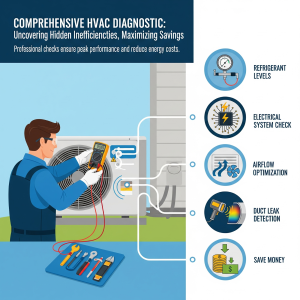
Modern air conditioning systems are complex machines. A problem is not always obvious to the untrained eye. For example, a refrigerant leak might cool the home today but force the compressor to work harder until it fails. Professional air conditioner repair in Santa Rosa, CA, includes diagnostic checks that homeowners cannot safely perform on their own:
Measuring refrigerant charge with precision gauges
Testing electrical components and capacitor health
Checking airflow balance across ductwork
Inspecting thermostat calibration
Identifying hidden duct leaks with smoke tests or pressure diagnostics
North HVAC Services technicians use certified equipment to find these inefficiencies before they drain money from utility bills. A single professional tune-up can pay for itself in energy savings within one season.
Infographics: Professional Air Conditioning Systems Diagnostics Catch Hidden Inefficiencies
Local Expertise Matters: The Advantage of a Certified HVAC Contractor in Santa Rosa, CA
Hiring a professional is about more than tools and training. It is also about local knowledge. Santa Rosa homeowners face unique challenges: warm summers, wildfire smoke in the fall, and rising PG&E electricity rates.
At North HVAC Services, we understand these local conditions and adjusts recommendations accordingly:
Wildfire season readiness: Adding MERV 13+ filters or air purifiers during repair visits to protect indoor air quality.
Rebate programs: Sonoma Clean Power and TECH Clean California offer incentives for efficiency upgrades. A local contractor helps homeowners qualify for rebates that outsiders might overlook.
Code compliance: City and county building codes require specific installation and safety standards. Local contractors are aware of how to maintain compliance and stay out of trouble.
The California Energy Commission notes that extreme summer heat drives a surge in electricity demand across the state, with air conditioning often becoming the single biggest stress on the grid during peak hours. Hiring local experts means your system is tuned to handle both comfort and efficiency in this specific climate.
North HVAC Services ensures every repair meets these standards while looking for additional ways to cut costs.
Repair Now vs. Replace Later: The Real Cost Comparison
Many homeowners delay calling for air conditioner repair in Santa Rosa, CA, hoping to get through the summer before addressing the problem. Unfortunately, this approach often backfires.
System short cycling, higher bills + premature replacement
Compressor replacement
$1,200–$2,800
If ignored, complete cooling loss, possibly $5,000+ for system replacement
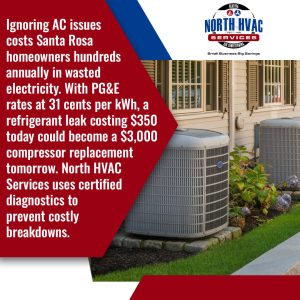
By investing in timely Santa Rosa AC repair, homeowners can save thousands. North HVAC Services often finds that a $300 fix today prevents a $3,000 replacement tomorrow.
When to Call for Air Conditioner Repair in Santa Rosa, CA
Many homeowners try to stretch their cooling systems through the season, hoping small quirks will resolve on their own. Unfortunately, air conditioners rarely “self-correct.” In reality, small warning signs are your system’s way of telling you professional service is required. Ignoring these red flags only allows problems to grow more expensive.
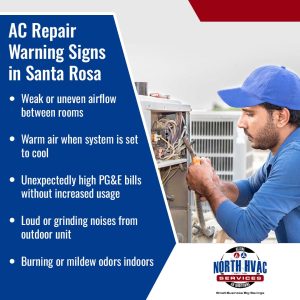
Warm air blowing when set to cool: This often signals a refrigerant issue or compressor problem. Even if the system still runs, it wastes energy and strains expensive components.
Unexplained spikes in PG&E bills: When utility costs jump without a change in household use, it usually means your system is working harder than it should. Professional diagnostics from North HVAC Services, Inc Heating & Air Conditioning uncover hidden leaks, clogged filters, or inefficient components.
Loud or grinding noises from the outdoor unit: Unusual noises suggest failing motors or loose parts. If ignored, this can lead to system-wide failure requiring replacement instead of repair.
Strange smells such as burning or mildew: A burning smell may point to electrical issues, while mildew indicates moisture buildup or mold growth. Both are serious health and safety concerns.
Water pooling near the indoor unit:This is often a clogged condensate drain line. Left unresolved, it can cause water damage or mold in the surrounding areas of the home.
Weak airflow in certain rooms: Uneven cooling typically means duct leaks or blower problems. Since leaky ducts can waste up to 30% of cooled air, this issue directly inflates energy bills.
If any of these symptoms appear, scheduling service is not optional. Prompt air conditioning repair in Santa Rosa, CA, restores comfort and prevents larger failures. Calling North HVAC Services guarantees an EPA-certified, factory-trained technician can pinpoint the cause, recommend the most cost-effective fix, and keep your system operating at peak efficiency.
Why Delaying AC Repair Costs More in Santa Rosa
It is natural to wonder whether a repair can wait until next month or even next season. However, Santa Rosa’s climate and utility rates make delaying an expensive gamble. Every day a struggling system operates, it wastes energy and increases wear on components.
1. Heat waves magnify problems
During late summer, when outside temperatures climb, AC systems already run at maximum capacity. An untreated refrigerant leak, dirty coil, or failing motor is far more likely to trigger a full breakdown under this stress. Emergency replacements in peak season can cost double compared to off-season repairs.
2. Wildfire smoke adds hidden strain
Wildfire season in Sonoma County often forces AC systems to filter heavy smoke particles for weeks at a time. Filters clog quickly, fans work harder, and air quality inside the home deteriorates. Only a professional HVAC contractor in Santa Rosa, CA, can optimize filtration while maintaining efficiency. North HVAC Services technicians frequently upgrade customers to higher-rated filters or recommend duct sealing to protect both health and equipment.
3. High PG&E electricity rates increase the penalty for inefficiency
According to PG&E’s 2024 Electric Rate Advisory, the average residential customer paid about 46.8 cents per kilowatt-hour, nearly three times the national average reported by the U.S. Energy Information Administration. That means wasted energy in Santa Rosa translates into significantly higher monthly bills compared to most U.S. households.
4. Repairs become replacements when ignored
A minor fix, such as refrigerant recharge or capacitor replacement, might cost a few hundred dollars. But if ignored, these small issues can cascade into compressor or motor failures costing thousands. Timely Santa Rosa AC repair converts a $300 call into a long-term savings decision.
In many situations, homeowners would have missed their chance to save money by the time they realized the actual cost of waiting. For this reason, North HVAC Services views repair calls as investments rather than costs.
Call Today for Professional AC Repair in Santa Rosa, CA
Scheduling professional repair now helps prevent expensive system failures later. It also improves energy efficiency, protects against smoke during wildfire season, and keeps the system in line with local codes.
North HVAC Services is the trusted HVAC contractor in Santa Rosa, CA, for homeowners who want reliability, expertise, and cost savings. With licensed, EPA-certified technicians and factory-authorized dealer status for Mitsubishi, Trane, and Day & Night, North HVAC Services delivers trusted results that last.
Take Action Now
Do not wait until small AC issues spiral into a major replacement. Schedule an inspection with North HVAC Services and secure your system’s performance for the season ahead. Call (415) 845-6910 or email no***************@***il.com to book your appointment today.
Late summer heat in Northern California can push your air conditioner harder than any other time of year. By that point, months of use—and a layer of dust, pollen, and debris—have taken a toll on performance. Systems that seemed fine in May can struggle by August, running longer, cooling less efficiently, or even breaking down completely.
The best way to avoid those issues is with a professional AC tune-up. Annual maintenance isn’t just routine—it’s one of the most effective ways to lower your energy costs, extend your system’s lifespan, and prevent expensive mid-summer repairs.
How annual tune-ups save you money
When your air conditioner runs day after day, small problems build up. Dirt settles on coils, electrical contacts loosen, and airflow decreases. Each of those issues forces the system to work harder to deliver the same results, driving up your monthly energy bill.
According to ENERGY STAR, regular maintenance can improve HVAC efficiency by 10–15%. That means if your average electric bill is $300 in the summer, you could save $30–45 per month just by keeping your system tuned up.
A tune-up also ensures your AC doesn’t overwork itself. When parts run at proper voltage, lubrication, and refrigerant levels, the system cycles efficiently, using less energy to maintain your desired temperature.
What a professional AC tune-up includes
A proper tune-up goes far beyond simply changing your air filter. During a professional maintenance visit, the technician inspects, tests, and adjusts every major component of your system to ensure peak performance.
Typical tasks include:
Inspecting and tightening all electrical connections
Testing capacitors, relays, and safety switches
Cleaning the condenser and evaporator coils
Checking refrigerant levels and pressures
Verifying airflow and duct performance
Lubricating blower and motor bearings
Testing thermostat calibration and controls
Clearing the condensate drain line
Replacing or cleaning air filters
When these steps are done consistently, your system runs cooler, quieter, and far more efficiently—even on 100°F days in Sonoma or Marin County.
The hidden cost of skipping maintenance
Many homeowners skip maintenance because their AC “seems to be working fine.” But most failures start small and go unnoticed. A weak capacitor or clogged coil might not cause immediate failure, but over time they strain the compressor—the most expensive part of your air conditioner.
A tune-up costs far less than replacing that component. For comparison:
Typical AC tune-up: $150–$250
Compressor replacement: $1,500–$3,000
Emergency service during a heat wave: often double normal rates
When you think of tune-ups as preventive maintenance, they quickly become one of the most cost-effective investments in home comfort.
Preventing breakdowns in late summer
Breakdowns tend to happen during the hottest weeks of the year, when your system is under maximum demand. That’s also when HVAC companies are busiest—meaning longer waits, higher prices, and more discomfort.
A spring or early-summer tune-up catches small problems before they escalate into failures, including:
Low refrigerant or leaks
Weak electrical components
Dirty coils reducing heat exchange
Clogged condensate lines causing water damage
Restricted airflow from dirty filters or ducts
When these issues are fixed early, you avoid losing your cooling on the hottest day of the year. You also prevent added stress that shortens your system’s lifespan.
Protecting your manufacturer warranty
Most major HVAC brands—including Trane, Carrier, and Lennox—require proof of annual professional maintenance to keep your warranty valid. If your system fails and you can’t show service records, the manufacturer can deny coverage.
Scheduling regular tune-ups through North HVAC Services keeps your equipment in compliance with warranty requirements and ensures small issues are addressed before they cause larger problems.
Improving indoor comfort and air quality
An annual tune-up doesn’t just save energy—it improves how your home feels. When coils, fans, and ducts are clean, your AC maintains even temperatures and stable humidity. You’ll notice fewer hot and cold spots and faster recovery when your thermostat adjusts.
Tune-ups also improve indoor air quality. A clean system filters out dust, pollen, and allergens more effectively. If you or anyone in your home suffers from allergies, annual maintenance can noticeably reduce symptoms during high-pollen seasons.
Extending system life and avoiding early replacement
Regular maintenance helps your system reach or even exceed its expected lifespan. Most air conditioners last 12–15 years, but units that are cleaned and tuned annually can last well beyond that.
Without maintenance, dirt and electrical stress cause wear that adds up quickly. Motors overheat, compressors run harder, and refrigerant lines clog—all of which shorten lifespan. A yearly tune-up prevents those conditions, keeping your system performing like new for years longer.
How to know if your AC needs service now
Even if you had your system serviced last year, these warning signs mean it’s time to schedule another visit soon:
Airflow feels weak from vents
The system cycles on and off frequently
Utility bills are higher than normal
You hear rattling or buzzing noises
Rooms don’t cool evenly
You smell musty or burning odors near vents
If you notice any of these symptoms, schedule a service visit before the system stops working entirely. A simple inspection could prevent a full breakdown.
The best time to schedule your tune-up
The ideal time for AC maintenance is spring, before temperatures rise and HVAC companies get busy. But even if you missed that window, it’s never too late—late-summer tune-ups can still restore performance and prevent wear before next year’s season.
Try setting an annual reminder each March or April to contact your HVAC company for scheduling. Regularity is what matters most.
Why professional tune-ups matter
While changing filters or cleaning around the outdoor unit are great homeowner steps, professional maintenance is more detailed and diagnostic. Technicians have the tools to measure refrigerant pressures, test electrical draw, and identify failing parts before they fail.
At North HVAC Services, every tune-up includes a multi-point system inspection and performance test tailored to your home’s system type and age. Their technicians serve homeowners across Sonoma, Marin, and Napa counties, helping you stay cool and efficient all summer long. Call (415) 845-6910 to schedule your annual AC tune-up before peak season.
The long-term financial benefits
When you calculate the savings from reduced energy use, fewer repairs, and a longer equipment lifespan, annual maintenance pays for itself many times over. You’re not just avoiding repairs—you’re reducing monthly bills and protecting one of your home’s largest investments.
For example, even a 10% improvement in efficiency can mean hundreds of dollars saved each year for larger homes. Over a decade, that adds up to thousands in avoided energy waste and emergency repair costs.
Start saving before the next heat wave
The best time to schedule maintenance is before you need it. Late-summer tune-ups not only improve comfort but also prepare your system for the following season.
North HVAC Services offers comprehensive maintenance plans that keep your system efficient year-round, helping homeowners avoid surprise breakdowns and inflated repair costs. To schedule your tune-up or learn more about maintenance plans, call (415) 845-6910 today.
Are you a resident of Forestville, CA, or perhaps a business owner in this charming town nestled in the heart of Sonoma County? If so, then you know the importance of having a reliable air conditioning system. The hot and dry summers can be unbearable without proper cooling, making it essential to keep your AC unit up and running. However, what happens when your air conditioner suddenly breaks down? In this article, we will go beyond the filter and explore the common causes of air conditioning breakdowns in Forestville.
1. Lack of Maintenance
It’s no secret that regular maintenance is crucial for any appliance to function efficiently, and your air conditioner is no exception. Many homeowners make the mistake of neglecting their AC units until they break down completely. However, regular maintenance can prevent costly repairs and extend the lifespan of your system.
During routine maintenance, a professional HVAC technician will thoroughly inspect and clean your unit. They will also check for any potential issues and make necessary repairs before they become bigger problems. Neglecting maintenance can lead to clogged filters, dirty coils, and other issues that can cause your air conditioner to break down.
2. Refrigerant Leaks
Refrigerant is what keeps your home cool by absorbing heat from inside and transferring it outside. A refrigerant leak can significantly affect the performance of your AC unit as it won’t have enough refrigerant to cool your home efficiently.
One common cause of refrigerant leaks is wear and tear on the copper tubing connecting the outdoor unit to the indoor evaporator coil. Over time, these tubes can become damaged or corroded due to exposure to weather elements or pests. It’s essential to address refrigerant leaks promptly as they not only reduce cooling efficiency but also pose health risks.
3. Electrical Issues
Your air conditioner relies on electricity to function properly; therefore, any electrical issues can cause your unit to break down. Some common electrical problems that can lead to AC breakdowns include faulty wiring, blown fuses, and tripped circuit breakers. These issues often occur due to overloading the system or using extension cords and power strips.
If you notice any flickering lights or hear buzzing sounds coming from your AC unit, it’s crucial to have a professional inspect it immediately. Ignoring electrical issues can not only result in a breakdown but also pose a fire hazard.
4. Dirty Condenser Coils
The condenser coils in your outdoor unit are responsible for releasing heat absorbed from inside your home. However, these coils can become dirty over time due to exposure to outdoor elements like dirt, leaves, and grass clippings. When the condenser coils are dirty, they cannot release heat efficiently, leading to increased strain on your air conditioner.
To avoid dirty condenser coils from causing a breakdown in your AC unit, it’s essential to keep the area around your outdoor unit clean and clear of debris. You should also schedule regular maintenance with a professional HVAC technician who will clean the coils during their visit.
5. Age of Your Air Conditioner
Like any other appliance in your home, air conditioners have a lifespan. If you have an older unit that is constantly breaking down or not functioning as efficiently as it used to, it may be time for a replacement.
The average lifespan of an air conditioner is 10-15 years; however, this can vary depending on how well it has been maintained and its usage. If you’re experiencing frequent breakdowns with an old AC unit, investing in a new one will save you money on repairs and energy costs in the long run.
In conclusion,
While regular maintenance is crucial for preventing air conditioning breakdowns in Forestville, CA., there are other factors that can contribute to a malfunctioning unit. Refrigerant leaks, electrical issues, dirty condenser coils, and an old AC unit are common causes of breakdowns that can be avoided with proper care and attention. Don’t wait for your air conditioner to break down before addressing these issues; schedule regular maintenance and address any problems promptly to keep your home cool and comfortable all summer long.
When it comes to air conditioning repair, choosing the right HVAC company can make all the difference. In Santa Rosa, where temperatures can soar during the summer months, having a reliable and efficient air conditioning system is essential. But with so many HVAC companies out there, how do you know which one to trust? Keep reading as we break down what to look for when choosing an HVAC company for your air conditioning repair in Santa Rosa.
Experience and Expertise
First and foremost, it’s important to choose an HVAC company with a solid track record of experience and expertise. Look for a company that has been in business for several years and has a team of certified technicians who are knowledgeable in all aspects of air conditioning repair. A reputable company should also be able to provide references from satisfied customers.
At North HVAC Services, we have been serving Sonoma County and Marin County for over 15 years. Our technicians are highly trained and experienced in handling all types of air conditioning repairs. We take pride in our workmanship and always strive to exceed our customers’ expectations.
24/7 Emergency Services
Air conditioning problems can happen at any time, even in the middle of the night or on weekends. That’s why it’s crucial to choose an HVAC company that offers 24/7 emergency services. A reliable company should be available round-the-clock to address any urgent cooling issues that may arise.
At North HVAC Services, we understand that AC emergencies can’t wait until normal business hours. That’s why we offer 24/7 emergency services so you never have to suffer through a hot summer night without proper cooling.
Transparent Pricing
When looking for an HVAC company for your air conditioning repair, it’s important to find one that offers transparent pricing. This means they should provide you with a detailed estimate before starting any work so you know exactly what you’re paying for.
At North HVAC Services, we believe in being upfront with our pricing. We offer free, no-obligation estimates for all air conditioning repairs and will never charge hidden fees or surprise you with additional costs. Our goal is to provide our customers with affordable and transparent pricing so they can make informed decisions about their AC repairs.
Quality Products and Services
Another key factor to consider when choosing an HVAC company for your air conditioning repair is the quality of their products and services. Look for a company that uses top-of-the-line equipment and parts from reputable brands. They should also offer a warranty on their products and services to give you peace of mind.
At North HVAC Services, we only use high-quality products from trusted brands in all our air conditioning repairs. We stand behind our workmanship and offer a 100% satisfaction guarantee on all our services.
Customer Service
Last but not least, excellent customer service is crucial when it comes to choosing an HVAC company for your air conditioning repair. A reliable company should have friendly, knowledgeable staff who are dedicated to providing exceptional customer service from start to finish.
At North HVAC Services, we pride ourselves on our outstanding customer service. From the moment you call us for an estimate until the completion of your repair, we will treat you with respect and professionalism. Our goal is not just to fix your AC problem but also to provide a positive experience for every customer.
In conclusion (oops!), when it comes to choosing the right HVAC company for your air conditioning repair in Santa Rosa, be sure to consider their experience, emergency services, pricing transparency, product quality, and customer service. At North HVAC Services, we check all these boxes and more! Contact us today for all your air conditioning needs in Santa Rosa and let us keep you cool all summer long!