Jul 21, 2026 | AC Maintenance
If your AC runs but won’t cool, the four most common causes are a tripped breaker, a clogged filter, a frozen evaporator coil, or a wrong thermostat setting. Three checks take five minutes. Refrigerant and electrical issues require a licensed Santa Rosa AC repair technician.
Key Takeaways
- Dirty filters and tripped breakers are safe for homeowners to check and address.
- Refrigerant repairs are restricted to EPA Section 608-certified technicians under federal law.
- A frozen evaporator coil must thaw for two to three hours before restarting.
- North HVAC Services dispatches same-day across Santa Rosa, Petaluma, and nearby Sonoma County areas.
Why Is Your Air Conditioner Running But Not Cooling the House?
Most homeowners searching for AC repair in Santa Rosa are dealing with one of four issues: a dirty filter restricting airflow, low refrigerant from a leak, a frozen evaporator coil, or a thermostat set to the wrong mode or temperature.
HVAC manufacturers generally recommend inspecting or replacing filters every 30 to 90 days, depending on filter type, usage, and indoor air quality conditions. A clogged filter starves the system of airflow and causes the evaporator coil to freeze, stopping the cooling cycle. Low refrigerant can produce similar symptoms, but because AC systems operate as sealed systems, any measurable refrigerant loss typically indicates a leak requiring professional repair.
What Should You Check Before Booking Santa Rosa AC Repair?
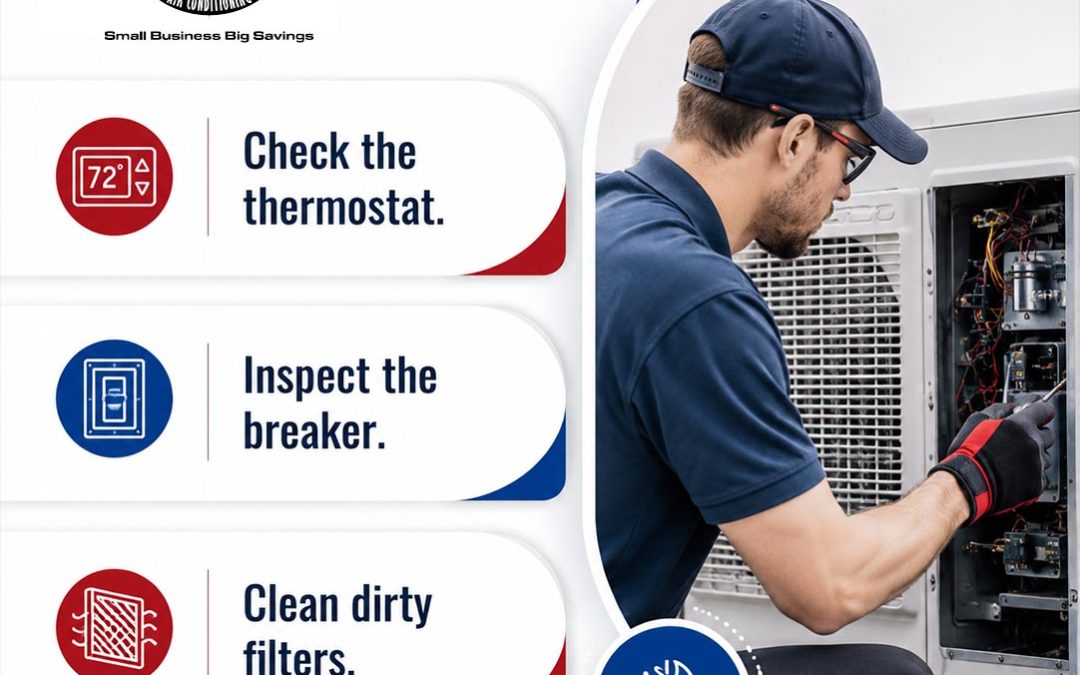
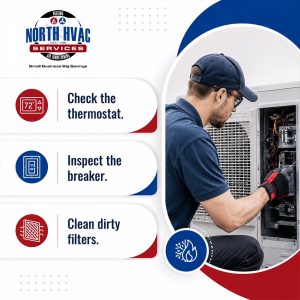
Before searching online for AC repairs near you, run these three checks. You can also review our HVAC maintenance page to see what a professional inspection covers.
| Step |
Action |
What You’re Checking |
| 1 |
Inspect the thermostat |
Mode on “cool,” fan on “auto,” setpoint 5°F below room temp |
| 2 |
Check the breaker panel |
HVAC breaker resting in the middle (tripped) position |
| 3 |
Pull the filter |
Visible dust blocking airflow through the filter media |
Do not open the outdoor unit, touch refrigerant lines, or reset a breaker more than once.
When Should You Stop and Schedule Air Conditioner Repair in Santa Rosa, CA?
Call a licensed technician for air conditioner repair, when you observe any of these:
- Ice on the indoor coil or refrigerant lines
- A burning smell or smoke from any component
- The outdoor unit hums, but the fan won’t spin
- A breaker that trips again after one reset
- Warm air from vents with a clean filter and correct thermostat settings
These are the conditions that drive most AC repair calls during a Sonoma County summer. Refrigerant work requires EPA Section 608 certification under federal law. NATE certification sets the diagnostic quality standard. North HVAC Services technicians hold both credentials on every call dispatched.
Which AC Failures Count as Real Emergencies During a North Bay Heat Wave?
WeatherSpark climate data for Santa Rosa shows July daily highs averaging 82°F, with peak heat events regularly exceeding 95°F. Homeowners who delay air conditioning repair in Santa Rosa, CA, during those conditions risk health consequences, not just discomfort.
| Category |
When to Act |
Examples |
| Emergency – call now |
Indoor temps above 85°F, electrical smell, vulnerable household members |
Smoke, sparking, full shutdown |
| Same-day |
System runs but won’t cool, intermittent shutdowns |
Warm air, partial cooling |
| Schedule within a week |
Slow cooling, longer cycles, unusual sounds |
Modest efficiency drop |
What Does a Same-Day AC Repair in Santa Rosa Service Call Include?
| Service Step |
What the Technician Does |
| Diagnostic |
Pressure check, electrical reading, thermostat and coil inspection |
| Repair Scope |
Filter swap, capacitor or contactor replacement, leak detection |
| Sign-Off |
Temperature differential test (16 to 22°F across the coil) |
North HVAC Services has served Sonoma County since 1988, with 48+ combined years of ownership-level HVAC experience. We are a Mitsubishi Diamond Authorized Dealer and a Trane Authorized Factory Dealer, servicing all makes and models. For homeowners weighing repair versus replacement, our repair-vs-replace guide and cooling services page cover both decisions in detail.
Book Same-Day AC Repair Across Santa Rosa and Nearby Areas
North HVAC Services is a family-owned HVAC contractor – NATE- and EPA Section 608-certified, Mitsubishi Diamond Authorized, and Trane Authorized Factory Dealer – available for air conditioning repair in Santa Rosa, CA, and surrounding North Bay communities, including Petaluma, Rohnert Park, Windsor, Healdsburg, and Sebastopol.
Call (415) 845-6910, email northhvacservices@gmail.com, or visit our Contact Us page to book.
May 27, 2026 | AC Maintenance, AC Repair, HVAC Maintenance
When your air conditioner starts pushing warm air on a hot Petaluma afternoon, the issue typically traces back to one of five causes: incorrect thermostat settings, a clogged air filter, low refrigerant from a leak, a frozen evaporator coil, or a failing outdoor unit. This guide walks Sonoma County homeowners through each cause, what to check before picking up the phone, and when the situation calls for a licensed technician. North HVAC Services has been diagnosing and solving these issues across Petaluma and the surrounding area since 1988.
How Petaluma’s Summer Climate Puts Pressure on Home AC Systems
Requests for air conditioning repair in Santa Rosa, CA, spike sharply between late July and September, when back-to-back heat days push aging systems past their limits. Petaluma sits in a climate zone that feels mild for most of the year – until peak summer arrives and the conditions become less forgiving for aging or undermaintained cooling systems.
According to WeatherSpark’s year-round climate data for Petaluma, summer daily highs climb from around 76°F in early summer to 83°F by mid-season, with temperatures occasionally spiking close to 93°F. September tends to deliver the hottest stretches of the year – a detail that catches some homeowners off guard after a relatively mild July and August.
For homes with AC systems that are 10 years or older, those extended heat events are where performance failures concentrate. Compressors run harder and longer. Filters that were borderline in April become fully restricted by late summer. Refrigerant lines under sustained thermal stress are more likely to develop small leaks.
According to the U.S. Energy Information Administration, air conditioning accounted for roughly 19% of all residential electricity consumption in U.S. homes as of 2020 – and that share climbs sharply during summer months in transitional climate zones like Sonoma County, where the swing between cool morning temperatures and hot afternoons is steeper than coastal areas. A system working overtime to compensate for an underlying issue is not only failing to cool your home – it’s running up your utility bill at the same time.
Warm air from your vents is rarely a sudden failure. It’s usually the visible symptom of a problem that has been developing over one or more seasons of deferred maintenance.
Top Causes Behind Air Conditioning Repair in Santa Rosa, CA
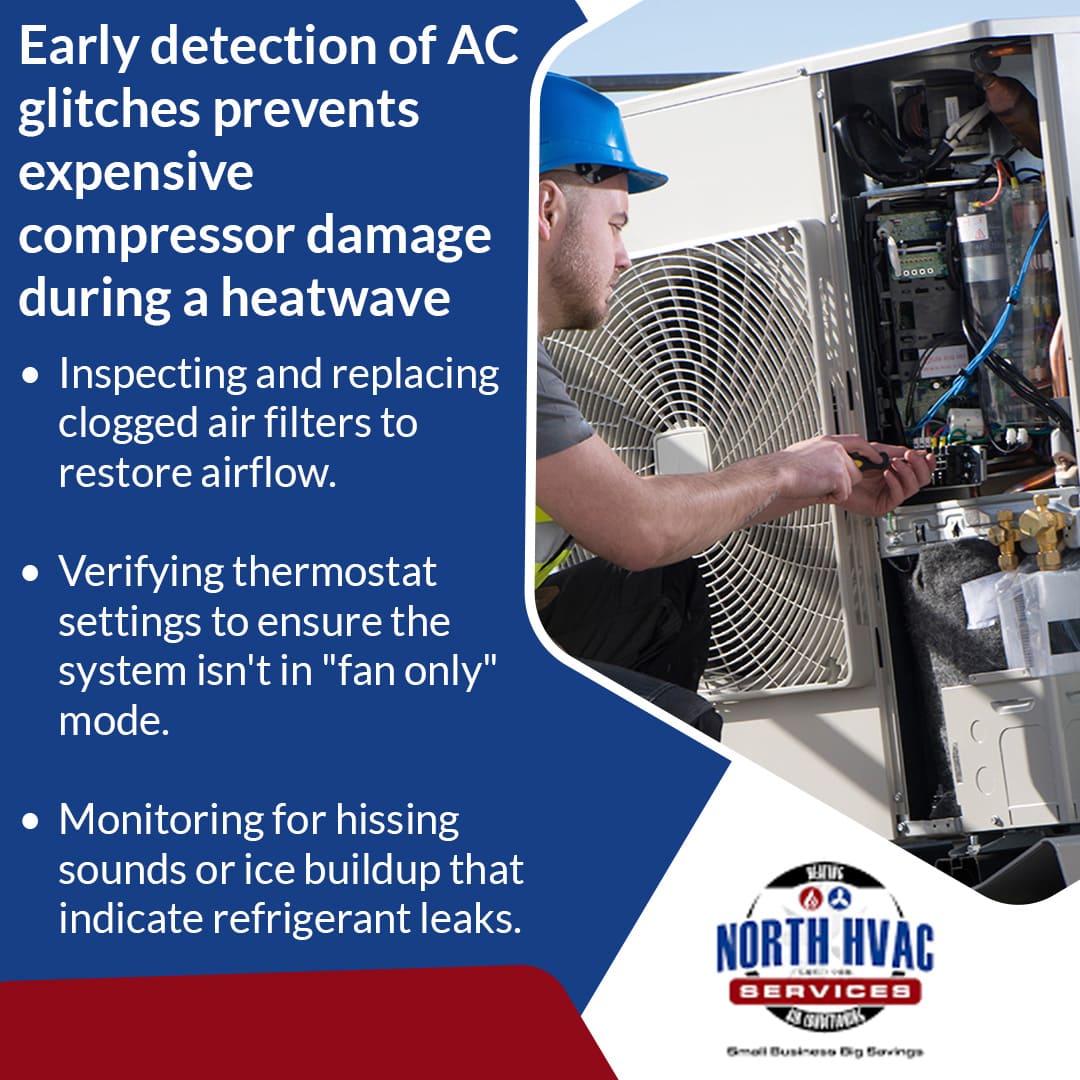
There is no single reason an AC stops cooling. The specific cause depends on the system’s age, when it was last serviced, and how hard it has been running. The five issues below account for most warm-air service calls across Petaluma and Sonoma County each summer.
| Cause |
What You’ll Notice |
Likely Fix |
| Dirty or clogged air filter |
Weak airflow, warm air, system runs non-stop |
Replace the filter ($10–$20) |
| Thermostat set to “fan only” mode |
Air circulates but the space never cools |
Switch to “cool” mode; verify the temperature setpoint |
| Low refrigerant from a leak |
Warm air, hissing sound, ice on refrigerant lines |
Professional leak repair and refrigerant recharge |
| Frozen evaporator coil |
Weak airflow, visible ice on indoor unit |
Turn the system off, allow full thaw, address the root cause |
| Failing outdoor condenser unit |
No cooling at all, outdoor fan not running |
Check the breaker; call a licensed technician if the issue persists |
A few important points on the more serious causes:
- Refrigerant leaks should not be treated as a typical DIY repair. Section 608 of the Clean Air Act establishes the EPA’s National Recycling and Emission Reduction Program, which requires that anyone purchasing or handling refrigerants in AC systems hold a valid Section 608 certification. Only certified technicians can legally recover, recycle, or recharge refrigerant. Attempting refrigerant work without proper equipment risks additional system damage and regulatory violations.
- Frozen evaporator coils are a downstream symptom – typically caused by a clogged filter, low refrigerant, or restricted airflow rather than a standalone part failure. Thawing the coil without addressing the underlying cause will produce the same result within days.
- System age matters across all five issues. A unit 12–15 years old with deferred maintenance is far more likely to present multiple compounding problems in the same service call.
Easy Checklist Before Calling for Santa Rosa AC Repair
Before searching online for AC repair near you and waiting on hold during a busy summer stretch, run through these steps first. Several common warm-air causes resolve without a service call.
- Check the thermostat. Confirm the system mode is set to “cool,” not “fan” or “heat.” Verify the setpoint temperature is lower than the current room temperature. Replace the batteries if the display looks dim or slow to respond.
- Inspect the air filter. Locate the filter at your return air vent or air handler cabinet. Pull it out and hold it up to a light source. If light doesn’t pass through clearly, it needs replacing. A new filter costs $10–$20 and can restore normal airflow immediately. This single step resolves a significant share of warm-air complaints.
- Check your breaker panel. Look for a tripped breaker labeled “AC,” “air handler,” or “condenser.” A tripped breaker sits between the full on and off positions rather than snapping cleanly to either side. Reset it once and watch the system. If the breaker trips again within a few minutes, stop. That signals an electrical fault requiring a licensed technician, not another reset.
- Inspect the outdoor unit. Walk outside and look at the condenser. Clear away any debris: leaves, grass clippings, or overgrown shrubs within 2 feet of the unit on all sides. Check the refrigerant lines running to the unit for ice buildup. If you see ice, turn the system fully off and allow it to thaw before restarting.
- Listen carefully. A hissing or bubbling sound typically points to a refrigerant leak. Grinding or squealing from the indoor blower usually indicates a motor or belt problem. Repeated clicking that doesn’t stop is a common sign of a relay or capacitor issue.
- Restart the system. Set the thermostat to “off,” wait 5 minutes, and return it to cooling mode. This allows system pressures to equalize and occasionally resolves a short-cycling event caused by a temporary pressure spike.
When to stop and call a professional: If the system still isn’t cooling after these checks, or if you notice ice buildup, unusual smells, or an electrical problem, do not proceed further. Refrigerant handling, sealed system repairs, and electrical diagnostics require professional tools and certified training. Proceeding without them risks additional component damage and can void your equipment warranty.
When Warm Air Means You Need AC Repair Services in Santa Rosa, CA
Some symptoms cannot be resolved with a filter swap or thermostat adjustment. The warning signs below point to a deeper system problem – and waiting through a summer to address them typically raises the total repair cost.
| Warning Sign |
What It Likely Means |
| Ice on refrigerant lines or the indoor unit |
Refrigerant leak or severely restricted airflow |
| Hissing or bubbling sounds during operation |
Active refrigerant leak in the sealed system |
| Electrical or burning smell from any component |
Wiring failure or motor overheating |
| Short cycling (system turns on and off repeatedly) |
Refrigerant issue, oversized unit, or early compressor failure |
| Water pooling around the indoor air handler |
Clogged condensate drain or frozen coil actively thawing |
What does professional AC repair cost in California? According to HomeAdvisor’s HVAC Repair Cost Guide, most homeowners spend an average of $350 on HVAC repairs, with typical costs ranging between $130 and $2,000, depending on the component involved and the complexity of the repair. More involved repairs, such as refrigerant leak work, evaporator coil replacement, or compressor service, can push costs toward the higher end of that range or beyond. In California, where labor rates and refrigerant prices are elevated due to the EPA’s AIM Act phasedown of older refrigerant types, homeowners with aging systems should expect costs that reflect current market conditions. The timing of Santa Rosa AC repair also matters. Summer peak scheduling means longer wait times and, in some cases, higher emergency service rates.
The cost of delay compounds quickly. A slow refrigerant leak accelerates compressor wear over weeks. A partially frozen coil that keeps running further restricts airflow each day. Short cycling stresses the compressor, capacitors, and contactor simultaneously. A repair that costs $400–$600 in spring can become a $2,000+ problem if a system limps through an August heat stretch without service.
North HVAC Services diagnoses the actual issue, not just the symptom, and provides a clear assessment before any repair work begins. We’ve served Petaluma and Sonoma County homeowners since 1988, and that doesn’t change based on what the estimate looks like.
Preventive Steps That Keep Your AC Cooling All Summer
Homeowners who rarely deal with mid-summer breakdowns have one thing in common: they service the system before the cooling season begins, not after something stops working.
Annual spring tune-up. A pre-season inspection allows a technician to check refrigerant levels, clean the evaporator and condenser coils, test capacitors and electrical contactors, and flag anything that’s wearing out before it fails under load. This is also often a warranty condition. Many equipment manufacturers require documented annual maintenance to keep coverage valid.
Filter replacement schedule. Filters should be replaced every 1–3 months during periods of heavy use. Homes with pets, allergy sensitivity, or smokers benefit from monthly replacement. A clean filter maintains airflow efficiency, which directly affects both how well the system cools and how long it lasts before needing compressor work.
Outdoor unit clearance. Keep at least 2 feet of clear space around the condenser on all sides and trim back plants through the summer. After storms or high-wind events, check for debris in or against the unit before restarting.
Maintenance contracts and local AC services. A scheduled maintenance agreement means your system gets a professional inspection before each season: automatically, without relying on memory during a busy spring. It also typically shortens response time during peak demand. Searching for air conditioner repair near you in mid-July, when every HVAC company in Sonoma County is running a full schedule, is a situation proactive maintenance helps you avoid entirely. Our team at North HVAC Services offers maintenance plans specifically designed for homes in our service area, and scheduling AC repair services in Santa Rosa, CA, before the summer rush starts means faster appointments and lower overall costs. Contact us for details.
Common Questions and Answers
How often should I service my AC?
Once per year is the standard recommendation for a well-maintained air conditioning system, ideally in spring before cooling demand increases. Homes with older equipment, heavy AC usage, or recurring performance issues may benefit from additional inspections during the year to identify wear and potential problems before they lead to breakdowns.
Can a dirty filter really make my AC blow warm air?
Yes, and it happens more often than homeowners expect. A clogged filter restricts airflow across the evaporator coil. Without adequate airflow, the coil cannot absorb heat from your home’s air effectively, so the system circulates air that stays at or above room temperature. In more severe cases, restricted airflow causes the coil to drop below freezing and ice over completely, stopping the cooling process until the ice thaws and the filter is replaced.
Is it cheaper to repair or replace an older AC unit?
A widely used benchmark is the 50% rule: if a repair estimate exceeds 50% of the cost of a comparable new system, replacement typically offers better long-term value, particularly for units that are already 10–12 years old or carrying deferred maintenance. A local AC services provider can walk you through that comparison on-site before you commit to either option, giving you the actual numbers rather than a guess.
Stay Cool This Summer – Schedule Your AC Inspection with North HVAC Services
If your AC is blowing warm air, struggling to keep pace during the afternoon heat, or showing any of the warning signs covered here, a professional inspection is the right next step, before the problem grows into a larger repair or a full system replacement. North HVAC Services is a family-owned HVAC contractor serving Petaluma, Santa Rosa, Sonoma, Marin, and Napa counties. Our EPA-certified technicians are trained to diagnose and repair all makes and models. As a Diamond Authorized Dealer for Mitsubishi and an Authorized Factory Dealer for Trane and Day & Night, we have direct access to factory-backed parts and manufacturer support your system deserves.
Call us at (415) 845-6910 (Marin County); (707) 430-3360 (Sonoma County) or email northhvacservices@gmail.com to schedule an inspection, request an estimate, or ask about our maintenance programs:
May 22, 2026 | AC Installation, AC Maintenance, AC Repair
What Unexpected AC Freezing Looks Like
When your air conditioner freezes up, it’s usually not subtle. You might notice a thick layer of frost or ice covering the copper refrigerant lines outside your building. Sometimes, the indoor evaporator coil inside your air handler or furnace will also freeze solid, even in the middle of a hot Petaluma summer.
Have you ever noticed water pooling under your system or dripping from vents? That’s often meltwater from a frozen coil thawing out. You may also hear a faint hissing or bubbling sound near the indoor unit. That’s refrigerant struggling to move through the icy blockage.
Here are some typical red flags that your AC is freezing up:
For further reading, see Why Is My Air Conditioner Freezing Up? from autotruckservice.org.
- Uneven cooling—certain rooms feel warm, others much colder
- Reduced airflow from vents
- Visible frost or ice on exterior copper lines or inside the air handler
- Water puddling around the indoor unit
- Unusual noises (hissing, bubbling, or gurgling)
Once you spot these issues, it’s tempting to just turn off the system and hope the problem goes away. Unfortunately, a frozen AC almost always points to an underlying issue that needs attention. If you’ve noticed any of these symptoms in your Petaluma business, it’s time to take a closer look at why your air conditioning system is freezing up.
How Poor Airflow Triggers Sudden Freezing
One of the most common causes of an AC freezing up is poor airflow across the evaporator coil. The evaporator coil is the cold part of your system, located inside the air handler. It needs a steady stream of warm air to work properly. If that airflow drops, the coil can become too cold and condensation freezes directly onto it.
Why does airflow drop? Here are the main culprits:
- Dirty air filters: A clogged filter blocks air before it reaches the coil. Even commercial-grade pleated filters can get packed with dust and debris in a few weeks during heavy use.
- Blocked or closed vents: Furniture, boxes, or closed registers reduce the amount of air the system can move.
- Blower motor issues: If the fan or blower motor is failing or running at the wrong speed, less air makes it over the coil.
- Duct problems: Collapsed, crushed, or leaky ducts restrict airflow and lower pressure in the system.
For example, North HVAC Services often finds that a single dirty air filter can reduce system airflow by 50% or more. That’s enough to cause ice to build up within hours. In commercial buildings, the problem is sometimes traced to a blocked return grille in a storeroom or supply closet. Even a well-maintained blower motor can’t compensate for a blockage in the ductwork or a thick layer of dust on the filter.
If your AC is freezing up, always start by checking for airflow problems. Replace filters monthly during peak cooling season. Walk your building to make sure all supply and return vents are open and unobstructed. If airflow still seems weak, it’s time for a professional inspection.
The Role of Low Refrigerant in AC Freezing Up
Low refrigerant is another big reason for unexpected AC freezing up. Refrigerant is the chemical that absorbs heat from inside your building and releases it outside. If your system is low on refrigerant, the pressure inside the evaporator coil drops. Lower pressure means a lower temperature—and that can cause the coil to freeze solid.
Why does refrigerant run low? Unlike oil in a car, it doesn’t get “used up.” Instead, it escapes through leaks—usually tiny pinholes in the copper lines, coil, or fittings. Over time, even a small leak can drop refrigerant levels enough to cause trouble.
What does this look like in real life? You might notice:
- Longer run times with little cooling effect
- Ice on the lines outside, especially near the service valves
- Bubbling or hissing sounds at the air handler or outdoor unit
- High energy bills, since the system works harder with less refrigerant
Don’t just top off the refrigerant. North HVAC Services recommends a leak check using electronic detectors or dyes. If a leak is found, proper repair is the only way to prevent ongoing freezing and further damage.
Running your system with low refrigerant can cause compressor failure, which is a costly repair. If you see ice and suspect low refrigerant, call a licensed HVAC contractor for help.
Thermostat Settings That Can Cause Freeze-Ups
Your thermostat does more than just set the temperature. It controls how long and how often your air conditioner runs. Certain settings can actually lead to your AC freezing up, even if the system is in good shape otherwise.
- Setting the thermostat too low: Most systems are designed for a minimum setpoint of about 68°F. If you set it lower—especially overnight—your coil can drop below freezing and ice over.
- Fan set to “On” instead of “Auto”: With the fan in the “On” position, the blower keeps running even when the compressor cycles off. This can cause warm air to blow over a cold coil and create excessive condensation, which then freezes.
- Short-cycling due to faulty thermostats: If the thermostat is malfunctioning, it might tell the unit to turn on and off rapidly. This can prevent the coil from warming up between cycles, leading to a freeze-up.
For example, in a Petaluma office, North HVAC Services found an energy-conscious manager had set the thermostat to 62°F overnight. By morning, the coil was a block of ice and the system couldn’t cool at all. Simply raising the setpoint to 70°F solved the problem.
Double-check your thermostat settings if you’re seeing ice. For commercial spaces, programmable thermostats that prevent extreme setpoints can help avoid these issues.
AC Freezing Up in Summer vs. Winter: What’s Different?
You might think AC freezing up is only a summer problem, but it can happen in the cooler months too. The causes and consequences are different depending on the season.
Summer: In summer, your AC works harder and longer. High humidity means more moisture in the air, which can freeze on a cold coil if there’s an airflow or refrigerant problem. You’ll usually spot ice on the outdoor lines, and indoor comfort drops quickly.
Winter: In winter, most businesses don’t run their AC, but some commercial systems use the cooling mode to control humidity or cool server rooms. If the outdoor temperature is low and the system runs anyway, the refrigerant pressure can drop too much. This can freeze the coil even with normal airflow. Many rooftop units have freeze protection built in, but older systems may not.
Common differences include:
- In summer, freezing usually points to airflow or refrigerant issues.
- In winter, freezing can occur from running the AC when it’s too cold outside, or from malfunctioning controls.
If your business relies on cooling year-round, talk to your HVAC contractor about low ambient controls or freeze sensors to prevent winter-related freeze-ups.
Hidden Problems Inside Your System
Sometimes, the cause of AC freezing up is harder to spot. Problems inside the system can create the right conditions for ice to form, even if filters are clean and refrigerant is at the right level. Here are some hidden issues North HVAC Services often uncovers:
- Dirty evaporator coils: Dust and grime act as insulation, reducing heat transfer and causing cold spots that ice over.
- Improperly sized system: An oversized unit cools the space too quickly, not allowing enough airflow across the coil.
- Malfunctioning expansion valve: This part meters refrigerant into the coil. If it sticks open or closed, pressures and temperatures drop, leading to freezing.
- Drainage problems: A clogged condensate drain can let water back up onto the coil, freezing into a solid block.
- Worn or damaged blower belts: In belt-driven systems, a loose or slipping belt reduces airflow even if the motor is running.
For example, a Petaluma restaurant called North HVAC Services for repeated freeze-ups. The cause turned out to be a partial clog in the condensate drain line. Water backed up onto the coil, froze, and blocked airflow even more. Cleaning the drain solved the issue immediately.
If basic troubleshooting doesn’t help, these hidden problems require a professional inspection.
Why Quick Fixes for AC Freezing Up Aren’t Enough
It’s tempting to just shut off the system and let the ice melt, especially in the middle of a busy workday. While this gets the air flowing again for a while, it doesn’t address the real issue. The underlying cause—whether it’s airflow, low refrigerant, or a hidden fault—remains, and the freezing will return.
Repeated freeze-ups can quickly wear out your compressor, blower motor, and other expensive parts. Ice on the coil can cause it to crack, leading to leaks and further damage. Over time, you’ll see:
- Higher energy bills
- Poor comfort and uneven cooling
- Frequent breakdowns
- Shortened equipment lifespan
Quick fixes can even make things worse. Adding refrigerant without fixing leaks leads to more ice, not less. Running the fan to “thaw” the coil can spread water into places it shouldn’t go, causing mold or electrical issues.
If your AC keeps freezing up, don’t just reset the thermostat or replace the filter and hope for the best. Have a professional diagnose and repair the root of the problem. That’s the only way to protect your investment and keep your business comfortable.
How to Prevent Your AC from Freezing Up Again
Preventing your AC from freezing up means staying ahead of the causes before they shut down your business. Here are practical steps you can take:
- Replace air filters regularly: Check them every month during the cooling season and change as needed.
- Keep vents open and clear: Don’t block supply or return grilles with furniture, boxes, or equipment.
- Schedule routine professional maintenance: At least once per year, have a licensed technician clean coils, check refrigerant levels, and inspect for leaks or wear.
- Monitor thermostat settings: Avoid setting temperatures below 68°F, and use programmable or smart thermostats to manage run times.
- Inspect ductwork: Look for signs of damage, disconnected sections, or visible dust buildup. Have ducts cleaned or repaired if needed.
For businesses in Petaluma, North HVAC Services offers maintenance plans that include full inspections, coil cleaning, and detailed checks of all the components that lead to freezing. Early detection of problems saves money and prevents downtime when you need cooling most.
If you’ve dealt with an AC freezing up once, it’s much easier to prevent it from happening again than to deal with another interruption. Make prevention a regular part of your building’s maintenance routine.
Need Help with a Freezing AC? Call North HVAC Services
If your air conditioning system is freezing up in your Petaluma business, don’t wait for it to thaw and hope for the best. Call North HVAC Services at (415) 845-6910. Our licensed technicians will diagnose the cause, repair the problem, and help you set up a maintenance plan that keeps your building cool and comfortable all year round. Get ahead of AC freeze-ups—call today.
Frequently Asked Questions
Why is my air conditioner freezing up even in hot weather?
An AC can freeze up in hot weather if there’s poor airflow over the evaporator coil, often caused by a dirty air filter, blocked vents, or failing blower fans. These issues prevent warm air from circulating properly, causing the coil to get too cold and freeze. Check and replace your air filter first, and if the problem persists, call a professional for a full inspection.
What should I do if I see ice on my AC lines or evaporator coil?
First, turn off your air conditioner to let it thaw completely—running it with ice can cause major damage. Once thawed, check your air filter and vents for blockages. If you’re still seeing ice or reduced airflow after these steps, contact North HVAC Services in Petaluma at (415) 845-6910 for a professional diagnosis.
Can a frozen AC cause water to leak inside my house?
Yes, when the ice on your AC thaws, it can create water puddles around the indoor unit or even drip from vents. This usually signals a bigger issue like a frozen evaporator coil, which needs to be addressed quickly to prevent water damage and system breakdown.
Is it safe to keep running my AC if it’s freezing up?
It’s not safe to keep running your AC when you notice it’s freezing up. Continuing to use it can lead to compressor damage and more expensive repairs. Turn off the system right away and troubleshoot for dirty filters or blocked vents, or call a local HVAC contractor like North HVAC Services for help.
What causes uneven cooling when my AC is freezing up?
Uneven cooling happens because frozen coils restrict proper airflow, so some rooms stay warm while others get colder. Fixing this usually involves addressing airflow issues, such as cleaning or replacing filters and making sure all vents are open and clear.

Feb 3, 2026 | AC Maintenance, HVAC Maintenance
The Science Behind Uneven Heating in Houses
Uneven heating in houses is a common concern for many homeowners. Often, you may find that some rooms feel like an icebox while others maintain a comfortable warmth. This issue arises due to various factors affecting how heat is distributed and retained within the home. Understanding the science behind this can help you identify the root causes and work towards effective solutions. At North HVAC Services, we recognize that achieving consistent comfort is crucial for your home environment.
Heat Distribution and Retention
The primary science behind uneven heating relates to heat distribution and retention. Heat moves from warmer areas to cooler ones, seeking to establish an equilibrium. If certain areas of your home have better heat retention, they will naturally stay warmer, while others with poor retention will feel colder. This discrepancy often leads to the sensation of uneven heating in house environments.
- Convection: Heat rises and circulates in a room, but if airflow is obstructed, some areas may not receive adequate warmth.
- Conduction: Heat loss through walls, floors, and ceilings can vary depending on materials and insulation quality.
- Radiation: Heat radiates from surfaces and can be absorbed differently based on the room’s furnishings and finishes.
External Factors
External factors like the home’s location and climate also play a significant role. In the SF North Bay area, where North HVAC Services operates, varying temperatures between seasons can affect how your heating system performs. Understanding these scientific principles provides a foundation for diagnosing and addressing uneven heating issues in your home.
Insulation Discrepancies: A Key Factor
One of the primary factors causing uneven heating in houses is the discrepancy in insulation quality and coverage. Insulation acts as a barrier to heat loss and gain, and any variation in its effectiveness can lead to significant temperature differences between rooms.
Identifying Insulation Issues
Rooms with inadequate or deteriorated insulation will lose heat more quickly, resulting in colder temperatures. This is particularly noticeable in older homes where insulation may have settled or degraded over time, according to physics.ucsc.edu. Insulation discrepancies can occur in various parts of the home, such as:
- Attics, where insulation may settle or become compacted.
- Walls, especially if the insulation was improperly installed.
- Floors above unconditioned spaces, like garages or basements.
Improving Insulation Quality
To address these issues, consider having a professional evaluation to determine where insulation improvements are needed. North HVAC Services can assist with heating system diagnostics to ensure your home is retaining heat effectively. Upgrading insulation can significantly improve the comfort levels throughout your home.
The Role of Ductwork in Temperature Variance
Ductwork plays a crucial role in distributing heated air from your furnace or heating system evenly throughout your home. When there are issues with the ductwork, it can lead to uneven heating, causing some rooms to feel like an icebox.
Common Ductwork Issues
Several ductwork issues can contribute to temperature variance:
- Leaks: Air leaks in the ductwork can lead to a loss of heated air before it reaches certain rooms.
- Blockages: Debris or obstructions in the ducts can restrict airflow, leading to underheated rooms.
- Poor Design: Incorrectly sized or designed duct systems can result in uneven air distribution.
Solutions for Ductwork Problems
To address these issues, it’s essential to have a professional assess and repair your ductwork. North HVAC Services offers hvac troubleshooting to identify and fix ductwork problems. Proper maintenance and repair can ensure that your heating system delivers consistent warmth to every room in your home.
Impact of Windows and Doors on Room Temperature
Windows and doors are often overlooked components that significantly impact room temperature. They can be major sources of heat loss, contributing to the feeling that some rooms are much colder than others.
Energy Loss Through Windows and Doors
Heat can escape through windows and doors in several ways:
- Single-pane glass: Without energy-efficient glazing, windows can allow significant heat loss.
- Poor seals: Gaps and cracks around windows and doors can lead to drafts.
- Inadequate curtains or blinds: Lack of proper window treatments can increase heat loss at night.
Enhancing Window and Door Efficiency
Consider upgrading to double or triple-pane windows and ensuring all seals are intact to reduce heat loss. Adding insulated curtains or blinds can also help retain heat. These improvements can make a noticeable difference in keeping your rooms consistently warm.
The Connection Between Room Placement and Temperature
The placement of rooms within a house can significantly affect their temperature. Certain factors related to room location can create a stark difference in warmth between different parts of your home.
Factors Influencing Room Temperature
Several factors related to room placement can influence temperature:
- Sun exposure: Rooms facing south may receive more sunlight and warmth, while north-facing rooms can be cooler.
- Proximity to heating sources: Rooms closer to the furnace or heating source may receive more heat.
- Levels of the house: Upper floors are typically warmer due to rising heat, while basements are often cooler.
Strategic Room Utilization
Understanding these factors can help you strategically utilize rooms based on their natural temperature tendencies. For example, using a south-facing room as a living area during winter can enhance comfort. North HVAC Services can help optimize your space with zoned comfort solutions to ensure each room maintains a comfortable temperature.
How HVAC System Issues Cause Uneven Heating
Problems with your HVAC system itself can also lead to uneven heating throughout your home. This can be due to a variety of mechanical or operational issues that impact the system’s ability to distribute heat evenly.
Common HVAC System Problems
Several issues with HVAC systems can lead to uneven heating:
- Inadequate system size: An HVAC system that is too small or too large for your home can lead to poor temperature regulation.
- Thermostat malfunctions: Faulty thermostats can cause inconsistent temperature control.
- Lack of maintenance: Regular hvac maintenance and tune-ups are essential for optimal performance.
Solving HVAC System Issues
Ensuring your HVAC system is properly sized and maintained is crucial for even heating. North HVAC Services provides comprehensive hvac system upgrades and maintenance to address these issues, enhancing your home’s comfort and efficiency.
Thermostat Placement and Its Effect on Room Temperatures
The placement of your thermostat can significantly impact how your heating system operates and the temperatures in different rooms. Improper placement can lead to inaccurate readings and uneven heating.
Ideal Thermostat Placement
For accurate temperature control, consider these tips for thermostat placement:
- Away from direct sunlight: Sunlight can cause the thermostat to register a higher temperature than the room’s actual one.
- Away from drafts: Drafts can lead to false readings and inefficient heating.
- Centrally located: Placing the thermostat in a central location helps it accurately gauge the home’s average temperature.
Professional Thermostat Installation
For optimal results, professional thermostat installation and replacement by North HVAC Services can ensure your system operates efficiently and maintains even temperatures throughout your home.
Solutions for Achieving Even Temperatures Throughout Your Home
Addressing uneven heating in your home involves a combination of improvements and professional services. Here are some solutions to achieve consistent temperatures:
- Upgrade Insulation: Enhance insulation in key areas to improve heat retention.
- Repair Ductwork: Ensure ducts are sealed and unobstructed for optimal airflow.
- Optimize Windows and Doors: Install energy-efficient windows and ensure proper sealing.
- Use Zoned Heating: Implement zoned comfort solutions to manage temperatures in different areas.
- Regular HVAC Maintenance: Schedule hvac maintenance and tune-ups to keep your system running efficiently.
North HVAC Services is here to help you achieve even temperatures in your home. Contact us for a free in-home evaluation to identify and resolve uneven heating issues. Call (415) 845-6910 today to learn more about how our expertise can enhance the comfort of your home.
Frequently Asked Questions
Why is one room in my house always colder than the others?
A colder room may result from poor insulation, obstructed airflow, or differences in how heat is retained. Check for drafts, ensure vents are open and unblocked, and consider adding insulation to improve heat retention.
How can I fix uneven heating in my house?
To fix uneven heating, try balancing the airflow by adjusting dampers and vents, seal any drafts, and consider upgrading insulation. Consulting with a professional like North HVAC Services can provide tailored solutions.
What role does insulation play in uneven heating?
Insulation affects how well heat is retained in each room. Poor insulation can lead to heat loss through walls and ceilings, making some areas colder. Improving insulation quality can help maintain consistent temperatures.
Can my HVAC system be the cause of uneven heating?
Yes, an improperly sized or malfunctioning HVAC system can cause uneven heating. It might not distribute air evenly or efficiently. Contacting North HVAC Services at (415) 845-6910 can help assess and address these issues.
Are there external factors that affect room temperatures?
External factors such as a home's location, surrounding climate, and sun exposure can impact room temperatures. Adjust window treatments to manage sunlight and consider weather-related adjustments to your HVAC settings.
Nov 21, 2025 | AC Maintenance, AC Repair
When your air conditioner runs nonstop but still doesn’t cool your Santa Rosa home, it’s more than just a comfort issue. You may be facing a repair or replacement decision, and without understanding the cause of the warm air, you risk overspending on small fixes or postponing critical repairs that only get worse.
Warm air complaints represent one of the most common service calls we receive at North HVAC Services. After serving Sonoma County families since 1988, we’ve identified five primary causes that account for nearly all cooling failures. More importantly, we’ve helped thousands of homeowners navigate the repair versus replacement decision using a clear framework based on system age, repair costs, and long-term value.
This guide explains what actually causes air conditioners to blow warm air, provides real cost data for common repairs, and gives you a practical decision-making framework. You’ll learn which questions to ask contractors, how to recognize red flags in service recommendations, and when repair makes better financial sense than replacement.
Recognizing Why Air Conditioners Blow Warm Air: The 5 Root Causes
Refrigerant Leaks: The Silent Performance Killer
Your air conditioning system doesn’t burn refrigerant like a car burns gasoline. Instead, refrigerant circulates continuously through a closed loop, absorbing heat from your indoor air and releasing it outside. When this closed loop develops even a small leak, your system’s cooling capacity drops noticeably.
Most refrigerant leaks occur at copper line connections, in corroded coil sections, or at service port valves. Refrigerant leaks develop gradually in commercial systems due to vibration stress, corrosion, and normal wear over time. Even small leaks progressively degrade system performance and efficiency until properly diagnosed and repaired.
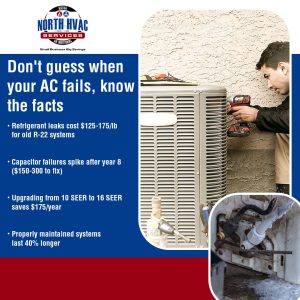
Here’s where Santa Rosa homeowners face a specific challenge. If your system was installed before 2010, it likely uses R-22 refrigerant, commonly called Freon. The EPA phased out R-22 production due to its ozone-depletion effects. Limited supply has driven R-22 costs to $145-250 per pound, compared to $50-100 per pound for the current standard R-410A refrigerant.
Some contractors offer to simply “top off” your refrigerant without locating and repairing the leak. This approach violates EPA Section 608 regulations and guarantees the same problem returns within months. Professional air conditioning repair services should always include leak detection using electronic sensors or tracer dyes, followed by proper repairs before recharging the system.
Refrigerant Repair Cost Reality:
| Refrigerant Type |
Approximate Cost per Pound* |
Typical System Charge |
Temporary Repair (No Leak Fix) |
Full Recharge / Repair (With Leak Fix) |
| R‑22 (Freon) |
$90 – $125 |
6–12 lbs |
$500–$850 |
$800–$1,400 |
| R‑410A |
$50–$90 |
6–8 lbs |
$240–$320* |
$650–$1,200* |
(Source: Today’s Homeowner). *Actual cost may vary depending on system size, leak repair requirements, and labor/service fees.
At North HVAC Services, our EPA-certified technicians use professional leak detection equipment to locate the source before adding any refrigerant. This approach costs more upfront but saves you from repeated service calls and wasted refrigerant.
Capacitor and Contactor Failures: The Electrical Weak Points
Air conditioning systems depend on multiple electrical components working in precise coordination. Capacitors store electrical energy and provide the power surge needed to start motors. Your system typically has two capacitors: one for the compressor and one for the outdoor fan motor.
When capacitors weaken or fail, motors struggle to start or run inefficiently. A failing capacitor often produces a distinctive humming sound from your outdoor unit without the fan actually spinning. Capacitor replacement typically costs $150-300, including labor.
The contactor acts as an electrical relay, controlling power flow to the compressor. When contact points pit or burn from repeated electrical arcing over the years, they fail to close properly. Contactor replacement runs $100-250, depending on your system size.
Frozen Evaporator Coils: The Misunderstood Problem
Here’s a cooling paradox: ice forming on your indoor coil actually stops your air conditioner from cooling your home. This happens because of airflow restriction, not because your system is working too hard.
Your indoor evaporator coil needs adequate air flowing across it to absorb heat properly. When airflow drops substantially, the coil temperature drops below freezing, moisture condenses and freezes on the coil surface, and ice buildup blocks remaining airflow completely.
Several conditions cause coil freezing beyond just dirty air filters. Low refrigerant levels reduce pressure and temperature in the evaporator. Blower motor failure prevents adequate air movement. Closed or blocked supply registers restrict return airflow, creating conditions that allow ice formation on evaporator coils.
Many homeowners try turning the system off and letting the ice melt. While this addresses the immediate symptom, it doesn’t solve the underlying cause. Repeated freeze and thaw cycles damage the thin aluminum fins on the coil and progressively reduce efficiency.
Compressor Failure: The Major Repair Decision Point
The compressor functions as the heart of your air conditioning system, pumping refrigerant through the entire loop. When a compressor fails, you face the most significant repair decision because compressor replacement often approaches half the cost of a complete new system.
Warning signs include hard starting, loud grinding or screeching noises, and circuit breakers that trip repeatedly. Most commercial-grade compressors are designed to operate reliably for 12 to 15 years under normal operating conditions with proper maintenance.
This is where the 50% rule becomes important for replacement decisions. If your repair cost exceeds 50% of replacement cost AND your system is over 10 years old, replacement typically makes better financial sense than continuing with repairs.
Thermostat and Control Issues: The “False Alarm” Diagnosis
Sometimes what appears to be a serious air conditioning problem turns out to be a simple thermostat or control board issue. These components control when your system runs and how it operates, so failures create symptoms that mimic more expensive problems.
Before assuming the worst, perform a simple calibration test. Place a separate thermometer near your thermostat for 20 minutes and compare readings. If temperatures differ by more than 3°F, you likely have a thermostat problem rather than an AC system failure.
When we diagnose cooling complaints at North HVAC Services, we always check the simplest and least expensive potential causes before recommending major repairs. This approach has kept us trusted in Sonoma County since 1988.

The Santa Rosa Climate Factor: Why Location Matters
Santa Rosa’s Mediterranean climate, classified by NOAA climate data, features warm, dry summers with temperatures reaching the high 80s and mild winters averaging the mid-50s. This moderate climate pattern subjects commercial HVAC systems to consistent seasonal cycling between heating and cooling modes.
While systems in extreme climates experience continuous operation in a single mode, Santa Rosa equipment cycles between heating and cooling throughout the year, affecting component longevity. Commercial systems in this climate zone typically require replacement consideration at 12 to 15 years rather than the 15 to 20-year lifespan possible in more stable climates.
Wildfire smoke season creates additional challenges. When smoke blankets our region, outdoor coils become contaminated with ash and fine particulates. Air filters clog much faster than normal. The California Air Resources Board documented that during the 2018 Camp Fire, PM2.5 levels increased by more than 300 percent compared to average levels, creating extreme demand on HVAC filtration systems throughout Northern California.
We recommend pre-summer inspections specifically to address smoke damage from the previous season. Our indoor air quality analysis helps identify whether your current filtration adequately protects your system during poor air quality periods.
Repair vs. Replacement: The Decision Framework
The Age-Cost-Efficiency Triangle
Three factors intersect in every repair versus replacement decision: your system’s age, the repair cost you’re facing, and the efficiency difference between keeping your current system versus upgrading.
System Age and Repair Cost Evaluation:
| System Age |
Repair Cost:
< $500 |
Repair Cost:
$500-1,500 |
Repair Cost:
> $1,500 |
| 0-5 years |
Always repair |
Repair |
Investigate warranty |
| 6-10 years |
Repair |
Evaluate efficiency |
Consider replacement |
| 11-15 years |
Repair if minor |
Calculate 5-year costs |
Lean toward replacement |
| 15+ years |
Repair only if under $300 |
Replace |
Definitely replace |
Older systems operate at 8-10 SEER (Seasonal Energy Efficiency Ratio), while current minimum standards require 14 SEER in northern states and 15 SEER in southern states. The U.S. Department of Energy provides guidance on energy efficiency standards and potential savings from system upgrades.
The Total Cost of Ownership Approach
Looking beyond the immediate price tag reveals the true financial picture. Let’s examine a real scenario. You have a 12-year-old system needing a $1,200 compressor repair.
Repair scenario over the next 3 years:
- Immediate repair cost: $1,200
- Estimated additional repairs: $800-1,500
- Energy costs at 10 SEER: $1,410
- Total 3-year cost: $3,410-4,110
Replacement scenario over the next 3 years:
- New 16 SEER system installed: $4,500-7,500
- Energy costs at 16 SEER: $885
- Likely repairs (under warranty): $0-200
- Total 3-year cost: $5,385-7,700
The replacement costs more initially, but after three years, your repaired system has reached 15 years old and likely faces replacement anyway. Your new system still has 12-15 years of useful life remaining with considerably lower operating costs.
At North HVAC Services, we provide these calculations during our free replacement consultations so you can make learned decisions based on your specific situation.
Red Flags That Signal Replacement Over Repair
Certain situations make replacement the clear choice. If you have an R-22 system requiring both refrigerant and a major component repair, your combined costs often exceed 60% of the replacement cost.
A second major repair within 24 months indicates your system has reached the failure cascade stage. Industry experience demonstrates that repeated major repairs rarely provide good value once systems exceed 75% of their expected lifespan. At this point, you are funding a series of expensive repairs on equipment that will continue declining.
Energy bills increasing 15-20% year-over-year despite consistent usage patterns signal declining efficiency. This gradual decline costs you hundreds in excess energy bills while you delay the inevitable replacement decision.
What to Expect From Professional Santa Rosa AC Repair Services
Professional Santa Rosa AC repair should follow a systematic diagnostic process. Proper evaluation includes visual inspection of both units, electrical testing, refrigerant pressure readings, airflow measurement, thermostat calibration, and duct system evaluation.
This comprehensive approach typically takes 45-90 minutes. Diagnostic fees range from $89-150, covering expertise, specialized testing equipment, and travel time. The Better Business Bureau guidelines emphasize that transparent diagnostic fees indicate professional operations.
Questions to Ask Before Authorizing Repairs
- “What exactly failed and what caused the failure?” A good technician explains both the broken component and why it failed.
- “How much useful life does my system have remaining?” Honest contractors will tell you if you’re repairing a system near the end of its lifespan.
- “Are there other components likely to fail soon?” This reveals whether you’re facing one repair or a series of upcoming expenses.
- “What’s included in your repair warranty?” Quality contractors stand behind their work with written warranties covering both parts and labor.
- “Do you offer a written estimate before starting work?” Written estimates protect both parties by documenting what work will be performed and at what cost.
We provide written estimates for all AC repairs at North HVAC Services, with clear warranty terms spelled out before any work begins. Our labor warranties reflect our confidence in the EPA-certified technicians who have been serving Sonoma County families for over 35 years.
Red Flags in Contractor Behavior
Be wary of pressure to decide immediately without a written estimate. Avoid contractors who seem reluctant to explain what failed and why. Never authorize refrigerant additions without leak detection and repair.
Verify licensing, insurance, and EPA certification before allowing anyone to work on your system. HVAC work requires a C-20 contractor license.
Preventive Strategies to Avoid Emergency Repairs
Monthly filter changes during heavy use seasons make the single biggest difference in system longevity. From April through October in Santa Rosa, standard 1-inch filters need replacement every 30 days during peak use.
Annual professional inspection timing matters greatly. Schedule service in March or April, before the cooling season begins. Research shows that properly maintained systems last 40% longer on average than neglected systems.
Outdoor unit maintenance prevents many service calls. Remove leaves, grass clippings, and debris. Trim vegetation to maintain at least two feet of clearance on all sides.
Our maintenance agreements at North HVAC Services include priority service, repair discounts, and regular professional attention. We’ve maintained these same agreements for families throughout Sonoma County for over 35 years.
When to Schedule Service
Fall, particularly October through November, represents the best time for non-emergency service. You can typically schedule appointments within 2-3 days rather than waiting 1-2 weeks during the summer.
Certain warning signs require immediate attention regardless of the season. Strange odors indicate electrical problems or mold growth. Water leaking inside your home signals drain line problems. Systems that short-cycle indicate serious problems. Circuit breakers that trip repeatedly mean dangerous electrical issues.
Making Your Repair Decision With Confidence
You now understand the five primary causes behind air conditioners blowing warm air and have a decision framework based on age, cost, and efficiency. Systems under 10 years old typically justify repairs unless costs exceed 50% of replacement value. Systems over 12 years old require careful cost projection analysis.
Professional diagnosis provides the information you need for confident decisions. A $200 capacitor replacement caught during spring maintenance prevents the $2,500 compressor failure that occurs when you ignore the problem.
When you need reliable air conditioning repair in Santa Rosa, CA, working with experienced professionals ensures you make the right decision for your home and budget. North HVAC Services has served Sonoma County families since 1988 with honest diagnosis, transparent pricing, and quality workmanship.
Call us at (415) 845-6910 or email northhvacservices@gmail.com to schedule your air conditioning diagnostic or to discuss whether repair or replacement makes the most sense for your specific situation. Our EPA-certified technicians bring the experience and equipment needed for accurate diagnosis and lasting air conditioner repair in Santa Rosa, serving homeowners throughout the city and surrounding communities.
Aug 30, 2025 | AC Maintenance, HVAC Maintenance
As a homeowner, you depend on your HVAC system to keep your home comfortable year-round. However, like all mechanical systems, it has a finite lifespan. Knowing when to replace your old HVAC system instead of continuing to repair it can save you time, money, and hassle in the long run. In this guide, we’ll explore the signs that indicate it might be time to consider a replacement and how North HVAC Services can assist with this important decision.
Increased Frequency of Repairs
One of the clearest signs that it might be time to replace your HVAC system is the rising frequency of repairs. If your system seems to need constant attention, it could be more than just a series of unfortunate events. Older systems often experience more frequent breakdowns because their components are simply worn out.
Consider a scenario where your furnace has broken down multiple times in the past year. Each time, you’re faced with repair costs that seem to add up quickly. While it might be tempting to continue fixing it, these expenses can quickly approach or even exceed the cost of a new system. If you find yourself searching for furnace troubleshooting tips more often than you’d like, it might be time to consider the benefits of a new installation.
By choosing to replace your furnace or AC unit sooner rather than later, you can avoid the stress and unpredictability of frequent breakdowns. This proactive approach not only saves money but also enhances the reliability of your home’s heating and cooling.
Rising Energy Bills
Another indicator that it might be time for a new HVAC system is a noticeable increase in your energy bills. As systems age, they become less efficient, requiring more energy to heat or cool your home to the same level. This inefficiency is often reflected in higher monthly bills.
For example, if you notice a significant jump in your heating costs during the winter months, it could be due to your aging furnace working harder to maintain the desired temperature. Similarly, a spike in cooling costs in the summer might indicate your old AC unit is on its last legs.
- Check your past energy bills for patterns of increase over time.
- Consider having a heating diagnostics service performed to assess your system’s efficiency.
- Explore energy-efficient heating options that could lead to significant savings.
Investing in a new, energy-efficient system from North HVAC Services can reduce your energy consumption and lower your monthly bills, offering peace of mind and long-term savings.
Inconsistent Temperatures
Inconsistent temperatures throughout your home can be frustrating and uncomfortable. If some rooms are too hot while others are too cold, your HVAC system may be struggling to distribute air evenly. This could be a sign that it is no longer capable of meeting your home’s heating and cooling demands effectively.
Consider a home where the living room feels like a sauna while the bedroom remains chilly. This imbalance often results from an HVAC system that is either too old or improperly sized for the home. While you might consider furnace maintenance tips or scheduling a professional to diagnose heating issues, sometimes these problems persist despite your best efforts.
Replacing your system with one that is properly sized and designed for your specific home layout can resolve these issues. North HVAC Services can help you explore heating options that ensure each room in your home is comfortable year-round, eliminating those pesky hot and cold spots.
Age of the System
The age of your HVAC system is a critical factor in determining whether to repair or replace it. Most HVAC systems have a lifespan of 10-15 years. If your system is approaching or exceeding this age range, it may be time to consider an upgrade.
For example, if your AC unit is over 15 years old and requires frequent air conditioning repair, a replacement could be more cost-effective. Similarly, an aging furnace might not perform as efficiently as it once did, leading to increased wear and tear on its components.
- Review the installation date of your current system to assess its age.
- Consider the benefits of a new system, such as improved efficiency and reliability.
- Research furnace installation help to ensure a seamless transition to a new unit.
North HVAC Services is equipped to handle furnace installation services and air conditioning replacement, ensuring that your new system meets the latest standards for efficiency and performance.
Final Thoughts
Knowing when to replace your old HVAC system can be challenging, but the benefits of a new, efficient system are clear. From reducing repair costs to lowering energy bills and improving your home’s comfort, a replacement can offer significant advantages.
If you’re experiencing any of the issues mentioned above, it might be time to consult with North HVAC Services. Our team of experts is here to help you make informed decisions about your HVAC needs. Whether you need professional heating solutions or are looking to get ac installed, we are committed to providing dependable service and expert advice.
Take the next step towards a more comfortable and efficient home by contacting us today. Let North HVAC Services guide you in making the best choice for your heating and cooling needs.