Jul 27, 2026 | Heat Pumps, Heating Systems
What Are the Key Differences Between Heat Pumps and Furnaces for Marin and Sonoma County Homes?
Heat pumps and furnaces both heat your home, but they do so in fundamentally different ways. Heat pumps transfer heat from the outside air, while furnaces generate heat by burning fuel or using electricity.
A heat pump works by extracting heat from the air outside (even when it’s chilly) and moving it indoors. It can also reverse this process in summer, acting as an air conditioner. Heat pumps are powered by electricity, making them a single-system solution for both heating and cooling.
A furnace creates heat by burning natural gas, propane, or using electric resistance coils. It’s dedicated to heating only, so you’ll need a separate air conditioning system for summer. Furnaces typically deliver higher heat output, which can be helpful on the coldest days.
For further reading, see Natural Gas or a Heat Pump? Where You Live Matters from aga.org.
- Heat pumps can both heat and cool your home; furnaces only heat.
- Furnaces tend to heat spaces faster and to higher temperatures than heat pumps.
- Heat pumps are more energy efficient in mild climates.
- Furnaces may be necessary where winter temperatures regularly dip below freezing.
Choosing between a heat pump and a furnace depends on your heating and cooling needs, energy goals, and the layout of your home.
How Does the Local Climate in Marin and Sonoma Counties Affect Heat Pump vs Furnace Performance?
The mild, coastal climate in Marin and Sonoma Counties makes heat pumps a strong contender, but some rural or inland areas may still benefit from a furnace.
Heat pumps are most effective in regions where winter temperatures rarely drop below freezing. In Marin and Sonoma, typical winter lows are in the 30s and 40s. This means a heat pump can efficiently extract enough warmth from the outside air to heat your home for most of the year.
If your property is in a microclimate—like Sonoma Mountain, Occidental, or higher elevations—that experiences harder winter freezes, a furnace may provide more reliable heat during cold snaps. Furnaces work well regardless of the outside temperature because they create heat rather than move it.
- Coastal and valley locations: Heat pumps usually offer efficient, year-round comfort.
- Hilly or rural areas with hard freezes: Furnaces or dual-fuel (hybrid) systems may be more consistent on the coldest nights.
Ask yourself: How often does your area experience freezing temperatures? If it’s rare, a heat pump could be a practical, efficient choice.
What Is the Installation Process Like for Heat Pumps Compared to Furnaces?
Installing a heat pump is typically more complex than a furnace because it requires both indoor and outdoor components, but both require professional handling for safety and performance.
- Heat Pump Installation:
- Install outdoor condenser/compressor unit.
- Install indoor air handler (connected to ductwork or wall-mounted for ductless systems).
- Run refrigerant and electrical lines between units.
- Test and charge the system with refrigerant.
- Furnace Installation:
- Install furnace unit (usually in a garage, attic, or closet).
- Connect to existing ductwork and gas or electrical utilities.
- Add flue/venting for combustion gases (if gas-powered).
- Test for leaks and ensure safe operation.
Heat pump installation often involves more steps, especially if you’re replacing an older furnace-only system. It can require new wiring, refrigerant lines, and sometimes electrical upgrades. Furnace replacements are often straightforward if you’re swapping out an old unit for a new one of the same type.
North HVAC Services can assess your current setup and recommend the most efficient installation path with minimal disruption to your home or business.
How Do Installation Costs Compare: Heat Pump vs Furnace in Marin and Sonoma Counties?
Generally, installing a heat pump system costs more upfront than a standard furnace, but the gap narrows if you also need air conditioning.
Heat pumps serve both heating and cooling functions, so you’re investing in a two-in-one system. Furnaces are less expensive to install, but pairing one with a new air conditioner can raise your total investment.
| System Type |
Typical Installation Steps |
Relative Upfront Cost |
Includes Cooling? |
| Heat Pump |
Indoor & outdoor units, refrigerant lines, wiring |
Higher |
Yes |
| Furnace Only |
Indoor unit, venting, gas/electric hookup |
Lower |
No |
| Furnace + AC |
Furnace + separate AC installation |
Highest |
Yes |
Actual costs vary depending on home size, ductwork, electrical upgrades, and equipment efficiency. If your goal is to upgrade both heating and cooling, a heat pump often makes financial sense. North HVAC Services can give you a detailed quote for both options so you can compare apples to apples.
What Are the Pros and Cons of Heat Pump vs Furnace Installation for Local Homes?
Both systems have clear advantages and drawbacks. Here’s a breakdown to help you weigh your options for Marin and Sonoma homes.
- Heat Pump Pros:
- Provides both heating and cooling
- Lower energy use in mild climates
- No onsite combustion or flue gases (safer, no carbon monoxide risk)
- Potentially lower lifetime maintenance
- Heat Pump Cons:
- Higher initial installation cost
- Less efficient when outdoor temperatures drop below freezing
- May require electrical upgrades for older homes
- Furnace Pros:
- Reliable, strong heating in any temperature
- Simpler to install if replacing an old furnace
- Lower upfront cost (if cooling isn’t needed)
- Furnace Cons:
- Only provides heat—separate AC needed for cooling
- Produces combustion gases (if gas-powered)
- Greater fluctuation in indoor air humidity
Consider which factors are most important for your property—comfort, safety, efficiency, or initial investment.
How Does Each System Impact Monthly Energy Bills in Marin and Sonoma County?
Heat pumps can significantly lower monthly energy bills in our region’s mild climate, while furnaces may cost more to operate—especially if you use electric resistance heating.
Because heat pumps transfer heat instead of generating it, they use less electricity to deliver the same amount of warmth. This efficiency means lower utility bills during winter, particularly if you’re replacing electric baseboard or old, inefficient systems.
Gas furnaces are efficient, but fluctuating natural gas prices can affect your bills. Electric furnaces are typically the most expensive to run because they use more electricity per unit of heat.
- Heat pumps usually lower monthly heating costs in Marin and Sonoma’s climate.
- Furnaces can be more cost-effective in homes with easy access to affordable natural gas.
- If you cool your home in summer, heat pumps can also cut cooling costs compared to older AC units.
If you’re interested in reducing your carbon footprint while saving on bills, a modern heat pump is often the best fit for the North Bay’s weather.
Which Is a Better Long-Term Investment: Heat Pump or Furnace for Your Home?
For most Marin and Sonoma County homes, a heat pump is the better long-term investment due to its dual functionality and energy savings, especially if you need both heating and cooling.
A new heat pump can last 10–15 years with proper maintenance. Its high efficiency leads to lower utility bills over time. Because it replaces both a furnace and an air conditioner, you simplify maintenance and replacement cycles.
Furnaces, especially gas models, are durable and can last up to 20 years. If you already have a separate, efficient air conditioner and rarely need cooling, replacing just the furnace can make sense for targeted upgrades.
- Heat pumps: Lower long-term energy costs, reduced maintenance, modern comfort features.
- Furnaces: Long lifespan, higher heat output, lower upfront cost if cooling isn’t a concern.
Think about your total cost of ownership, not just purchase price. North HVAC Services can help you calculate payback periods and expected savings for your home or business.
How to Decide Between Heat Pump and Furnace Installation for Your Marin or Sonoma County Home
To decide between a heat pump and a furnace, consider your climate, comfort needs, energy costs, and whether you want one system for both heating and cooling.
- Assess your local winter lows—heat pumps excel in mild climates, furnaces in colder spots.
- Do you already have or need air conditioning? If yes, a heat pump often simplifies things.
- Check your fuel sources: Is natural gas available and affordable? Or is electricity your main option?
- Consider your budget for installation and long-term operation.
- Factor in safety, air quality, and maintenance preferences.
- Consult a trusted local contractor like North HVAC Services for an evaluation of your existing system and a tailored recommendation.
Ready to explore your options? Contact North HVAC Services at (415) 845-6910 for personalized advice and a no-obligation estimate for your Marin or Sonoma County home.
Frequently Asked Questions
Which is more energy efficient for Marin and Sonoma County homes: a heat pump or a furnace?
A heat pump is generally more energy efficient in Marin and Sonoma County’s mild climate. Since heat pumps transfer existing heat rather than generating it, they use less energy for most of the year, making them a great choice for local homeowners.
Can a heat pump keep my home warm enough during colder winter nights?
Heat pumps can provide sufficient warmth for most winter nights in Marin and Sonoma Counties, but on the coldest nights, a furnace may deliver higher heat output. If your home is in an area that occasionally experiences freezing temperatures, you might want to consider a backup heat source or consult with North HVAC Services for tailored advice.
Do I need both a heat pump and a furnace, or just one of them?
In most cases, you only need one system, but the best choice depends on your comfort goals and home’s layout. Heat pumps provide both heating and cooling, while furnaces only heat your home, meaning you’d also need a separate air conditioner if you choose a furnace.
How does installation cost compare between a heat pump and a furnace?
Installation costs can vary based on system size, existing ductwork, and your home’s needs, but heat pumps can sometimes have a higher upfront cost because they handle both heating and cooling. Contact North HVAC Services to get a detailed estimate for your specific situation.
Is a heat pump or furnace better for indoor air quality?
Heat pumps typically offer better indoor air quality since they don’t burn fuel and circulate air more consistently. However, both systems require regular filter changes and maintenance to keep your air clean and healthy.
Jul 12, 2026 | Heat Pumps
What Is the 20 Degree Rule for Heat Pumps?
When it comes to 20 degree rule heat pump, the “20 degree rule” for heat pumps means that a heat pump system is designed to maintain a temperature difference of about 20 degrees Fahrenheit between the indoor and outdoor air. If it’s 40°F outside, your heat pump can typically keep your home at 60°F efficiently—but expecting 70°F inside when it’s 40°F outside may push the system beyond its comfort zone.
This rule is a guideline, not a hard limit. It reflects how heat pumps transfer warmth from outside air—even in cold weather—to heat your building. The 20 degree rule helps set realistic expectations, especially during extreme weather. For example, in Petaluma or Santa Rosa, when a cold front drops outdoor temperatures to 35°F, your heat pump may struggle to keep your space at 68°F, especially in older or drafty buildings. Understanding this rule helps you plan for supplemental heat or manage thermostat settings during rare cold snaps.
Why Do HVAC Professionals Reference the 20 Degree Rule?
HVAC professionals reference the 20 degree rule because it sets practical expectations for how heat pumps perform in real-world conditions. This guideline helps prevent oversizing or undersizing systems and avoids frustration with unrealistic comfort demands.
For further reading, see What Is The 20 Degree Rule? from hsvutil.org.
Heat pumps don’t generate heat—they move it. When it’s cold outside, there’s less heat for the system to extract, so efficiency drops as the temperature gap widens. The 20 degree rule helps you:
- Understand system limitations during extreme weather
- Decide when to use backup or supplemental heat
- Set thermostat targets that the heat pump can realistically achieve
- Plan HVAC upgrades or insulation improvements
For business owners, this means fewer surprises during winter cold spells or summer heat waves. North HVAC Services uses the 20 degree rule when recommending, sizing, and servicing heat pump systems in Sonoma County and beyond. It helps ensure your investment matches your comfort needs and building realities.
How Does the 20 Degree Rule Affect Your Home’s Comfort?
The 20 degree rule directly impacts how comfortable your space feels during extreme outdoor temperatures. If you set your thermostat too far from the outdoor temperature, your heat pump may run constantly, fall behind, or create noticeable temperature swings.
For those concerned with 20 degree rule heat pump, here’s what you might experience:
- If it’s 35°F outside, aiming for 55°F to 60°F inside is realistic with a standard heat pump.
- Pushing for 68°F inside when it’s 35°F outdoors could result in the system running without reaching the setpoint.
- Rooms farthest from the heat pump may feel cooler.
- Some systems will switch on electric resistance backup heat, which increases energy use and costs.
You can improve comfort by:
- Adding insulation or sealing drafts to reduce heat loss
- Using programmable thermostats to gradually adjust temperatures
- Considering multi-zone or ductless heat pumps for targeted heating
- Supplementing with portable heaters only as needed
Understanding the 20 degree rule helps you avoid disappointment and plan for true comfort, especially during rare cold spells in the Bay Area.
Does the 20 Degree Rule Apply in Both Heating and Cooling Modes?
Yes, the 20 degree rule applies to both heating and cooling with heat pumps. In heating mode, your system can usually maintain an indoor temperature about 20°F above the outdoor temperature. In cooling mode, it can cool about 20°F below the outdoor temperature.
For example:
- On a 95°F summer day, your heat pump can reliably keep your indoor space at around 75°F.
- Trying to cool to 68°F on that same day may result in the system running non-stop, higher electric bills, and uneven cooling.
- In winter, when it’s 38°F outside, setting your thermostat to 60°F will be within reach for most systems—going much higher could cause comfort issues.
This rule of thumb isn’t a strict limit, but it helps set realistic expectations for both heating and cooling performance. If you notice your system can’t keep up even within this range, there may be underlying issues—like undersized equipment, duct leaks, or poor insulation—that North HVAC Services can help you address.
Is It Safe to Set Your Thermostat Beyond the 20 Degree Rule?
It’s not unsafe to set your thermostat beyond the 20 degree rule, but it isn’t efficient or economical. The system will work harder, your energy bills will spike, and you may wear out components faster.
For those concerned with 20 degree rule heat pump, here’s what happens if you ignore the rule:
- The system may run constantly with little effect on indoor temperature.
- Electric backup heat (if available) may engage, using much more electricity.
- Long runtimes can put stress on compressors, fans, and other parts.
- Rooms furthest from the air handler may never reach the target temperature.
If you run a business, these issues can mean higher utility costs and more frequent repairs. While it won’t damage the system overnight, consistently exceeding the 20 degree guideline is not sustainable. If your comfort needs aren’t being met, consult a professional—sometimes a heat pump upgrade, zoning, or supplemental heat is the smarter long-term solution.
How the 20 Degree Rule for Heat Pumps Applies in Sonoma, Marin, and Napa Counties
In Sonoma, Marin, and Napa counties, the 20 degree rule for heat pumps is very relevant. Our climate features cool, damp winters and occasional summer heat waves. Most residential and small business heat pumps in this region are sized with this rule in mind.
For example:
- Winter lows in Petaluma or Santa Rosa can reach the upper 30s. Your heat pump should keep you comfortable in the mid- to upper-50s indoors without supplemental heat.
- On rare mornings when it dips below freezing, you may notice the system struggling to reach your preferred 68°F setpoint.
- During summer, when outdoor highs hit 95°F in Napa, your heat pump should comfortably maintain 75°F to 78°F inside.
- Old buildings with poor insulation may experience greater temperature swings and need more backup heat to meet comfort goals.
North HVAC Services often recommends improving insulation and sealing drafty areas to give your heat pump an easier job. In some cases, upgrading to a high-capacity or cold-climate model can help push past the traditional 20 degree boundary—but always balance cost, comfort, and efficiency.
Common Questions About the 20 Degree Rule and Heat Pumps
- Can a heat pump work when it’s below freezing outside?
Yes, but efficiency drops. Many standard heat pumps can still provide heat at 32°F, though you may need backup heat below that point.
- Does the 20 degree rule mean my heat pump is broken if it can’t heat beyond that?
No. If the system keeps your indoor temperature about 20°F above the outdoor temperature, it’s likely working as designed.
- Will adding insulation help my heat pump?
Absolutely. Better insulation reduces heat loss, helping your heat pump maintain comfort with less effort and energy.
- Are there heat pumps that can go beyond the 20 degree rule?
Yes, some high-performance and cold-climate models can provide heat at larger temperature differences, but they often cost more upfront.
- Should I use a space heater if my heat pump can’t keep up?
You can, but use it safely and only as a temporary supplement. It’s better to address underlying issues with your HVAC contractor.
When to Contact an Expert About Heat Pump Performance Limits
Contact an HVAC expert if your heat pump consistently fails to keep your building within the 20 degree guideline, or if you notice unusually high energy bills, constant cycling, or cold spots—even when outdoor temperatures are mild.
You should also reach out when:
- You’re planning a renovation or expansion
- You want to upgrade to a cold-climate heat pump
- Comfort is uneven from room to room
- You’re considering improving insulation or ductwork
- System noises or error codes appear
North HVAC Services helps business owners and homeowners throughout Petaluma, Sonoma, Marin, and Napa counties get the most from their heat pumps. If you’re unsure whether your system is sized, installed, or running correctly, call us at (415) 845-6910. We’re ready to assess your needs, explain your options, and help you achieve reliable comfort—no matter what the weather brings.
Frequently Asked Questions
What is the 20 degree rule for heat pumps?
The 20 degree rule for heat pumps means your system is designed to efficiently maintain an indoor temperature that is about 20°F warmer than the outdoor air. For example, if it’s 40°F outside, you can expect your heat pump to keep your home around 60°F without extra strain.
Why can’t my heat pump keep my house 70 degrees when it’s really cold outside?
Heat pumps are less effective as the temperature difference between inside and outside increases, which is why the 20 degree rule exists. When it’s much colder outside, your heat pump may struggle to maintain very warm indoor temperatures, and you may need supplemental heating or to adjust your thermostat expectations.
Should I use a backup heat source if my heat pump can’t keep up in the cold?
Yes, using a supplemental heat source like electric resistance heat or a portable heater can help if your heat pump isn’t maintaining comfortable temperatures during a cold snap. This is especially helpful in older or less insulated homes.
How do I know if my heat pump is working properly during cold weather?
Your heat pump is likely working as designed if it’s maintaining a temperature difference close to the 20 degree rule, but struggling to go beyond that in very cold weather. If you notice much lower performance or no heat, call a professional like North HVAC Services at (415) 845-6910 to check your system.
Can I improve my home’s comfort during a cold snap with a heat pump?
You can improve comfort by sealing drafts, adding insulation, and adjusting your thermostat to more realistic settings based on the 20 degree rule. If you need help optimizing your system, contact North HVAC Services in Petaluma for an efficiency check or home assessment.

Jun 25, 2026 | Heat Pumps, Heating Systems
Are Most Heat Pump Problems Truly Repairable?
Yes, most heat pump problems are repairable when handled by a skilled technician with the right tools and knowledge. Many issues that seem serious—like loss of heat, odd noises, or even a unit that won’t start—often have solutions that don’t require replacing the entire system.
Common repairable problems include faulty relays, capacitor failures, thermostat issues, and refrigerant leaks. Even compressor and fan motor failures, which are sometimes misdiagnosed as catastrophic, can often be resolved. In our experience at North HVAC Services, we routinely revive heat pumps that others have written off. The main reason repairs fail is not the equipment, but a lack of accurate diagnostics or technical know-how. With advanced troubleshooting and up-to-date training, technicians can often restore your system to reliable operation, saving you the cost and hassle of early replacement.
What Does ‘The Right Expertise’ Mean for Heat Pump Repairs?
The right expertise means a technician who truly understands heat pump systems, stays current with technology, and uses thorough, methodical diagnostics. This expertise separates average repairs from lasting solutions.
Heat pumps blend heating and cooling technology, so repairs require knowledge of refrigeration, electrical circuits, controls, and airflow. The best technicians:
For further reading, see Heat Pump Repair in Manton, California from homecomfort.org.
- Carry specialized tools for pressure testing and electrical measurements
- Understand brand-specific quirks and common failure points
- Stay updated on new models and refrigerants
- Follow safety protocols, especially when handling refrigerant or high voltage
Real expertise also means knowing when a repair is truly safe and cost-effective. For example, at North HVAC Services, we often find that a heat pump written off by a general handyman is fully repairable—just overlooked due to lack of experience with these systems. The right technician will explain your options clearly and never push a replacement when a repair is possible and practical.
Which Heat Pump Failures Are Most Often Misjudged as Unrepairable?
Several heat pump failures are commonly misjudged as unrepairable by less experienced or rushed service providers. In reality, many of these problems have proven solutions.
- Compressor not running—Often a failed start capacitor or relay, not a dead compressor
- Frozen outdoor unit—Could be a faulty defrost control board or sensor, not a system-ending failure
- Low or no heat output—Frequently caused by a thermostat or control board issue, not a total system failure
- Refrigerant leaks—Most leaks can be located and sealed, then the system recharged
- Loud or unusual noises—Could be loose components, worn bearings, or debris, not always internal damage
- Short cycling (turning on/off rapidly)—Often a result of dirty filters, miswired thermostats, or faulty sensors, not a sign that replacement is needed
- Outdoor fan failure—Sometimes just a bad capacitor or contactor, not a burnt-out motor
We frequently see these “unrepairable” diagnoses turn into affordable, effective repairs when handled by someone with deep experience in heat pump repair services.
How an Experienced Technician Approaches Heat Pump Repair Services
An experienced technician follows a systematic process to identify and fix heat pump issues, ensuring nothing is overlooked and repairs last.
- Listen to the Customer—Ask about symptoms, noises, timing, and any recent changes or maintenance.
- Visual Inspection—Look for obvious issues: damaged wires, dirty coils, ice buildup, or leaking refrigerant.
- Electrical Testing—Check capacitors, relays, contactors, fuses, and voltage at key points in the system.
- Refrigerant Check—Measure pressures and temperatures to confirm proper refrigerant charge and flow.
- Test Controls and Thermostat—Verify that control boards, sensors, and thermostats communicate properly.
- Airflow and Ducts—Check filters, blower function, and ductwork for blockages or leaks.
- Pinpoint Root Cause—Combine findings to identify the real issue, not just the symptom.
- Discuss Options—Explain repair vs. replacement, costs, and risks so you can make an informed decision.
- Complete Repair and Retest—Fix the problem, then run the system through all modes to ensure reliability.
This step-by-step approach is what sets professional heat pump repair services apart from quick, surface-level fixes.
Why Homeowners Are Sometimes Told Their Heat Pump Can’t Be Fixed
Homeowners are sometimes told their heat pump can’t be fixed due to limited diagnostic skills, lack of access to parts, or a financial incentive to sell a replacement system. The result is unnecessary expense and waste.
General HVAC technicians may not keep up with the latest heat pump technology, leading them to misdiagnose complex problems. Some companies may avoid repairs that require extra time or specialized parts, especially if the system is older. Others may focus on sales quotas, pushing for new installations instead of cost-effective repairs.
At North HVAC Services, we often hear from clients who were advised to replace their system—only for us to find a faulty sensor, a bad capacitor, or a miswired thermostat. Always ask for a second opinion from a heat pump repair service that prioritizes repairs when possible and doesn’t just default to replacement.
When Is Heat Pump Replacement the Only Sensible Option?
Replacement is the only sensible option when repair costs approach or exceed the value of a new system, or when safety and reliability can’t be restored. Most other cases warrant a careful repair evaluation first.
- Compressor Burnout with Contaminated System—A compressor that fails and spreads metal debris or acid throughout the system can damage other components, making repair risky and costly.
- Extensive Coil or Heat Exchanger Damage—Cracked or corroded coils often require replacement of large, expensive parts.
- Repeated Major Failures—If your heat pump has a history of major repairs in a short time, it may be near the end of its useful life.
- Obsolete or Unsupported Equipment—If the manufacturer no longer makes parts, repairs may not be feasible.
- System Age—Most heat pumps last 10–15 years; repairs on very old units may not be cost-effective compared to energy savings and reliability from a new system.
Even in these cases, a skilled technician should explain your options and the risks before you commit to replacement.
How to Choose a Heat Pump Repair Service with Proven Expertise
Choose a heat pump repair service with proven expertise by looking for clear signs of skill, transparency, and a track record with similar systems. Don’t settle for the first company you find—dig a little deeper.
- Specialization in Heat Pumps—Ask if they handle heat pump repairs regularly, not just general HVAC work.
- Up-to-Date Training—Look for technicians with recent manufacturer or industry training.
- References and Reviews—Check for positive feedback about successful repairs, not just installations.
- Transparent Diagnostics—A good technician explains findings and walks you through repair options.
- Written Estimates—Get a detailed estimate before work begins.
- Willingness to Repair—Beware of companies that push replacement without exploring repair.
- Local Knowledge—A company familiar with Petaluma’s climate and local building codes can provide better solutions.
North HVAC Services combines local experience, factory training, and a customer-first approach to heat pump repair services in the Petaluma area.
What Can You Do if You’re Unsure Whether to Repair or Replace?
If you’re unsure whether to repair or replace your heat pump, start by getting a thorough inspection and honest feedback from a reputable technician. Don’t rush the decision—gather information and weigh your options.
- Ask for a Detailed Diagnosis—Request a clear explanation of what’s wrong and how it can be fixed.
- Compare Costs—Look at the cost of the repair versus the cost of a new system, including long-term energy savings.
- Consider System Age—If your heat pump is under 10 years old and hasn’t needed many repairs, fixing it often makes sense.
- Check Warranty—A warranty may cover parts or labor, reducing your out-of-pocket expense.
- Get a Second Opinion—If a company pushes hard for replacement, seek another evaluation from a repair-focused specialist.
- Think About Comfort—If your system has struggled to heat or cool your building, replacement could improve comfort and efficiency.
Ready to get expert advice? Call North HVAC Services at (415) 845-6910 to schedule a professional evaluation. We’ll explain your options so you can make the best decision for your business and your budget.
Frequently Asked Questions
Can most heat pump problems be repaired instead of replaced?
Yes, most heat pump problems can be repaired by a skilled technician rather than requiring full replacement. Common issues like refrigerant leaks, electrical faults, or faulty components are usually fixable if diagnosed correctly, saving you money and extending your system’s life.
What are common signs that my heat pump needs repair?
Signs your heat pump may need repair include loss of heating or cooling, unusual noises, frequent cycling, or if the system won’t start at all. If you notice any of these issues, call a professional like North HVAC Services in Petaluma for prompt diagnostics and service.
How do I find a qualified technician for heat pump repair?
Look for a technician with specific experience in heat pump systems, proper certifications, and up-to-date training. Ask if they use advanced diagnostic tools and are familiar with your heat pump’s brand to ensure a thorough and accurate repair.
Is it worth repairing an older heat pump?
In many cases, repairing an older heat pump is worthwhile if the issue is isolated and the system has been well-maintained. A technician can assess the condition and recommend whether a repair or replacement is the best long-term solution for you.
How quickly can I get heat pump repair service in Petaluma, CA?
You can often get same-day or next-day heat pump repair service in Petaluma by calling local experts like North HVAC Services at (415) 845-6910. Acting quickly when you notice a problem helps prevent further damage and keeps your home comfortable.
Jun 19, 2026 | Heat Pumps
What Is the 20 Degree Rule for Heat Pumps?
The 20 degree rule states that you should set your heat pump so the indoor temperature is no more than 20 degrees Fahrenheit warmer than the outdoor temperature in winter, or cooler in summer. This keeps your system running efficiently and avoids overworking it.
For example, if it’s 40°F outside, you should keep your thermostat set to 60°F or lower for heating. If it’s 90°F outside, you should set your cooling no lower than 70°F. While you may want your business to feel extra cozy or cool, pushing the temperature difference beyond 20 degrees makes your heat pump work much harder, which can waste energy and wear out the system faster.
This rule is especially important in climate zones like Petaluma, CA, where temperature swings aren’t extreme but can fluctuate quickly. Even on chilly mornings, aiming for a 20 degree difference ensures your system isn’t straining. This is a foundational principle among heat pump efficiency tips, and it’s an easy one to remember for everyday comfort and cost savings.
For further reading, see Heat Pump Efficiency from lcpud.org.
Why Does the 20 Degree Rule Matter for Heat Pump Efficiency?
The 20 degree rule matters because exceeding a 20 degree temperature difference between indoors and outdoors rapidly decreases your heat pump’s efficiency and increases energy use.
Heat pumps move heat rather than generate it. The larger the temperature gap, the harder the system has to work to maintain comfort. Once you exceed about 20 degrees, the compressor and other components run longer and more intensely. This leads to:
- Higher electricity bills due to longer run times
- Shortened equipment lifespan from constant heavy use
- Poor humidity control and uneven comfort
- Potential for the backup electric resistance heat to kick in—which uses much more energy
For business owners who rely on consistent comfort without huge utility costs, following the 20 degree rule is one of the most practical heat pump efficiency tips. North HVAC Services regularly reminds clients that this small adjustment can prevent costly repairs and keep systems running at their best.
How to Apply the 20 Degree Rule in Your Home
To apply the 20 degree rule, compare your desired indoor temperature to the current outdoor temperature and adjust your thermostat so the difference doesn’t exceed 20 degrees.
- Check the outdoor temperature
Use your phone, a weather app, or a nearby thermometer to see the current outdoor reading.
- Subtract 20 degrees
For heating, add 20 to the outdoor temperature to get your max indoor setpoint. For cooling, subtract 20 from the outdoor temperature for your minimum setpoint. For example, if it’s 45°F outside, set your heat pump no higher than 65°F.
- Set your thermostat accordingly
Adjust the thermostat to match the calculated setpoint. Programmable and smart thermostats make this easy—set a schedule that follows the rule throughout the day.
- Educate your staff
Make sure anyone who adjusts the thermostat understands the rule. Post a simple reminder near the thermostat if needed.
- Monitor comfort and make small tweaks
If the space feels too warm or cool, try adjusting by just a degree or two at a time, but stay within the 20 degree difference for best efficiency.
Applying this rule is straightforward and doesn’t require technical knowledge—just a little awareness and discipline. Over time, you’ll notice steadier comfort and lower energy costs.
Common Mistakes When Ignoring the 20 Degree Rule
Ignoring the 20 degree rule leads to several common issues that can cost your business money and comfort.
- Cranking the thermostat – Setting the thermostat much higher or lower than the outdoor temperature, thinking it will heat or cool faster. It won’t—it just overworks the system.
- Leaving doors or windows open – This lets conditioned air escape, making the heat pump work even harder to maintain a large temperature difference.
- Using “auxiliary heat” too often – When the setpoint is too far from the outdoor temperature, the backup electric heat kicks in, drastically increasing energy usage.
- Not adjusting settings as weather changes – Sticking to one setpoint year-round can mean running the system inefficiently during mild weather.
- Believing more is better – Assuming that a bigger temperature difference will always result in greater comfort, when in reality it just wastes energy and leads to uneven heating or cooling.
These mistakes are easy to make if you’re not aware of the system’s limitations. North HVAC Services often sees these issues on service calls—catching them early protects your investment and comfort.
Heat Pump Efficiency Tips Beyond the 20 Degree Rule
While the 20 degree rule is a fundamental guideline, there are several other heat pump efficiency tips that can help your business save energy and maintain comfort.
- Keep filters clean – Dirty air filters restrict airflow and make your system work harder. Check and replace filters every 1–2 months.
- Schedule regular professional maintenance – Seasonal checkups by a contractor like North HVAC Services catch issues early and keep everything running smoothly.
- Seal air leaks – Weatherstrip doors and windows to prevent conditioned air from escaping.
- Use programmable thermostats – These automatically adjust settings based on your schedule, preventing unnecessary heating or cooling.
- Shut blinds or curtains at night – This keeps heat in during winter and blocks sun during summer.
- Zone your system if possible – Direct heat only where it’s needed, reducing wasted energy on unused spaces.
- Don’t block vents – Make sure furniture or boxes aren’t obstructing airflow.
- Upgrade insulation – Good insulation reduces the need for large temperature differences and supports overall comfort.
Combining these heat pump efficiency tips with the 20 degree rule gives you the best chance for year-round savings and reliability.
Does the 20 Degree Rule Apply Year-Round?
Yes, the 20 degree rule applies for both heating in winter and cooling in summer, but it’s especially important during temperature extremes.
In cold months, it protects your heat pump from running inefficiently or relying on backup resistance heat. In hot months, it prevents excessive strain and keeps humidity in check. If your building uses a heat pump for both heating and cooling—as most do in Petaluma—follow the rule in both directions.
During mild weather, you may not need the full 20 degree difference. In fall and spring, small adjustments can keep everyone comfortable without overworking your equipment. Always use outside temperature as your starting point when making thermostat decisions.
How Much Can the 20 Degree Rule Save on Energy Bills?
Following the 20 degree rule can help you avoid the steep increases in energy use that happen when your heat pump tries to maintain large temperature differences. While exact savings depend on your building, usage patterns, and equipment, you can expect noticeable reductions in both energy bills and system wear.
When you keep the temperature gap within 20 degrees, your heat pump operates in its most efficient range. The compressor cycles less, backup heat rarely engages, and system components last longer. Many business owners in Petaluma who follow this and other heat pump efficiency tips report lower monthly bills, sometimes by as much as 10-20% during peak seasons compared to running the system at more extreme settings.
Beyond direct energy savings, you’ll likely see fewer service calls and repairs. That adds up over the years, making the 20 degree rule a simple but powerful tool for controlling costs.
When Should You Adjust or Break the 20 Degree Rule?
There are a few situations where you may need to adjust or temporarily break the 20 degree rule for safety or special needs.
- Medical needs – If someone in your business has health requirements that demand a specific indoor temperature.
- Extreme heat or cold events – During rare weather emergencies, comfort and safety should come first, even if it’s less efficient.
- Critical equipment – If you have temperature-sensitive equipment or inventory that requires tighter control.
- Short-term comfort events – Hosting an event or meeting where comfort for guests or clients temporarily outweighs efficiency.
- System limitations – If your heat pump can’t maintain comfort even within the 20 degree range, it may be undersized, need repair, or require supplemental heating or cooling.
Always return to the 20 degree rule as soon as possible. If you find you regularly need to exceed it, consult a professional like North HVAC Services to assess your system and see if upgrades or changes are needed.
Ready to Make Your Heat Pump More Efficient?
Smart, consistent use of the 20 degree rule can help your business in Petaluma save money, extend your heat pump’s life, and keep your workplace comfortable. Combine this approach with other heat pump efficiency tips—like regular maintenance, sealing up drafts, and using smart thermostats—for the best results. If you have questions or want a professional assessment of your system, call North HVAC Services at (415) 845-6910 today.
Frequently Asked Questions
What is the 20 degree rule for heat pumps?
The 20 degree rule means you should set your heat pump so the indoor temperature is no more than 20°F warmer (in winter) or cooler (in summer) than the outdoor temperature. This helps your heat pump run efficiently and prevents unnecessary strain or higher energy bills.
How can I improve my heat pump’s efficiency at home?
To improve your heat pump’s efficiency, follow the 20 degree rule, clean or replace air filters regularly, and keep vents unblocked. Scheduling regular maintenance with a professional like North HVAC Services can also help your system run at peak performance.
Is it bad to set my heat pump much warmer or cooler than outside?
Yes, setting your heat pump to maintain a temperature difference greater than 20°F from outdoors can overwork the system and waste energy. Try to keep your thermostat within that 20 degree range for both comfort and energy savings.
What are some easy tips to lower my heat pump energy bills?
Keep your thermostat within 20 degrees of the outdoor temperature, seal drafts around doors and windows, and use curtains to help regulate indoor heat. For personalized advice, you can call North HVAC Services at (415) 845-6910.
Why does my heat pump struggle on very cold or hot days?
Heat pumps are less efficient when the difference between indoor and outdoor temperatures is more than 20°F, so they may struggle to keep up on extreme days. Try adjusting your thermostat closer to the outdoor temperature or use supplemental heating or cooling if needed.
Jun 14, 2026 | Heat Pumps
Can a Heat Pump Be Repaired or Is Replacement Needed?
Most heat pump problems can be repaired, but there are situations where replacement is the smarter or only option. The decision depends on the age of your system, the type of failure, and repair costs compared to replacement.
For many common issues—like electrical faults, refrigerant leaks, or worn-out motors—a professional heat pump repair is both possible and economical. But if your heat pump is over 10-15 years old, has a major compressor failure, or requires repairs that cost close to half the price of a new unit, replacement often makes more sense. North HVAC Services helps business owners in Petaluma weigh these factors during service calls.
Always consider your system’s age, warranty status, and how often it’s needed repairs in the past. If your heat pump is relatively new and has not had major issues before, repair is usually worthwhile. If your energy bills are rising or comfort is declining, it may be time to consider an upgrade.
For further reading, see Operating and Maintaining Your Heat Pump from the U.S. Department of Energy.
What Types of Heat Pump Problems Are Usually Repairable?
Most everyday heat pump issues can be fixed with professional heat pump repair. Here are the most common repairable problems:
- Thermostat Malfunctions: Incorrect readings, unresponsive controls, or wiring issues can often be repaired or replaced.
- Refrigerant Leaks: Technicians can locate, seal, and recharge the refrigerant circuit if there is a leak causing poor heating or cooling.
- Electrical Issues: Faulty capacitors, relays, or wiring can disrupt operation but are typically easy to replace.
- Faulty Reversing Valve: This valve switches between heating and cooling modes and can be repaired or replaced if it fails.
- Blower or Fan Motor Failure: Motors can burn out but are replaceable.
- Clogged or Dirty Filters and Coils: Cleaning or replacing filters and coils restores airflow and efficiency.
- Frozen Outdoor Unit: A frozen coil can often be resolved by correcting airflow or refrigerant levels.
- Unusual Noises: Rattling, grinding, or buzzing can result from loose parts, debris, or failing bearings, which are often repairable.
Nearly all of these issues can be repaired by a qualified HVAC technician like those at North HVAC Services. Quick attention to these problems helps prevent more serious and costly damage.
When Is Heat Pump Repair Not Possible?
Heat pump repair is not possible or practical when the system has severe damage, is obsolete, or repairs are uneconomical compared to replacement. The most common scenarios include:
- Compressor Failure in Old Units: The compressor is the heart of your heat pump. If it fails after 10-15 years of use, replacement is usually recommended.
- Extensive Refrigerant Leaks in Inaccessible Areas: If the leak is inside the coil or in a location that requires replacing major components, repair may not be feasible.
- Obsolete or Discontinued Parts: If needed parts are no longer available, repairing the system is not possible.
- Repeated Failures: If your heat pump has suffered multiple breakdowns in a short period, the underlying cause may be system-wide and not worth repairing.
- Major Electrical Short or Fire Damage: Extensive damage to wiring or control boards can make repair unsafe or unreliable.
In these situations, investing in a new, energy-efficient heat pump will bring better comfort, reliability, and lower energy costs in the long run. A professional inspection is the best way to know for sure.
How Does a Professional Diagnose If a Heat Pump Can Be Repaired?
A trained HVAC technician follows a series of clear steps to determine if heat pump repair is possible or if replacement is needed. Here’s how the process usually works:
- Initial Assessment: The technician asks about symptoms—such as noises, lack of heating/cooling, or system shutdown.
- Visual Inspection: They check for obvious signs of wear, leaks, corrosion, or damage on the indoor and outdoor units.
- Electrical and Control Testing: All electrical connections, relays, capacitors, and control boards are tested for faults.
- Refrigerant Level Check: Using specialized gauges, they verify if refrigerant charge is correct and look for leaks.
- Component Testing: Motors, fans, and the compressor are tested for function and efficiency.
- Cost Evaluation: The technician estimates the cost of needed parts and labor versus the age and condition of your system.
- Repair vs. Replace Recommendation: Based on findings, they give you honest advice about the best path forward.
This diagnostic process ensures you get all the facts before making a decision. North HVAC Services always provides a clear explanation and upfront pricing, so you can make an informed choice for your property.
How Much Does Heat Pump Repair Cost in the North Bay?
Heat pump repair costs in the North Bay can vary widely based on the nature of the problem, the parts required, and labor time. Most minor repairs—like thermostat replacement or capacitor swaps—are relatively affordable, while major repairs can be more expensive.
- Minor Repairs: Issues such as thermostat replacement, capacitor changes, or fixing loose wires can often be resolved for a few hundred dollars.
- Moderate Repairs: Replacing fan motors, fixing refrigerant leaks, or repairing reversing valves may cost several hundred to over a thousand dollars, depending on parts and labor.
- Major Repairs: Compressor replacement, extensive coil repair, or major electrical work can approach the cost of a new system, especially if your unit is out of warranty.
Costs also depend on accessibility, system type, and whether emergency service is needed. North HVAC Services provides detailed, upfront estimates so you know what to expect before work begins. Always weigh repair costs against the age and reliability of your current heat pump when deciding how to proceed.
How Long Do Heat Pump Repairs Usually Take?
Most heat pump repairs can be completed within a few hours, but the exact timeframe depends on the type of repair and parts availability. Here’s what you can expect:
- Simple Repairs: Tasks like replacing a thermostat, capacitor, or relay may take 30 minutes to 1 hour.
- Moderate Repairs: Fixes such as motor replacement or refrigerant leak repair usually require 1-3 hours.
- Major Repairs: Compressor replacement, coil repairs, or complex electrical work can take several hours to a full day, especially if parts need to be ordered.
If your system uses uncommon parts or requires extensive troubleshooting, repairs may take longer due to shipping times or scheduling. Most business owners in Petaluma can expect their heat pump to be back in service the same day for routine repairs, especially when working with a responsive contractor like North HVAC Services.
What to Expect from a Heat Pump Repair Service Call
During a heat pump repair service call, you can expect a straightforward process designed to get your system running as quickly and efficiently as possible. Here’s a typical workflow:
- Arrival & Greeting: The technician arrives at your property, confirms the scope of the problem, and discusses your observations.
- System Diagnosis: They inspect and test the system, using diagnostic equipment to pinpoint the issue.
- Explanation & Estimate: After diagnosis, you’ll receive a clear explanation of the problem and a detailed cost estimate for repair.
- Repair Work: With your approval, the technician completes the repair, replacing faulty parts or making necessary adjustments.
- Testing: The system is tested thoroughly to ensure proper operation and efficiency.
- Final Walk-Through: The technician reviews the repair, answers questions, and offers maintenance tips to prevent future issues.
This approach ensures transparency and minimizes disruption to your business. North HVAC Services is committed to professionalism and clear communication throughout every service call.
Heat Pump Repair vs. Replacement: How to Decide for Your Home
Deciding between heat pump repair and replacement comes down to cost, system age, reliability, and energy efficiency. Here’s how to make the right choice for your property:
- System Age: If your heat pump is under 10 years old and has not had major problems, repair is usually best.
- Repair Frequency: If breakdowns are rare, repairing is a good investment. If repairs are frequent, reliability is a concern.
- Repair Cost: If a single repair costs more than 40-50% of a new system, replacement may be the smarter option.
- Energy Efficiency: Newer heat pumps are often much more efficient. If your energy bills are high, upgrading could save you money long-term.
- Comfort & Features: If your current system struggles to keep up with demand or lacks modern controls, a replacement may offer better performance and convenience.
Always compare repair and replacement quotes based on your specific needs. A reputable contractor like North HVAC Services will help you weigh these factors and provide honest recommendations, so you can make an informed decision that fits your business and budget.
If you need expert heat pump repair or advice in Petaluma or the North Bay, call North HVAC Services at (415) 845-6910. Our experienced technicians will help you restore comfort quickly and cost-effectively.
Frequently Asked Questions
Can most heat pump problems be repaired?
Yes, most common heat pump problems—such as thermostat issues, refrigerant leaks, or electrical faults—can be repaired by a professional technician. It’s a good idea to schedule a service call with an HVAC expert to accurately diagnose the problem and recommend the right fix.
When should I replace my heat pump instead of repairing it?
You should consider replacing your heat pump if it’s over 10-15 years old, has a major compressor failure, or if repair costs are close to half the price of a new unit. Frequent breakdowns or rising energy bills are also signs that replacement may be a smarter investment.
How do I know if my heat pump repair is worth it?
A repair is usually worth it if your heat pump is relatively new, under warranty, and hasn’t had major issues before. If repairs are minor and infrequent, fixing the unit can extend its lifespan and restore comfort.
What are the most common heat pump repairs?
The most common heat pump repairs include fixing thermostat malfunctions, sealing refrigerant leaks, and addressing electrical issues like faulty capacitors or contactors. These issues can usually be resolved quickly by a qualified HVAC technician.
Who should I call for heat pump repair in Petaluma?
For reliable heat pump repair in Petaluma, contact North HVAC Services at (415) 845-6910. Their technicians can diagnose your system, explain your options, and help you decide whether repair or replacement is best for your situation.
Apr 29, 2026 | Heat Pumps
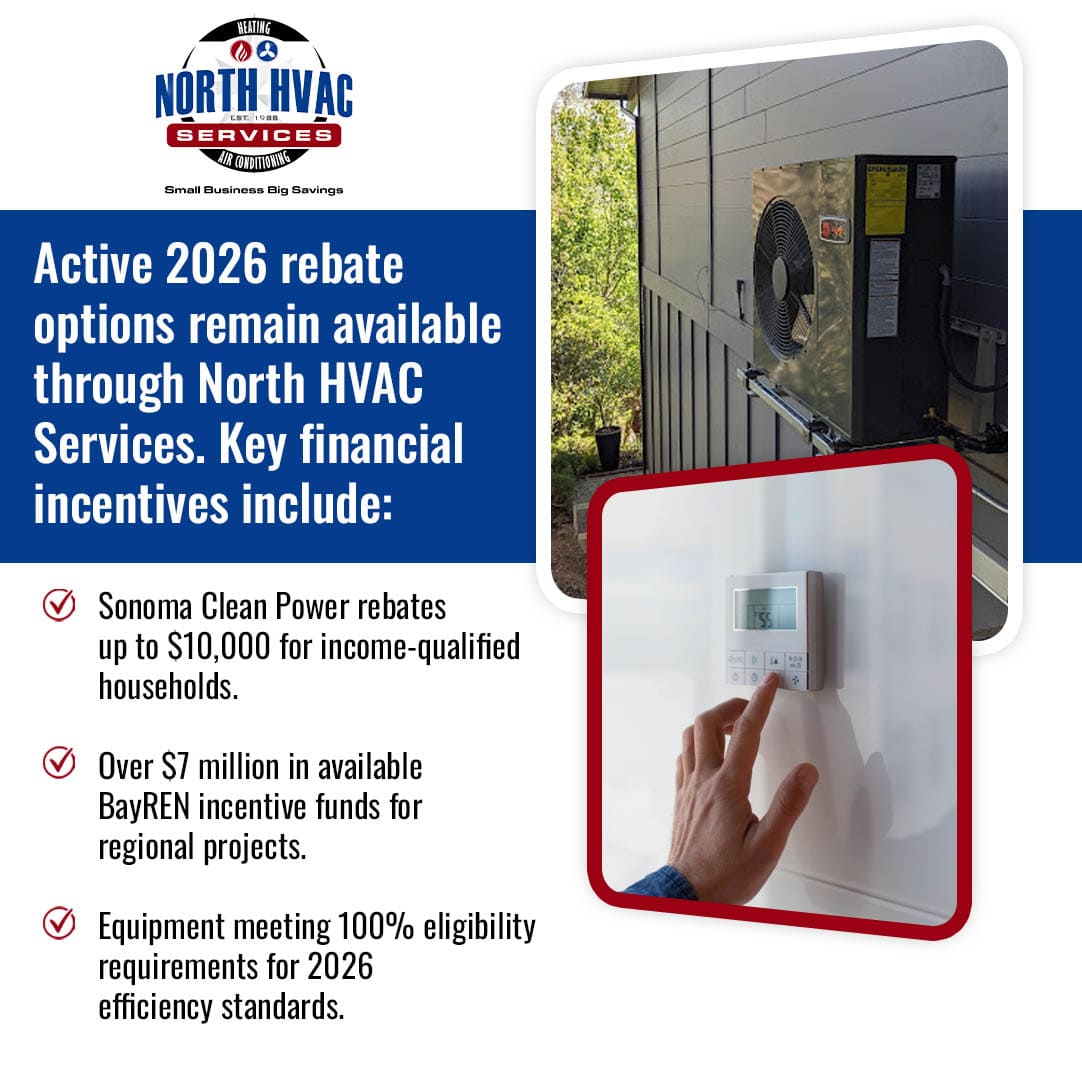
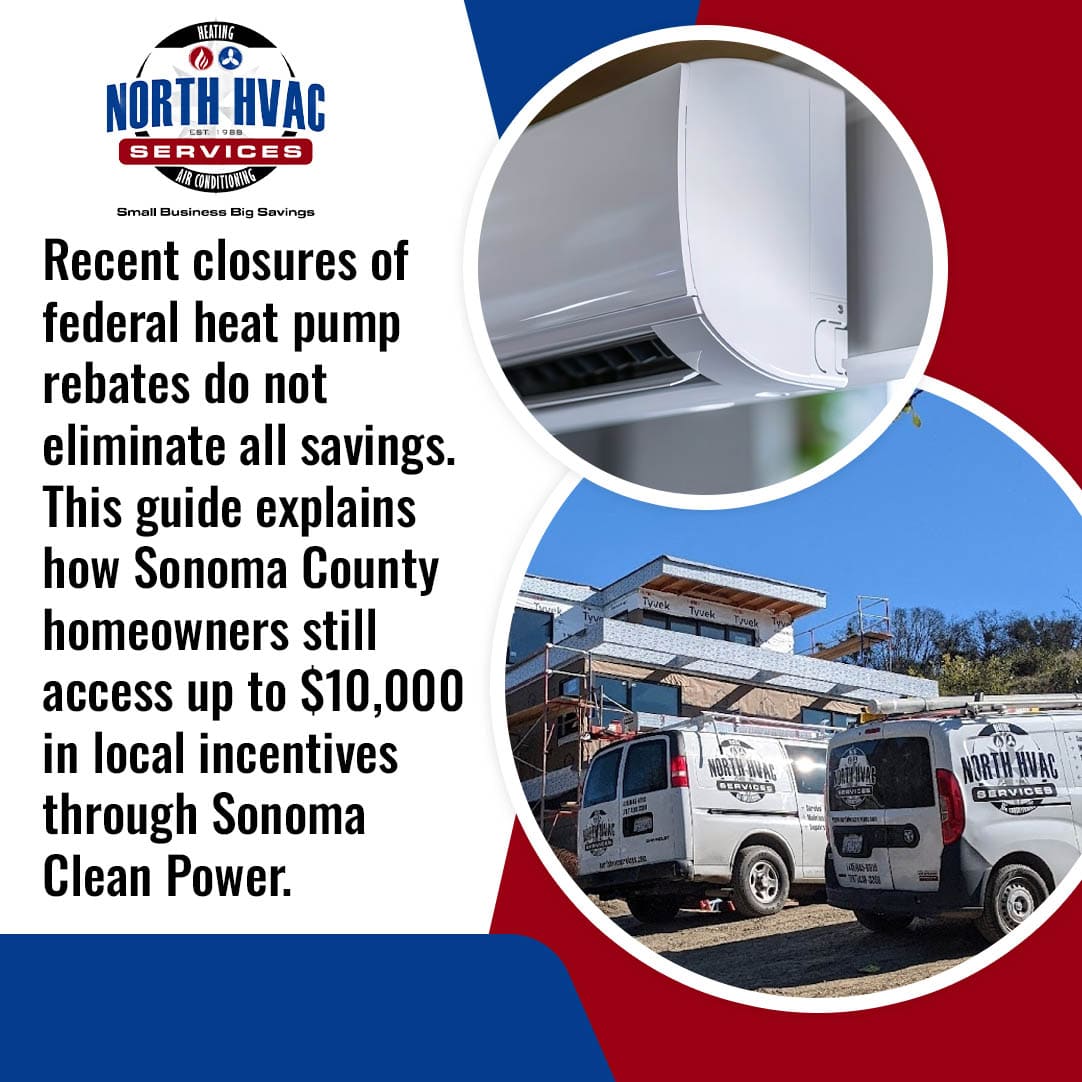
The California heat pump rebate landscape shifted dramatically in early 2026. TECH Clean California single-family programs closed to new reservations on February 24, 2026, and the federal 25C tax credit expired on December 31, 2025. Sonoma County homeowners still have access to meaningful financial support through Sonoma Clean Power rebates, BayREN programs, and local utility initiatives. North HVAC Services helps homeowners navigate these remaining incentive programs to reduce installation costs by $1,000 to $10,000, depending on income qualifications and project scope. This guide explains which programs remain active, how to qualify, and what documentation you need to secure available funding before current allocations run out.
Understanding What Changed in Early 2026
Two major rebate programs that drove heat pump adoption in California through 2025 are no longer accepting new applications. TECH Clean California placed all single-family heat pump HVAC reservations on a waitlist as of February 24, 2026, after distributing allocated federal Inflation Reduction Act funds. The California Energy Commission confirms that no new income verification applications are being processed for the Home Electrification and Appliance Rebates program statewide.
The federal government’s 25C Energy Efficient Home Improvement Credit ended on December 31, 2025. This tax credit previously provided up to $2,000 annually for qualifying heat pump installations. According to the Internal Revenue Service, homeowners who installed systems before the December deadline can still claim the credit on their 2025 tax returns filed in 2026, but new installations receive no federal tax benefit.
| Program Name |
Previous Benefit |
Current Status (April 2026) |
| Federal 25C Tax Credit |
Up to $2,000 for heat pumps / up to $3,200 total annually |
Expired Dec 31, 2025 |
| TECH Clean California |
Varies by program/equipment; approx: $3,000–$8,000 |
Fully reserved, waitlist only |
| HEEHRA Rebates |
Up to $8,000 income-based for qualifying heat pump HVAC |
Fully reserved statewide |
| Sonoma Clean Power |
$1,000–$10,000 depending on eligibility/project |
Active and accepting applications |
| BayREN Programs |
Varies by project |
Active in Sonoma County |
These closures do not mean homeowners lost all financial support for electrification projects. Local utility programs and regional energy networks continue operating with dedicated funding pools separate from the federal programs that reached capacity.
Sonoma Clean Power Rebates Still Available
Sonoma Clean Power maintains active rebate programs for residential customers in Sonoma and Mendocino counties who replace gas heating systems with electric heat pump installation technology. Standard rebates provide $1,000 back for qualifying heat pump heating and cooling systems that meet minimum efficiency thresholds.
Income-qualified households enrolled in California Alternate Rates for Energy (CARE) or Family Electric Rate Assistance (FERA) programs receive significantly enhanced support. These customers qualify for rebates covering 50% of total project costs, capped at $10,000. For a $15,000 project for heat pump services in Sonoma County, CARE or FERA participants would receive $7,500 back, reducing the out-of-pocket expense to $7,500.
Hydronic heat pump systems that provide both space conditioning and water heating in integrated packages qualify for up to $1,700 in standard rebates. Heat recovery ventilators that improve indoor air quality while maintaining system efficiency earn up to $1,000.
Program requirements from Sonoma Clean Power specify:
- The installation address must have an active Sonoma Clean Power account
- Heat pump systems paired with gas heating elements are ineligible
- Applications must be submitted within 90 days of project completion (typically the permit finalization date)
- Equipment must meet specified performance standards (minimum SEER2 and HSPF2 ratings)
- One rebate per equipment type per account number
Customers receive rebates after installation through a reimbursement process. Submit finalized permits, itemized invoices showing equipment specifications, and installation photos through the online rebate portal. Processing timelines typically run 60 to 90 days from complete application submission to check disbursement.
BayREN and Regional Programs in Sonoma County
The Bay Area Regional Energy Network operates programs across nine counties, including Sonoma. BayREN coordinates local utility incentives and provides additional funding layers that stack with Sonoma Clean Power rebates when both apply to the same project.
The City of Healdsburg administers its own rebate programs for residents pursuing heating and air conditioning upgrades. Healdsburg homeowners can apply for dedicated funding for heat pump water heating, heat pump space heating, weatherization improvements, and related efficiency measures. These city-level programs operate independently from broader county initiatives.
BayREN’s multifamily programs remain active with $7.4 million in unreserved incentive funds for program years 2026 and 2027. Properties with five or more dwelling units qualify for substantial electrification incentives, including $500 for in-unit electrical panel upgrades ($750 for low-income units) and $5,000 for central panel upgrades necessary to support heat pump equipment.
Income-qualified homeowners throughout Sonoma County access enhanced support through BayREN’s programs. The Clean HEET initiative provides $3,000 to $10,500 for replacing wood-burning stoves or fireplace inserts with heat pump installers completing electric heat pump conversions. Projects in areas most impacted by air pollution receive priority consideration due to limited funding availability.
Equipment Specifications That Qualify for Rebates
All active rebate programs require equipment meeting minimum efficiency standards established by the Department of Energy and ENERGY STAR certification programs. The efficiency metrics changed in January 2023 when new testing procedures took effect, creating SEER2 and HSPF2 ratings that more accurately reflect real-world performance.
SEER2 (Seasonal Energy Efficiency Ratio 2) measures cooling efficiency. According to the U.S. Department of Energy, the rating calculates total heat removed from conditioned space during an annual cooling season divided by total electrical energy consumed. Higher SEER2 numbers indicate a more efficient cooling operation.
HSPF2 (Heating Seasonal Performance Factor 2) measures heating efficiency. The rating represents total heating output in British Thermal Units divided by electricity consumption in watt-hours over a typical heating season. Split-system heat pumps require a minimum HSPF2 of 7.5 under current federal standards, though rebate programs often set higher thresholds.
Minimum efficiency requirements for Sonoma County rebate qualification:
| Equipment Type |
Minimum SEER2 |
Minimum HSPF2 |
Additional Notes |
| Ducted Split System |
15.2 |
8.1 |
ENERGY STAR requirement |
| Ductless Mini-Split |
16.0 |
8.5 |
Higher threshold for ductless |
| Single-Package Unit |
14.3 |
7.5 |
Federal minimum only |
| Hydronic System |
Varies |
8.0+ |
Combined heating/water heating |
Sonoma Clean Power accepts ENERGY STAR-rated equipment for standard rebates. CARE and FERA participants have expanded equipment eligibility that includes any ENERGY STAR certified model, regardless of specific SEER2 or HSPF2 numbers, provided the system meets basic program requirements.
Cold-climate performance matters in Sonoma County’s varied microclimates. Coastal areas experience different heating demands than inland valleys. Equipment rated for reliable heating output at outdoor temperatures down to 5°F performs better during winter cold snaps without requiring backup electric resistance heat that increases operating costs for your heat pump installation. North HVAC Services installs only ENERGY STAR certified equipment from manufacturers like Mitsubishi, Trane, and Day & Night that meet or exceed all Sonoma Clean Power rebate requirements.
Why Working With HVAC Contractors in Santa Rosa, CA, Simplifies Rebate Applications
Contractor selection directly affects rebate approval rates and application processing speed. HVAC contractors in Santa Rosa, CA, who regularly work with Sonoma Clean Power and BayREN programs understand documentation requirements, submission timelines, and common approval obstacles that delay reimbursement.
Established building department relationships
Local contractors maintain connections with Sonoma County permitting offices and understand workflows specific to Santa Rosa, Petaluma, Sebastopol, and other municipalities. They know which plan checkers require detailed load calculations versus simplified equipment specifications, and which inspectors focus on electrical service sizing versus refrigerant line installation details.
Climate-specific system sizing
Proper sizing requires Manual J load calculations that account for local conditions. Sonoma County’s geography creates significant variation between fog-influenced coastal zones and inland areas experiencing summer temperatures above 100°F. Contractors performing thousands of calculations across these microclimates deliver accurate sizing that prevents oversized or undersized installations that fail inspections or underperform.
Rebate program expertise
Experienced heat pump installers know exactly which documentation Sonoma Clean Power requires, how to format submissions correctly, and which common errors trigger application rejections. This knowledge accelerates processing and reduces back-and-forth with program administrators.
Fast response for post-installation verification
Utility program staff sometimes request additional documentation weeks after project completion, including supplemental photos, equipment serial numbers, or electrical panel specifications. Contractors operating locally can respond to these requests within 24 to 48 hours rather than coordinating multi-week return visits from distant service areas.
North HVAC Services has completed heat pump projects throughout Sonoma and Marin counties since 1988. Our technicians hold C-20 HVAC specialty licensing, EPA Section 608 refrigerant handling certification, and maintain Diamond Authorized Dealer status with Mitsubishi, plus Authorized Factory Dealer certifications with Trane and Day & Night. We submit Sonoma Clean Power rebate applications as part of project completion and can verify the current program funding status before installation begins.
Financing Options When Rebates Don’t Cover Full Costs
Sonoma County offers property-assessed financing through the Sonoma County Energy Independence Program. This voluntary assessment allows property owners to finance energy efficiency improvements through property tax payments spread over time.
The assessment attaches to the property rather than the individual owner, transferring to new buyers if the home sells before the assessment period concludes. Interest rates and terms vary based on project scope and property qualifications. Combining PACE financing with available Sonoma Clean Power rebates reduces immediate cash requirements while spreading remaining costs across multiple years.
GoGreenFinancing connects PG&E customers with lenders offering up to 100% financing for energy upgrades. Eligible improvements include electric appliances, building envelope improvements, clean energy systems, and HVAC equipment. Unlike PACE programs, traditional financing does not attach to property tax evaluations.
Many contractors offer equipment financing through manufacturer programs or third-party lenders. Mitsubishi, Trane, and Day & Night each provide financing options with varying interest rates and promotional periods. North HVAC Services helps customers compare contractor-arranged financing against county PACE programs and traditional home equity lines to determine the most cost-effective funding approach
Common Mistakes That Delay Rebate Processing
Homeowners pursuing Sonoma Clean Power rebates encounter several recurring obstacles that delay reimbursement or disqualify applications entirely. Understanding these pitfalls before starting your project protects your financial investment.
Most frequent rebate application errors:
- Missing the 90-day submission deadline – Sonoma Clean Power enforces this timeline strictly. Projects completed in January must have rebate applications submitted by early April. Missing this window forfeits the rebate entirely, regardless of equipment qualification or proper installation.
- Installing before verifying program funding – While Sonoma Clean Power programs remain active in April 2026, budget allocations operate on fiscal cycles. Confirming available funding before purchasing equipment prevents situations where installations are completed after program budgets are exhausted.
- Submitting incomplete documentation – Processing delays of 30 to 60 days occur when required items are missing. Applications need finalized building permits showing passed inspections, itemized invoices listing specific equipment model numbers and AHRI certification numbers, installation photos showing outdoor and indoor units, and proof of CARE or FERA enrollment for income-qualified applicants.
- Selecting non-qualified equipment – A $12,000 heat pump system delivering excellent performance still generates zero rebate funding if the SEER2 rating falls below program minimums or the manufacturer lacks ENERGY STAR certification. Always verify equipment model numbers against program requirements before signing purchase agreements.
- Working with inexperienced contractors – Contractors unfamiliar with Sonoma Clean Power application procedures often submit incomplete paperwork or miss critical documentation elements. Interview potential contractors about their experience with local rebate programs and request examples of successful recent submissions.
Start Your Heat Pump Project With North HVAC Services
Remaining rebate programs in Sonoma County operate with annual budget allocations that can be exhausted before the fiscal year-end. Historical patterns show that many utility incentive programs reduce available funding or close applications entirely during fourth-quarter budget cycles.
As a local heating and air conditioning service company in Petaluma, CA, we provide comprehensive home evaluations, including Manual J load calculations tailored to your property and Sonoma County’s varied microclimates. Our team explains which rebate programs apply to your situation, estimates total available incentives based on income qualifications, and handles all application documentation from initial filing through final reimbursement for your heat pump services in Sonoma County.
Schedule your evaluation by calling (415) 845-6910 or visiting our contact page with property details and questions about current rebate program availability.
We serve Santa Rosa, Petaluma, Rohnert Park, Sebastopol, Healdsburg, Sonoma, Novato, San Rafael, and surrounding Sonoma and Marin County communities with licensed C-20 HVAC services. Learn more about our heating services, heat pump installations, and maintenance programs that extend equipment lifespan and maintain peak efficiency long after rebate checks clear.