Aug 7, 2026 | HVAC, HVAC Maintenance
What Do Homeowners Usually Get Wrong About Emergency HVAC Repair Timing?
Most homeowners wait too long to call for emergency HVAC repair during extreme weather, often underestimating how quickly conditions can worsen if the system fails. Many also misjudge what actually qualifies as an emergency, sometimes calling too soon or not soon enough.
When an HVAC system shows signs of trouble during a heatwave or cold snap, some homeowners hope the issue will resolve itself or plan to wait until after the weather improves. This approach can lead to bigger problems—like complete system failure, increased repair costs, or even health risks if indoor temperatures become unsafe. Others mistake minor issues for emergencies, overwhelming service lines and delaying help for those in real need.
In Petaluma and surrounding areas, extreme weather can place immediate stress on HVAC equipment. North HVAC Services regularly receives calls from homeowners who waited until their system stopped working altogether, only to face longer waits and higher repair bills. Understanding the difference between minor issues and true emergencies—and acting quickly when needed—can save time, money, and comfort.
Why Waiting Too Long During Extreme Weather Can Backfire
Delaying emergency HVAC repair during extreme weather can quickly turn a manageable problem into a major crisis. The longer you wait, the more likely you are to experience complete system failure, property damage, or health concerns for your family or tenants.
In a heatwave, a struggling air conditioner can stop working entirely, allowing indoor temperatures to rise dangerously. High indoor temperatures put children, seniors, and pets at risk of heat exhaustion or heat stroke. During cold snaps, a failed furnace can lead to frozen pipes, water damage, and unsafe living conditions.
- Example: A homeowner in Sonoma County ignored a noisy AC for three days during a July heatwave. The unit failed on a 100°F afternoon, requiring a more expensive compressor replacement instead of a quick fix.
- Repair companies often have longer response times during extreme weather due to surging demand, especially if you wait until your system completely fails.
- HVAC systems working overtime in extreme conditions are more likely to suffer permanent damage if not serviced promptly.
The best approach is to call at the first sign of trouble, especially if you notice odd noises, weak airflow, or inconsistent temperatures. Acting fast can prevent discomfort and bigger expenses.
Are You Mistaking a Routine Issue for an Emergency?
Many homeowners confuse routine HVAC issues with emergencies, leading to unnecessary stress and higher service costs. Not every problem needs immediate, after-hours attention.
True emergencies involve situations where your safety, property, or business continuity is at risk. These include total loss of heating during a freeze, no cooling during a major heatwave, burning smells, smoke, or water leaks from your HVAC system. On the other hand, some issues are inconvenient but can wait for standard hours:
- Minor noise or vibration that does not increase or cause the system to shut down
- Reduced efficiency when the system still keeps up with demand
- Thermostat malfunctions that can be managed manually
If you’re not sure, ask yourself: Is anyone’s health at immediate risk? Is there active water or electrical damage? If not, a routine repair appointment is usually sufficient. North HVAC Services can help you assess over the phone whether your situation requires emergency action or if you can safely wait for regular service hours.
How Extreme Weather Exposes Hidden HVAC Problems
Extreme weather strains your HVAC system, often revealing hidden problems that weren’t obvious during milder conditions. Issues that may have seemed minor or gone undetected can escalate quickly when your system is working its hardest.
For example, a slightly clogged air filter or a weak blower motor might not cause noticeable issues during spring or fall. But during a high-demand heatwave or freeze, these problems can lead to sudden breakdowns. Other common hidden vulnerabilities include:
- Undetected refrigerant leaks that reduce cooling power under stress
- Electrical components that fail when the system cycles more frequently
- Blocked condensate lines that lead to water damage during heavy use
Regular maintenance is the best defense, but you should remain alert during extreme weather. If your system’s performance drops, call for help before a total failure occurs. North HVAC Services recommends scheduling a pre-season checkup to catch these problems before severe weather hits.
What Steps Should You Take Before Calling for Emergency HVAC Repair?
Before calling for emergency HVAC repair, you should do a quick self-check to rule out simple issues and avoid unnecessary costs. Here’s what to do:
- Check your thermostat—ensure it’s set to the correct mode (cooling or heating) and temperature
- Replace batteries in the thermostat if it’s not responding
- Inspect the circuit breaker—reset if it’s tripped
- Look for obvious blockages at vents or registers
- Check the air filter—replace if dirty or clogged
- Listen and look for unusual noises, smells, or water leaks
- Make note of any error codes or flashing lights on the HVAC unit
If you complete these checks and your system still doesn’t work—or you notice burning smells, smoke, or water leaks—call for emergency service immediately. Providing this information to North HVAC Services can help technicians arrive prepared and resolve your issue faster.
How Local Factors Affect the Urgency of Emergency HVAC Repair in Sonoma, Marin, and Napa Counties
Local climate, infrastructure, and population density all impact how urgent emergency HVAC repair can be in the North Bay area. Hot spells and cold snaps arrive quickly and can overwhelm older utility grids or HVAC systems, especially in rural areas.
- Wildfire smoke can further stress HVAC equipment and make indoor air quality a health concern, especially during summer.
- Rolling blackouts or power interruptions may complicate repairs or delay service if your system fails.
- Geography: Homes outside city centers may experience longer response times due to travel distances for technicians.
- Older buildings in Petaluma, Sonoma, or Napa often have legacy systems more prone to failure under strain.
During peak weather events, local HVAC companies like North HVAC Services can become fully booked within hours. If you’re a business owner or manage rental properties, quick action is especially important to protect your tenants and assets.
Emergency HVAC Repair: When to Call Immediately and When to Wait
You should call for emergency HVAC repair immediately if there is a risk to health, property, or business operations. If the issue is uncomfortable but not dangerous, you can often wait for regular service hours.
- Call immediately if:
- No heating during a cold snap (especially with vulnerable occupants)
- No cooling during a heatwave (indoor temps rising dangerously)
- Burning smells, smoke, or visible sparks
- Major water leaks from the HVAC unit
- Electrical problems causing the system to cycle on and off rapidly
- Wait (schedule regular repair) if:
- Minor noise or vibration without performance loss
- Slow cooling or heating but system is keeping up
- Thermostat misreads that are manageable
- System needs a filter change but otherwise operates normally
If you’re not sure, describe your problem clearly when you call (415) 845-6910—North HVAC Services will help you determine the right course of action.
How to Prepare for Future HVAC Emergencies Before Extreme Weather Hits
The best way to avoid emergency HVAC repair calls is to prepare your system and your household before the next heatwave or freeze. Here’s how:
- Schedule a professional HVAC inspection and tune-up each spring and fall
- Replace air filters every 1-3 months, or as recommended by your system manufacturer
- Test your system before each season to catch problems early
- Keep vents and registers clear of furniture, dust, and debris
- Learn how to reset breakers and thermostats
- Know your HVAC system’s age and any past repair history
- Keep the contact info for North HVAC Services handy for quick calls during emergencies
For business owners, consider setting up a maintenance contract or priority service agreement to minimize downtime and protect your operations during extreme weather.
Don’t let a small problem turn into a crisis when the temperature spikes or drops. If you’re facing urgent HVAC issues, call North HVAC Services at (415) 845-6910 for fast, professional emergency HVAC repair in Petaluma and the North Bay. Prepare now, and you’ll have peace of mind—no matter what the weather brings.
Frequently Asked Questions
What is considered an emergency HVAC repair during extreme weather?
An emergency HVAC repair is needed when your heating or cooling system completely stops working during a heatwave or cold snap, or if you notice signs like burning smells, electrical issues, or unsafe indoor temperatures. If your health or safety is at risk—such as infants, elderly, or medically sensitive people in the home—call for help right away.
How quickly should I call for HVAC repair if my system stops working in extreme temperatures?
You should call for emergency HVAC repair immediately if your system fails during extreme heat or cold. Delaying can lead to health risks, further damage to your equipment, and potentially more expensive repairs.
What are the risks of waiting too long to get emergency HVAC repairs?
Waiting too long can turn a small problem into a major one, possibly resulting in complete system failure, higher repair costs, or even property damage. North HVAC Services recommends acting quickly to avoid these complications and keep your home safe and comfortable.
How do I know if my HVAC issue is urgent enough for emergency service?
If your system is not producing any heat or cool air during severe weather, or if you notice smoke, strange noises, or electrical issues, it’s likely an emergency. For less urgent issues like minor noise or a clogged filter, regular service may be sufficient.
Can North HVAC Services help with emergency HVAC repairs in Petaluma?
Yes, North HVAC Services provides emergency HVAC repair in Petaluma and surrounding areas. If you’re experiencing an urgent problem, you can call (415) 845-6910 for prompt assistance.

Jun 3, 2026 | HVAC, HVAC Maintenance
Marin County businesses have a short pre-summer window: typically May through early June, to inspect and service commercial HVAC systems before peak cooling demand arrives. North HVAC Services walks through a 12-point maintenance checklist, explains what a licensed commercial inspection covers, and breaks down the cost difference between scheduled service and an emergency repair call. If your property hasn’t had a pre-season inspection this spring, act now – before your calendar fills and temperatures climb.
Why Marin County Summers Push Commercial Cooling Systems to the Limit
Marin County’s climate carries more complexity than a standard California summer. Coastal communities – Mill Valley, Sausalito, Tiburon – often stay cool through much of the day under the Pacific marine layer. But inland areas, including San Rafael and Novato, regularly see temperatures climb into the mid-to-upper 90s during July and August heat events, often within hours of a cool morning fog burn-off.
According to WeatherSpark’s climate data for San Rafael, the region’s hot season runs from late June through September, with peak afternoon temperatures typically occurring between 2 and 5 PM, precisely when retail floors, restaurant dining rooms, and office buildings carry their highest occupant loads.
Commercial rooftop units and split systems bear the full weight of that demand. Systems operating below capacity due to dirty coils, low refrigerant charge, or worn electrical components often fail during any early sustained heat event of the season. That pattern: deferred service meeting peak demand, is one of the most predictable causes of mid-summer HVAC failures in the North Bay.
The California Energy Commission’s Commercial End-Use Survey identifies HVAC systems, including space cooling, as among the top energy consumers in California’s commercial building sector. When systems aren’t properly maintained heading into summer, that cost reflects directly on monthly utility statements.
May and early June represent the right time to act. Service appointments are still available, replacement parts aren’t on backorder, and problems can be identified and resolved before summer heat puts systems under full load.

Your Pre-Summer Commercial HVAC Maintenance Checklist
Running through the following 12 tasks before summer arrives keeps systems operating at rated capacity and reduces the risk of unexpected downtime. Some items are appropriate for facility staff to handle. Others require a licensed, EPA-certified technician.
| Task |
Recommended Frequency |
Why It Matters |
| Air filter inspection and replacement |
Monthly to quarterly |
Restricted airflow forces systems to run harder and longer |
| Condenser coil cleaning |
Annually (pre-summer) |
Fouled coils reduce heat rejection and raise energy draw |
| Evaporator coil cleaning |
Annually |
Dirty coils cut cooling capacity and can cause system icing |
| Refrigerant level check and leak inspection |
Annually |
Low charge strains compressors and reduces cooling output |
| Electrical testing (contactors, capacitors, wiring) |
Annually |
Worn electrical parts are a leading cause of summer failures |
| Belt, motor, and bearing inspection |
Annually |
Mechanical wear causes inefficiency and unexpected shutdowns |
| Thermostat calibration and controls verification |
Seasonally |
Miscalibrated controls waste energy and reduce comfort consistency |
| Ductwork inspection for leaks and insulation gaps |
Every 2–3 years |
Leaky ducts can waste 20–30% of conditioned air before it reaches occupied zones |
| Condensate drain clearing |
Annually (pre-summer) |
Blocked drains cause water damage, mold growth, and system shutdowns |
| Damper function check |
Annually |
Failed dampers allow unconditioned air into occupied spaces |
| Outdoor unit clearance and debris removal |
Seasonally |
Blocked units overheat and lose efficiency under sustained load |
| Building automation system (BAS) verification |
Seasonally |
Incorrect scheduling and setpoints drive unnecessary energy costs |
Filter replacement, thermostat checks, and outdoor unit clearance are tasks facility staff can handle on a regular basis. Refrigerant handling, electrical diagnostics, and coil cleaning are a different matter. Under EPA Section 608 technician certification requirements, any technician who maintains, services, repairs, or disposes of equipment involving refrigerants must be certified – not just as a compliance formality, but to protect both the equipment and the people working on it.
What to Expect from Santa Rosa HVAC Contractors During a Commercial Tune-Up
A commercial HVAC inspection is a substantially different scope of work from a residential service call. Property managers who understand what a thorough inspection covers are far better positioned to evaluate proposals, ask the right questions, and hold contractors accountable for the work performed.
When Santa Rosa HVAC contractors arrive at a commercial property, a licensed technician should bring diagnostic tools capable of catching problems that a visual check alone would miss:
- Refrigerant analyzers to verify charge levels and detect active leaks
- Thermal imaging cameras to identify hot spots in electrical panels, ductwork, and mechanical components
- Amp draw meters to check that motors and compressors are operating within rated specifications
- Static pressure gauges to evaluate airflow distribution across duct systems
- Combustion analyzers for gas-fired rooftop units
Inspection duration depends on system count and size. A single packaged rooftop unit typically takes two to three hours. Properties with multiple zones should plan for a full-day engagement. Multi-building commercial portfolios often benefit from a service agreement that schedules inspections on a defined calendar throughout the year.
After the inspection, you should receive written documentation: a system condition report, photographs of components showing wear or failure, and a prioritized list of recommended repairs. That documentation supports capital planning conversations with ownership and protects property managers when tenants raise comfort complaints under their lease terms.
At North HVAC Services, our EPA-certified technicians provide written service reports on every commercial visit across Marin, Sonoma, and Napa counties. Clear documentation is a standard part of how we work – not an add-on.
The Real Cost of Skipping Summer HVAC Prep
Scheduling commercial HVAC maintenance before summer becomes a clear financial decision once you factor in what a mid-season failure actually costs – across emergency repairs, lost revenue, and accelerated equipment wear.
For restaurants, retail operations, and hospitality businesses, an HVAC failure during a July heat event doesn’t just create discomfort. A dining room reaching 85 degrees or a retail floor with no cooling drives customers out and, in some cases, forces a temporary closure. Emergency service calls carry premium rates, and parts availability during peak season can extend downtime by days.
On the energy side, the U.S. Department of Energy notes that simply replacing a clogged air filter with a clean one can lower an air conditioner’s energy consumption by 5 to 15 percent. Across an entire season of deferred maintenance – dirty coils, low refrigerant charge, worn components left unaddressed – the cumulative efficiency loss in commercial systems runs considerably higher. For a property operating multiple units through a full California cooling season, that gap shows up directly on monthly utility statements.
| Service Scenario |
Estimated Average Cost |
Notes |
| Scheduled annual tune-up (single unit) |
$150–$500 |
Per unit; varies by system size and contractor |
| Refrigerant recharge (per pound, R-410A) |
$100–$350 |
Higher when leak diagnosis and repair are included |
| Condenser fan motor replacement (emergency) |
$200–$500 |
After-hours and same-day labor premiums apply |
| Compressor replacement (mid-season failure) |
$800–$2,300+ |
Most costly single-component repair; commercial systems trend toward the higher end |
| Full rooftop unit replacement (emergency) |
$5,000–$15,000+ |
Varies by tonnage, brand, and installation complexity |
Cost estimates are based on HomeAdvisor HVAC repair data and industry cost references. Actual pricing varies by equipment type, location, labor rates, and emergency service requirements.
Property managers also carry lease and liability considerations. A documented service history is often the most straightforward line of defense when tenant comfort or air quality disputes arise under a lease agreement. Systems without regular service can accumulate microbial growth on coils and drain pans, circulating contaminants through occupied office and retail spaces – a detail that increasingly comes up in lease conversations and tenant health discussions.

How to Choose an HVAC Contractor in Santa Rosa, CA, for Your Business
Finding reliable service often starts with a search for HVAC service near you, helping you to connect with local professionals. That can return a list of options quickly. Knowing how to evaluate those results is what actually protects your property, your tenants, and your operating budget.
Here’s what to verify before committing to a service agreement:
- California C-20 license: HVAC contractors in California must hold a C-20 Warm-Air Heating, Ventilating, and Air-Conditioning license. Verify any contractor’s active status through the CSLB’s HVAC contractor licensing page, where you can confirm the license is current and in good standing.
- EPA Section 608 certification: Required by federal law for any technician handling refrigerants. This is a baseline requirement for commercial work, not a bonus credential.
- Manufacturer authorizations: Dealer authorizations from Trane, Mitsubishi, or Day & Night signal technicians trained to manufacturer service standards. North HVAC Services holds Authorized Factory Dealer status for both Trane and Day & Night, along with Diamond Authorized Dealer status for Mitsubishi: credentials that directly protect equipment warranties and confirm a higher level of technician training.
- Commercial liability insurance and bonding: Verify that coverage levels are appropriate for your property type and tenant occupancy.
- Service contract structure: Understand what the annual fee covers, what gets billed separately, response time commitments for emergency calls, and whether after-hours service is included.
- References from comparable commercial accounts: Experience with multi-unit commercial properties is meaningfully different from residential service work. Ask specifically for similar-sized commercial references.
Finding the right HVAC contractor in Santa Rosa, CA, for a commercial property takes more than checking a star rating. The credentials above represent the minimum standard for work that protects your equipment, your lease obligations, and the people inside your building.
How often should a commercial HVAC system be serviced?
Most commercial systems benefit from at minimum two inspections per year – one before the cooling season and one before the heating season. High-use applications, including restaurants, medical facilities, and 24-hour operations, often require quarterly visits to maintain performance and meet applicable health and safety requirements.
What does a commercial HVAC maintenance contract typically include?
A standard HVAC maintenance contract covers two scheduled inspections annually, filter replacements at each visit, coil cleaning, electrical component testing, refrigerant level verification, and priority scheduling for service calls. Many agreements also offer discounted labor and parts rates for repairs identified during planned inspection visits.
Can routine maintenance actually lower commercial energy bills?
Yes. Clean coils, properly charged systems, calibrated controls, and unobstructed airflow all contribute to a system running at rated efficiency. A system losing efficiency each year from deferred maintenance will show measurable cost differences on monthly utility statements – particularly across a full California cooling season.
Get Your Marin County Business Summer-Ready with North HVAC Services
The pre-summer service window in Marin County is short. Once late June arrives, booking a licensed commercial HVAC inspection becomes considerably harder, and waiting becomes more expensive.
North HVAC Services has served commercial and residential clients across Marin, Sonoma, and Napa counties since 1988. Our team includes EPA-certified technicians, Authorized Factory Dealers for Trane and Day & Night, and Diamond Authorized Dealer status for Mitsubishi – meaning every inspection is backed by manufacturer-trained technicians, not just general trade knowledge.
To schedule your pre-summer commercial inspection, explore our commercial HVAC services and maintenance tune-up programs, or request a maintenance contract quote. Call us directly at (415) 845-6910 (Marin County); (707) 430-3360 (Sonoma County) or email northhvacservices@gmail.com. You can also visit our Contact Page to get started. Your cooling season is coming – let’s get ahead of it.
May 27, 2026 | AC Maintenance, AC Repair, HVAC Maintenance
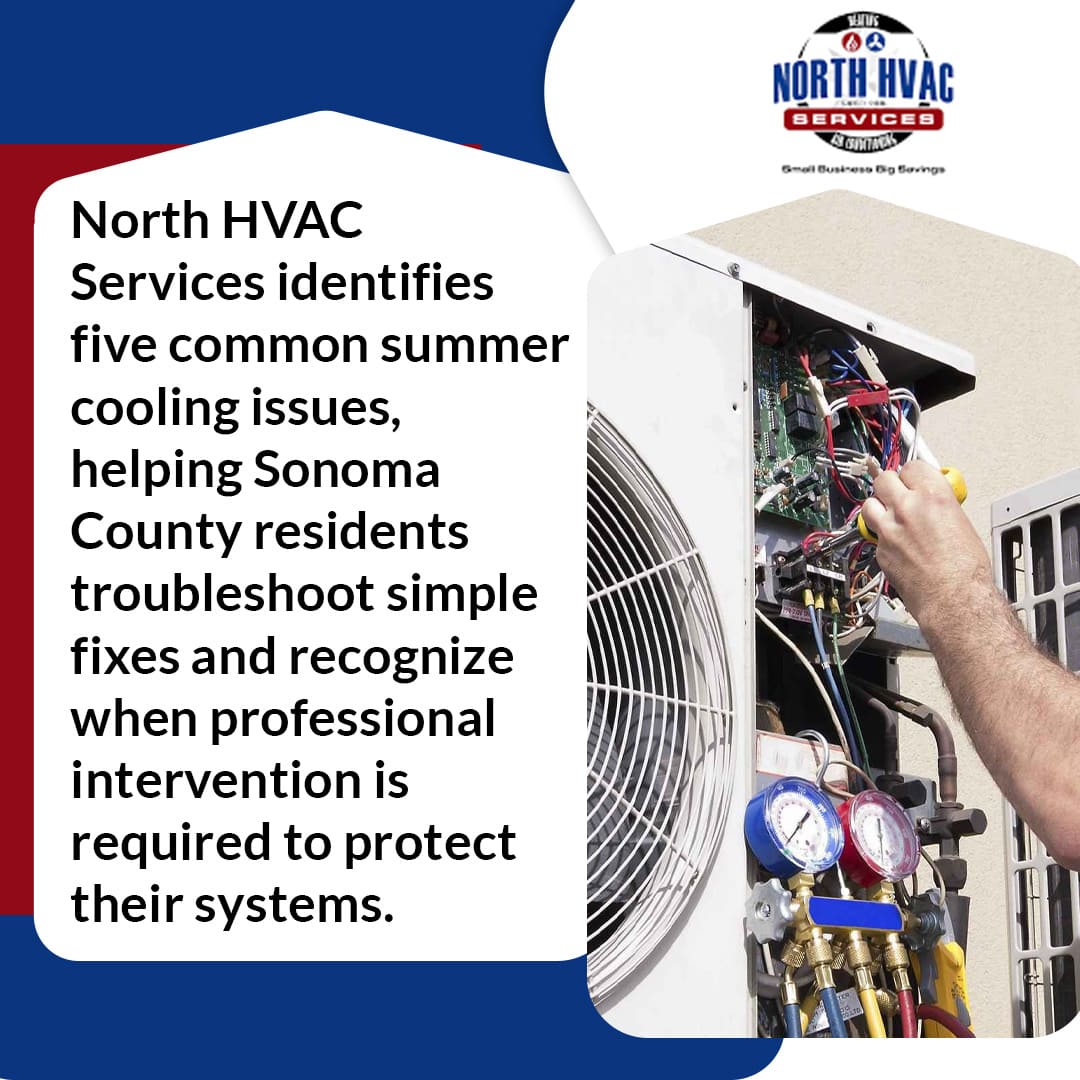
When your air conditioner starts pushing warm air on a hot Petaluma afternoon, the issue typically traces back to one of five causes: incorrect thermostat settings, a clogged air filter, low refrigerant from a leak, a frozen evaporator coil, or a failing outdoor unit. This guide walks Sonoma County homeowners through each cause, what to check before picking up the phone, and when the situation calls for a licensed technician. North HVAC Services has been diagnosing and solving these issues across Petaluma and the surrounding area since 1988.
How Petaluma’s Summer Climate Puts Pressure on Home AC Systems
Requests for air conditioning repair in Santa Rosa, CA, spike sharply between late July and September, when back-to-back heat days push aging systems past their limits. Petaluma sits in a climate zone that feels mild for most of the year – until peak summer arrives and the conditions become less forgiving for aging or undermaintained cooling systems.
According to WeatherSpark’s year-round climate data for Petaluma, summer daily highs climb from around 76°F in early summer to 83°F by mid-season, with temperatures occasionally spiking close to 93°F. September tends to deliver the hottest stretches of the year – a detail that catches some homeowners off guard after a relatively mild July and August.
For homes with AC systems that are 10 years or older, those extended heat events are where performance failures concentrate. Compressors run harder and longer. Filters that were borderline in April become fully restricted by late summer. Refrigerant lines under sustained thermal stress are more likely to develop small leaks.
According to the U.S. Energy Information Administration, air conditioning accounted for roughly 19% of all residential electricity consumption in U.S. homes as of 2020 – and that share climbs sharply during summer months in transitional climate zones like Sonoma County, where the swing between cool morning temperatures and hot afternoons is steeper than coastal areas. A system working overtime to compensate for an underlying issue is not only failing to cool your home – it’s running up your utility bill at the same time.
Warm air from your vents is rarely a sudden failure. It’s usually the visible symptom of a problem that has been developing over one or more seasons of deferred maintenance.
Top Causes Behind Air Conditioning Repair in Santa Rosa, CA
There is no single reason an AC stops cooling. The specific cause depends on the system’s age, when it was last serviced, and how hard it has been running. The five issues below account for most warm-air service calls across Petaluma and Sonoma County each summer.
| Cause |
What You’ll Notice |
Likely Fix |
| Dirty or clogged air filter |
Weak airflow, warm air, system runs non-stop |
Replace the filter ($10–$20) |
| Thermostat set to “fan only” mode |
Air circulates but the space never cools |
Switch to “cool” mode; verify the temperature setpoint |
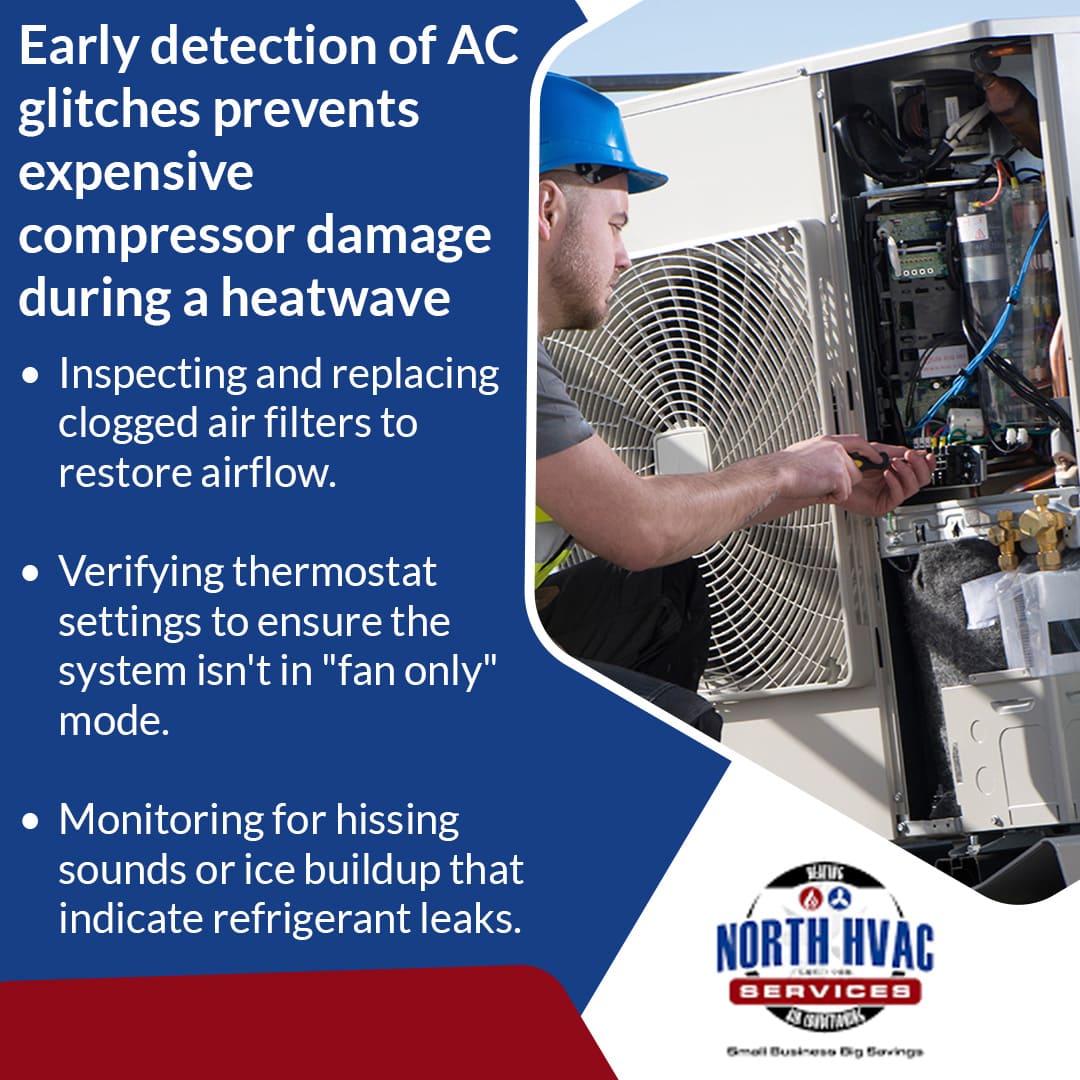
| Low refrigerant from a leak |
Warm air, hissing sound, ice on refrigerant lines |
Professional leak repair and refrigerant recharge |
| Frozen evaporator coil |
Weak airflow, visible ice on indoor unit |
Turn the system off, allow full thaw, address the root cause |
| Failing outdoor condenser unit |
No cooling at all, outdoor fan not running |
Check the breaker; call a licensed technician if the issue persists |
A few important points on the more serious causes:
- Refrigerant leaks should not be treated as a typical DIY repair. Section 608 of the Clean Air Act establishes the EPA’s National Recycling and Emission Reduction Program, which requires that anyone purchasing or handling refrigerants in AC systems hold a valid Section 608 certification. Only certified technicians can legally recover, recycle, or recharge refrigerant. Attempting refrigerant work without proper equipment risks additional system damage and regulatory violations.
- Frozen evaporator coils are a downstream symptom – typically caused by a clogged filter, low refrigerant, or restricted airflow rather than a standalone part failure. Thawing the coil without addressing the underlying cause will produce the same result within days.
- System age matters across all five issues. A unit 12–15 years old with deferred maintenance is far more likely to present multiple compounding problems in the same service call.
Easy Checklist Before Calling for Santa Rosa AC Repair
Before searching online for AC repair near you and waiting on hold during a busy summer stretch, run through these steps first. Several common warm-air causes resolve without a service call.
- Check the thermostat. Confirm the system mode is set to “cool,” not “fan” or “heat.” Verify the setpoint temperature is lower than the current room temperature. Replace the batteries if the display looks dim or slow to respond.
- Inspect the air filter. Locate the filter at your return air vent or air handler cabinet. Pull it out and hold it up to a light source. If light doesn’t pass through clearly, it needs replacing. A new filter costs $10–$20 and can restore normal airflow immediately. This single step resolves a significant share of warm-air complaints.
- Check your breaker panel. Look for a tripped breaker labeled “AC,” “air handler,” or “condenser.” A tripped breaker sits between the full on and off positions rather than snapping cleanly to either side. Reset it once and watch the system. If the breaker trips again within a few minutes, stop. That signals an electrical fault requiring a licensed technician, not another reset.
- Inspect the outdoor unit. Walk outside and look at the condenser. Clear away any debris: leaves, grass clippings, or overgrown shrubs within 2 feet of the unit on all sides. Check the refrigerant lines running to the unit for ice buildup. If you see ice, turn the system fully off and allow it to thaw before restarting.
- Listen carefully. A hissing or bubbling sound typically points to a refrigerant leak. Grinding or squealing from the indoor blower usually indicates a motor or belt problem. Repeated clicking that doesn’t stop is a common sign of a relay or capacitor issue.
- Restart the system. Set the thermostat to “off,” wait 5 minutes, and return it to cooling mode. This allows system pressures to equalize and occasionally resolves a short-cycling event caused by a temporary pressure spike.
When to stop and call a professional: If the system still isn’t cooling after these checks, or if you notice ice buildup, unusual smells, or an electrical problem, do not proceed further. Refrigerant handling, sealed system repairs, and electrical diagnostics require professional tools and certified training. Proceeding without them risks additional component damage and can void your equipment warranty.
When Warm Air Means You Need AC Repair Services in Santa Rosa, CA
Some symptoms cannot be resolved with a filter swap or thermostat adjustment. The warning signs below point to a deeper system problem – and waiting through a summer to address them typically raises the total repair cost.
| Warning Sign |
What It Likely Means |
| Ice on refrigerant lines or the indoor unit |
Refrigerant leak or severely restricted airflow |
| Hissing or bubbling sounds during operation |
Active refrigerant leak in the sealed system |
| Electrical or burning smell from any component |
Wiring failure or motor overheating |
| Short cycling (system turns on and off repeatedly) |
Refrigerant issue, oversized unit, or early compressor failure |
| Water pooling around the indoor air handler |
Clogged condensate drain or frozen coil actively thawing |
What does professional AC repair cost in California? According to HomeAdvisor’s HVAC Repair Cost Guide, most homeowners spend an average of $350 on HVAC repairs, with typical costs ranging between $130 and $2,000, depending on the component involved and the complexity of the repair. More involved repairs, such as refrigerant leak work, evaporator coil replacement, or compressor service, can push costs toward the higher end of that range or beyond. In California, where labor rates and refrigerant prices are elevated due to the EPA’s AIM Act phasedown of older refrigerant types, homeowners with aging systems should expect costs that reflect current market conditions. The timing of Santa Rosa AC repair also matters. Summer peak scheduling means longer wait times and, in some cases, higher emergency service rates.
The cost of delay compounds quickly. A slow refrigerant leak accelerates compressor wear over weeks. A partially frozen coil that keeps running further restricts airflow each day. Short cycling stresses the compressor, capacitors, and contactor simultaneously. A repair that costs $400–$600 in spring can become a $2,000+ problem if a system limps through an August heat stretch without service.
North HVAC Services diagnoses the actual issue, not just the symptom, and provides a clear assessment before any repair work begins. We’ve served Petaluma and Sonoma County homeowners since 1988, and that doesn’t change based on what the estimate looks like.
Preventive Steps That Keep Your AC Cooling All Summer
Homeowners who rarely deal with mid-summer breakdowns have one thing in common: they service the system before the cooling season begins, not after something stops working.
Annual spring tune-up. A pre-season inspection allows a technician to check refrigerant levels, clean the evaporator and condenser coils, test capacitors and electrical contactors, and flag anything that’s wearing out before it fails under load. This is also often a warranty condition. Many equipment manufacturers require documented annual maintenance to keep coverage valid.
Filter replacement schedule. Filters should be replaced every 1–3 months during periods of heavy use. Homes with pets, allergy sensitivity, or smokers benefit from monthly replacement. A clean filter maintains airflow efficiency, which directly affects both how well the system cools and how long it lasts before needing compressor work.
Outdoor unit clearance. Keep at least 2 feet of clear space around the condenser on all sides and trim back plants through the summer. After storms or high-wind events, check for debris in or against the unit before restarting.
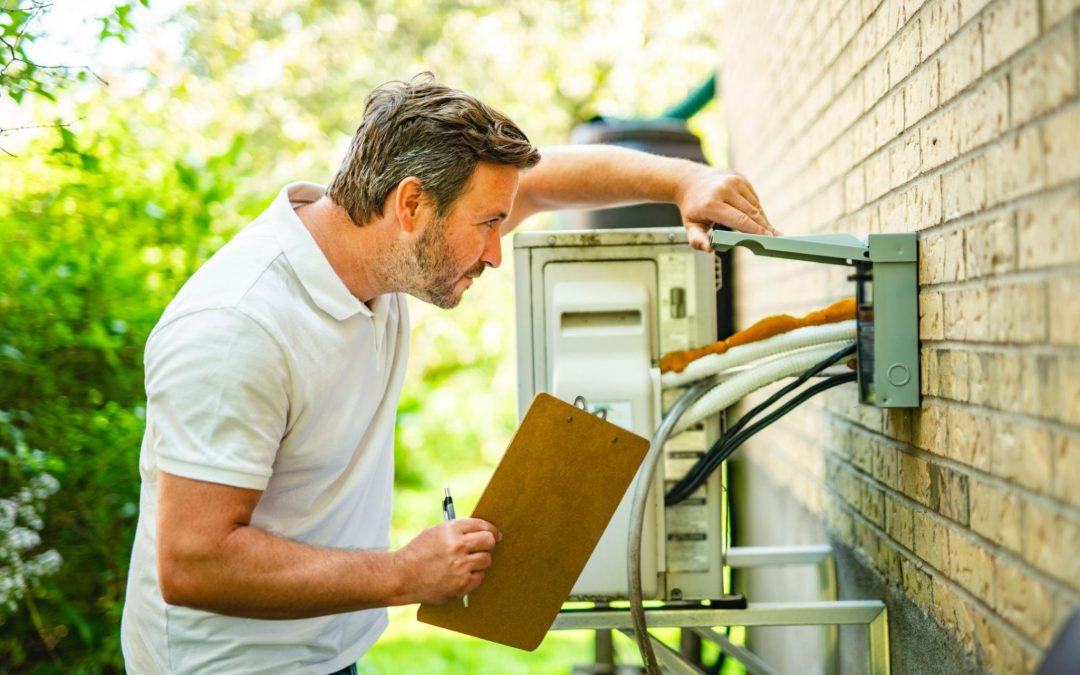
Maintenance contracts and local AC services. A scheduled maintenance agreement means your system gets a professional inspection before each season: automatically, without relying on memory during a busy spring. It also typically shortens response time during peak demand. Searching for air conditioner repair near you in mid-July, when every HVAC company in Sonoma County is running a full schedule, is a situation proactive maintenance helps you avoid entirely. Our team at North HVAC Services offers maintenance plans specifically designed for homes in our service area, and scheduling AC repair services in Santa Rosa, CA, before the summer rush starts means faster appointments and lower overall costs. Contact us for details.
Common Questions and Answers
How often should I service my AC?
Once per year is the standard recommendation for a well-maintained air conditioning system, ideally in spring before cooling demand increases. Homes with older equipment, heavy AC usage, or recurring performance issues may benefit from additional inspections during the year to identify wear and potential problems before they lead to breakdowns.
Can a dirty filter really make my AC blow warm air?
Yes, and it happens more often than homeowners expect. A clogged filter restricts airflow across the evaporator coil. Without adequate airflow, the coil cannot absorb heat from your home’s air effectively, so the system circulates air that stays at or above room temperature. In more severe cases, restricted airflow causes the coil to drop below freezing and ice over completely, stopping the cooling process until the ice thaws and the filter is replaced.
Is it cheaper to repair or replace an older AC unit?
A widely used benchmark is the 50% rule: if a repair estimate exceeds 50% of the cost of a comparable new system, replacement typically offers better long-term value, particularly for units that are already 10–12 years old or carrying deferred maintenance. A local AC services provider can walk you through that comparison on-site before you commit to either option, giving you the actual numbers rather than a guess.
Stay Cool This Summer – Schedule Your AC Inspection with North HVAC Services
If your AC is blowing warm air, struggling to keep pace during the afternoon heat, or showing any of the warning signs covered here, a professional inspection is the right next step, before the problem grows into a larger repair or a full system replacement. North HVAC Services is a family-owned HVAC contractor serving Petaluma, Santa Rosa, Sonoma, Marin, and Napa counties. Our EPA-certified technicians are trained to diagnose and repair all makes and models. As a Diamond Authorized Dealer for Mitsubishi and an Authorized Factory Dealer for Trane and Day & Night, we have direct access to factory-backed parts and manufacturer support your system deserves.
Call us at (415) 845-6910 (Marin County); (707) 430-3360 (Sonoma County) or email northhvacservices@gmail.com to schedule an inspection, request an estimate, or ask about our maintenance programs:
Apr 10, 2026 | HVAC, HVAC Maintenance
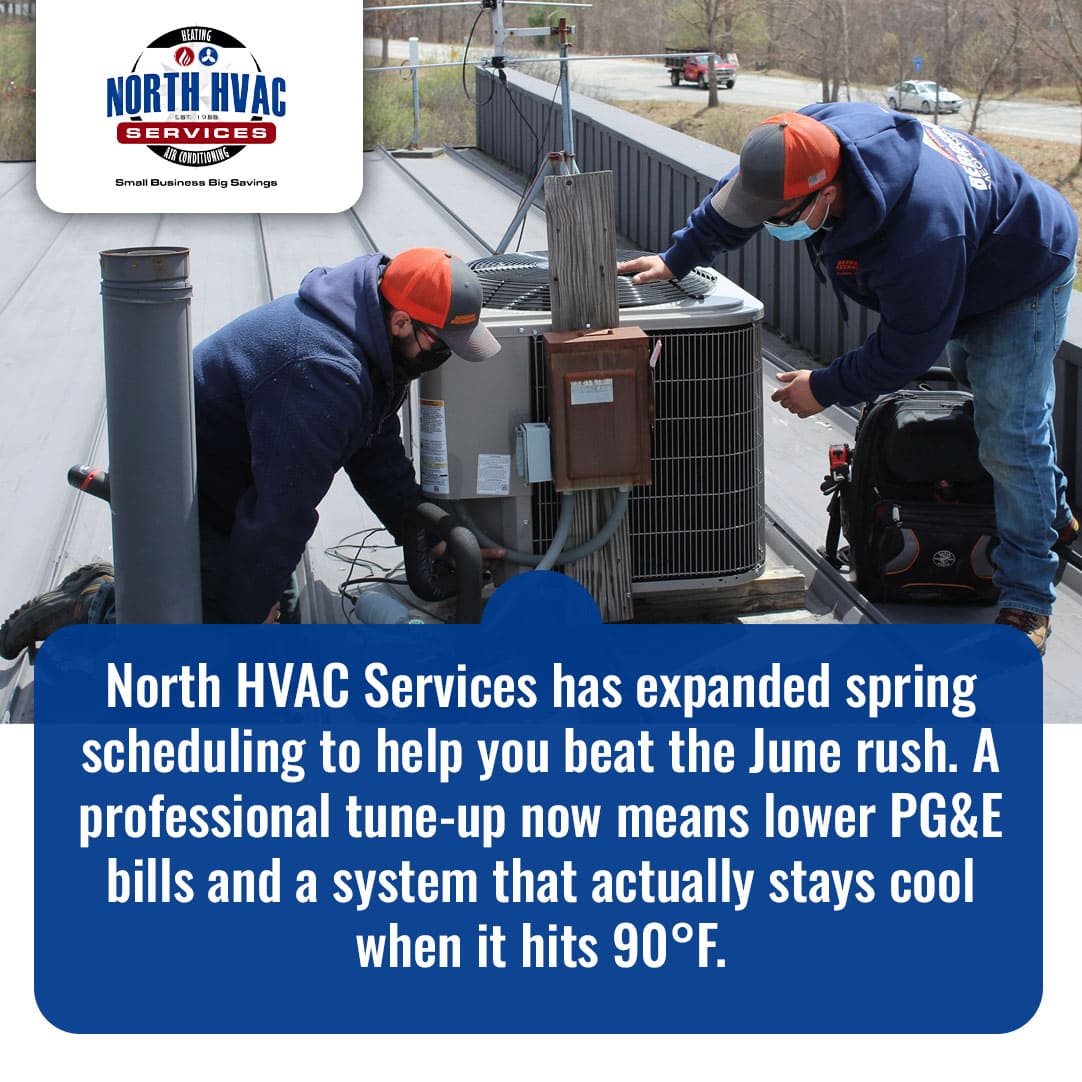
Spring represents the ideal window for air conditioning preparation in Santa Rosa, yet many homeowners delay servicing until temperatures spike. This timing difference often determines whether families enjoy uninterrupted cooling comfort or face emergency repair costs during Sonoma County’s hottest weeks.
Understanding when and how to service your cooling system can prevent the common scenario of discovering equipment failures on the year’s initial 90-degree day. North HVAC Services has observed consistent patterns in seasonal service demand that reveal why March and April appointments deliver better outcomes than waiting until summer arrives.
Why AC Maintenance Should Begin in March, Not June
The calendar matters more than homeowners realize when scheduling air conditioning service. Santa Rosa’s climate creates specific timing advantages that disappear once summer heat arrives.
Service Availability and Wait Times
March through early May represents the window when HVAC contractors maintain normal scheduling capacity. According to the U.S. Department of Energy‘s residential HVAC maintenance guidelines, preventive maintenance scheduled during off-peak periods allows for thorough inspections without the time pressures of emergency summer calls.
During the spring months, homeowners typically schedule appointments within 3-5 business days. By mid-June, that timeframe extends to 2-3 weeks as contractors work through backlogs of emergency calls. This delay means living without cooling during peak heat rather than addressing issues before they impact comfort.
Temperature Pattern Considerations
Historical climate data from Weather Spark for Santa Rosa shows the city typically reaches its first 85°F+ day between late April and mid-May. The first 90°F+ day usually occurs in late May or early June. Systems that haven’t operated for 6-8 months face higher failure rates during these initial startup cycles.
Equipment dormancy creates specific stresses. Refrigerant settles, lubricants thicken, and electrical components experience voltage surges after extended inactivity. Testing systems in March allows time to address these issues before they cause failures during actual cooling demand.
Parts and Supply Chain Factors
Spring service appointments benefit from full parts inventory at suppliers. Common components like capacitors, contactors, and fan motors are stocked at normal levels. Summer emergency repairs often require overnight shipping or multi-day waits for specialty parts, particularly for older system models.
What Professional Air Conditioner Maintenance Includes: The Complete 22-Point Inspection
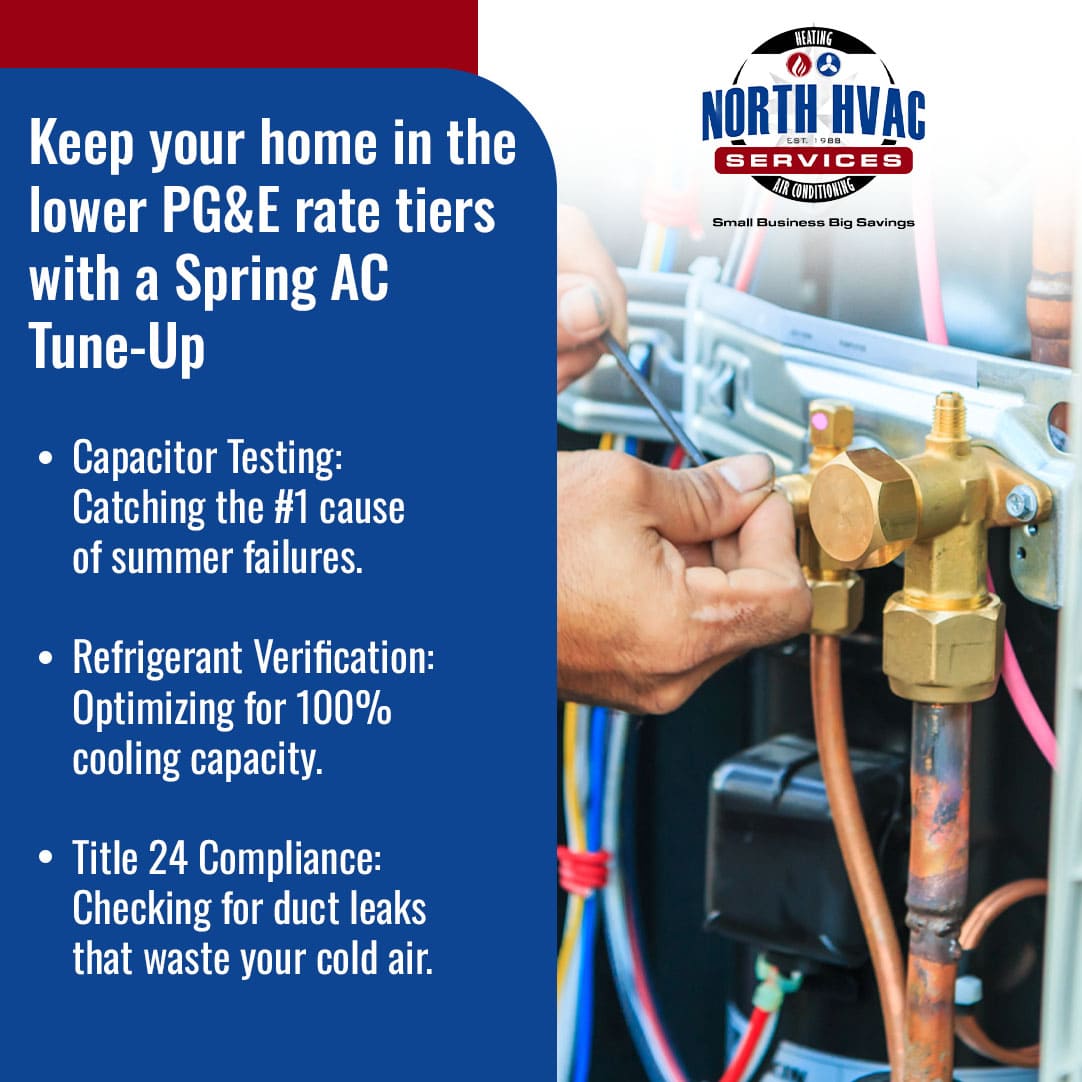
Thorough “AC service near me” searches should identify contractors who perform systematic evaluations rather than cursory checks. Professional AC maintenance involves specific measurements and tests that homeowners cannot replicate with basic tools. North HVAC Services technicians follow manufacturer-specific protocols for each system brand we service.
Refrigerant System Verification
Technicians measure refrigerant charge using superheat and subcool calculations specific to each system’s design. Incorrect refrigerant levels reduce efficiency by 20% and accelerate compressor wear. This process requires specialized gauges and manufacturer specifications that vary by equipment brand and model.
Low refrigerant always indicates a leak, as systems are sealed and should never need “recharging” under normal operation. Professional service locates and repairs leaks rather than simply adding refrigerant that will leak out again.
Electrical Component Testing
Capacitors represent the most common failure point in air conditioning systems. These components provide starting and running voltage to motors but degrade over time regardless of usage. Testing reveals capacitance values before failures occur, preventing the $300-500 emergency service calls that result from capacitor-related breakdowns.
Contactors, relays, and wire connections undergo visual inspection and voltage testing. Pitted contactors or loose connections create resistance that generates heat, leading to component failures during high-demand periods.
| Component |
Normal Service Interval |
Failure Impact |
| Capacitors |
5-7 years |
System won’t start or runs inefficiently |
| Contactors |
10-12 years |
Prevents compressor operation |
| Condenser Fan Motor |
10-15 years |
Overheating and compressor damage |
| Evaporator Coils |
Clean annually |
30% efficiency loss when dirty |
Coil Cleaning and Airflow Measurement
Both evaporator (indoor) and condenser (outdoor) coils require cleaning to maintain heat transfer efficiency. Dirty coils force systems to run longer cycles to achieve set temperatures, increasing energy consumption and component wear.
Airflow measurement across the evaporator coil verifies proper CFM (cubic feet per minute) delivery. Systems designed for 400 CFM per ton of cooling capacity but delivering only 300 CFM indicate ductwork restrictions, undersized returns, or blower issues requiring correction.
Thermostat Calibration and Documentation
Thermostat sensors drift over time, causing temperature discrepancies between displayed and actual room conditions. A thermostat reading 72°F while the actual temperature measures 75°F forces systems to short-cycle without achieving comfort.
Professional service includes documentation of all measurements: refrigerant pressures, electrical voltages, temperature differentials, and airflow readings. This baseline data allows future comparisons that identify developing problems before they cause failures.
Common Problems Found During Santa Rosa AC Repair Inspections
Spring inspections consistently reveal issues that would cause mid-summer breakdowns if left unaddressed. Understanding these patterns helps homeowners recognize warning signs earlier.
Capacitor Degradation
Capacitors fail more frequently than any other air conditioning component. These cylindrical components store electrical charge to start and run motors, but their capacitance degrades approximately 5-7% annually regardless of system usage.
When capacitance drops below equipment specifications, motors struggle to start or run inefficiently. This creates amperage draw increases that accelerate compressor wear and can cause complete motor failures requiring expensive replacements. North HVAC Services carries common capacitor sizes on every service vehicle to provide same-visit replacements when needed.
Refrigerant Leaks and System Impact
The Environmental Protection Agency regulates refrigerant handling through Section 608 regulations due to environmental concerns, but leaks also create significant cost implications for homeowners. Systems low on refrigerant run longer cycles, consume more energy, and risk compressor damage from inadequate cooling.
Older systems using R-22 refrigerant face particularly high repair costs, as this phased-out refrigerant now costs $80-150 per pound compared to $20-30 for newer R-410A. A system requiring 3-4 pounds of R-22 to recharge may cost more than replacing the entire unit with modern equipment.
Compressor Starting Issues
Compressors that show hard-start characteristics during spring testing typically fail within the first month of regular summer operation. This condition develops when internal components wear, requiring more starting torque than capacitors can provide.
Adding hard-start kits can extend compressor life temporarily, but these symptoms often indicate replacement should occur on the homeowner’s timeline rather than during an emergency situation when options and negotiating power decrease.
Condensate Drainage Problems
Air conditioner maintenance must address the water removal systems that prevent flooding. Evaporator coils remove humidity from indoor air, generating 5-20 gallons of water daily during summer operation. This condensate drains through pipes that can develop blockages from algae growth, debris, or installation issues.
Blocked drains cause water backups that damage ceilings, walls, and flooring. Secondary drain pans and safety switches can prevent damage, but don’t address the underlying blockage requiring professional cleaning.
| Common Issue |
Typical Discovery Time |
Prevention Method |
| Capacitor failure |
During first hot-weather operation |
Annual spring testing and replacement |
| Refrigerant leaks |
When cooling becomes inadequate |
Pressure testing during tune-ups |
| Drain blockages |
After water damage occurs |
Annual drain cleaning and biocide treatment |
| Compressor wear |
Mid-summer breakdown |
Electrical testing and starting current measurement |
Ductwork Air Leaks
Even as California pours billions into clean energy and home efficiency, many houses lose a large portion of heated and cooled air through leaky, unsealed ductwork before it can be used indoors. This represents substantial wasted energy and reduced comfort.
Spring service should include duct inspection in accessible areas. Connections at registers, return grilles, and equipment often develop gaps that worsen over time from building settlement and temperature cycling.
DIY Pre-Season Checklist: What Homeowners Can Do Before Professional Service
Homeowners can perform basic preparation tasks that improve system performance and help professional technicians work more efficiently during scheduled maintenance appointments.
- Outdoor Unit Clearing: Condenser units require unrestricted airflow to reject heat effectively. Remove leaves, grass clippings, and debris from fins using a garden hose spray (never pressure washers, which bend delicate fins). Trim vegetation, shrubs, and tree branches to provide 24 inches of clearance on all sides of the unit.
Check that the concrete pad beneath the unit remains level. Settling that causes tilting can stress refrigerant lines and affect proper drainage from the unit.
- Air Filter Management: Standard 1-inch pleated filters require monthly inspection and replacement every 1-3 months, depending on household conditions. Homes with pets, construction projects, or high dust exposure need more frequent changes.
Dirty filters restrict airflow, forcing blower motors to work harder and reducing system capacity. A system designed to cool a home to 72°F might only achieve 75°F when filters are severely clogged.
- Indoor Register Maintenance: Walk through your home, checking each supply register (where cool air blows out) and return grille (where air returns to the system). Remove any furniture, drapes, or storage items blocking airflow. Vacuum register faces to remove dust buildup.
Close inspection often reveals temperature differences between rooms that indicate ductwork issues requiring professional assessment. One bedroom is significantly warmer than the others suggests supply duct problems affecting that area.
- Thermostat System Check: Replace thermostat batteries annually, even if low-battery warnings haven’t appeared. Test cooling mode by setting the temperature 3-4 degrees below the current room temperature and verifying the system starts within 30-60 seconds.
Listen for unusual sounds during startup and operation. Grinding, squealing, or banging noises indicate mechanical issues requiring immediate AC repair in Santa Rosa before continued operation causes additional damage.
Energy Efficiency Gains from Spring AC Tune-Ups
Regular maintenance delivers quantifiable energy savings that offset service costs while reducing environmental impact. Being aware of these benefits helps homeowners evaluate the return on investment from seasonal servicing.
Efficiency Degradation Patterns
A long-term field study of 56 Florida homes found that air conditioner and heat pump performance often declined over time, with many systems degrading by about 5% per year. A system operating at 95% of design efficiency in year two drops to 90% in year three without maintenance.
This degradation compounds over time. After five years without service, a system might operate at only 75-80% of its original efficiency, consuming 20-25% more electricity to provide the same cooling output. On a $200 monthly summer cooling bill, that represents $40-50 in unnecessary costs.
PG&E Rate Structure Considerations
Santa Rosa residents served by PG&E face electricity rates that can vary based on usage, season, and time of day. PG&E’s current residential summer pricing spans from roughly the low 30-cent range to just over 50 cents per kWh, depending on the rate plan and usage level.
Well-maintained systems that run more efficiently keep households in lower rate tiers, creating savings that exceed the direct energy consumption reduction. A system using 15% less electricity might reduce costs by 20-25% if that reduction prevents tier escalation.
SEER Rating Preservation
Air conditioners carry Seasonal Energy Efficiency Ratio (SEER) ratings indicating their efficiency under ideal conditions. A system rated 16 SEER delivers that efficiency only when properly maintained. Dirty coils, low refrigerant, or restricted airflow can reduce effective SEER to 12-13, equivalent to operating a much older, less efficient unit.
California Rebate and Incentive Programs
California property owners may be eligible for HVAC and home-energy rebates through utility programs, state-administered initiatives, and, in some areas, local air districts. Rebate requirements vary by program, but they often involve proof of purchase, installation details, equipment eligibility, and qualified contractor documentation. North HVAC Services assists customers with rebate documentation and qualification requirements for efficiency upgrade programs.
Recognizing Warning Signs That Require Immediate AC Repair in Santa Rosa
Some system behaviors indicate problems that will worsen rapidly without intervention. Recognizing these patterns helps homeowners distinguish between scheduling routine service and requesting urgent evaluation.
- Unusual Operating Sounds: Air conditioners should produce relatively consistent, quiet operation. New sounds indicate developing mechanical issues:
- Grinding: Bearings wearing in motors or compressor internal damage
- Squealing: Belt slippage (older systems) or bearing friction
- Banging/Clanking: Loose components or failed mounts
- Hissing: Refrigerant leaks or expansion valve issues
Continuing operation after unusual sounds develops risks of converting minor repairs into major component replacements.
- Airflow and Cooling Performance Issues: Weak airflow from registers despite the blower running suggests ductwork restrictions, blower motor problems, or evaporator coil icing. Uneven cooling between rooms indicates supply duct leaks, damper positions, or inadequate system capacity for the home layout.
Systems that run continuously without reaching thermostat settings demonstrate capacity problems. This might result from refrigerant loss, compressor wear, or undersized equipment for the cooling load.
- Short-Cycling Behavior: Normal cooling cycles run 12-18 minutes in moderate weather and 20-25+ minutes during peak temperatures. Systems starting and stopping every 5-10 minutes indicate thermostat problems, refrigerant overcharge, or oversized equipment.
Short-cycling accelerates component wear because starting represents the highest electrical stress and mechanical wear period. A system short-cycling 6 times per hour experiences starting stress equivalent to normal all-day operation.
- Electrical and Safety Concerns: Burning odors, circuit breaker trips, or visible sparking require immediate shutdown and professional evaluation. These symptoms indicate electrical failures that pose fire risks and will worsen with continued operation.
Musty or moldy odors when the system operates suggest biological growth in ductwork or drain pans. This affects indoor air quality and can aggravate respiratory conditions, particularly for children and sensitive individuals.
- Cost Analysis: Repair vs. Replacement: Spring tune-ups sometimes reveal damage beyond economical repair. Systems over 12-15 years old requiring compressor replacement, refrigerant conversions, or multiple component failures often make replacement more financially sound.
Secure Your Summer Comfort: Book Your Pre-Season AC Tune-Up with North HVAC Services
Santa Rosa homeowners who schedule spring air conditioner maintenance avoid the summer service delays and emergency repair premiums that affect those who wait for problems to develop. Our Santa Rosa AC Repair team brings Diamond Authorized Dealer status for Mitsubishi systems and Factory Authorized Dealer credentials for Trane and Day & Night equipment, which means we maintain factory-trained technicians with access to manufacturer technical support and genuine parts.
What Your Spring AC Maintenance Appointment Includes:
- Complete 22-point inspection with documented measurements
- Baseline performance data for your specific system
- Documentation valuable for warranty claims and efficiency rebate applications
- Professional evaluation of repair versus replacement economics
- Priority scheduling during March and April with experienced technicians
North HVAC Services schedules spring maintenance appointments Monday through Saturday, 6:00 AM to 6:30 PM, providing flexibility that accommodates work schedules.
Three Easy Ways to Schedule:
Don’t wait until the initial heat wave reveals problems that could have been prevented. Contact us today to protect your summer cooling comfort and avoid the emergency service delays that affect last-minute callers.
Apr 6, 2026 | HVAC, HVAC Maintenance
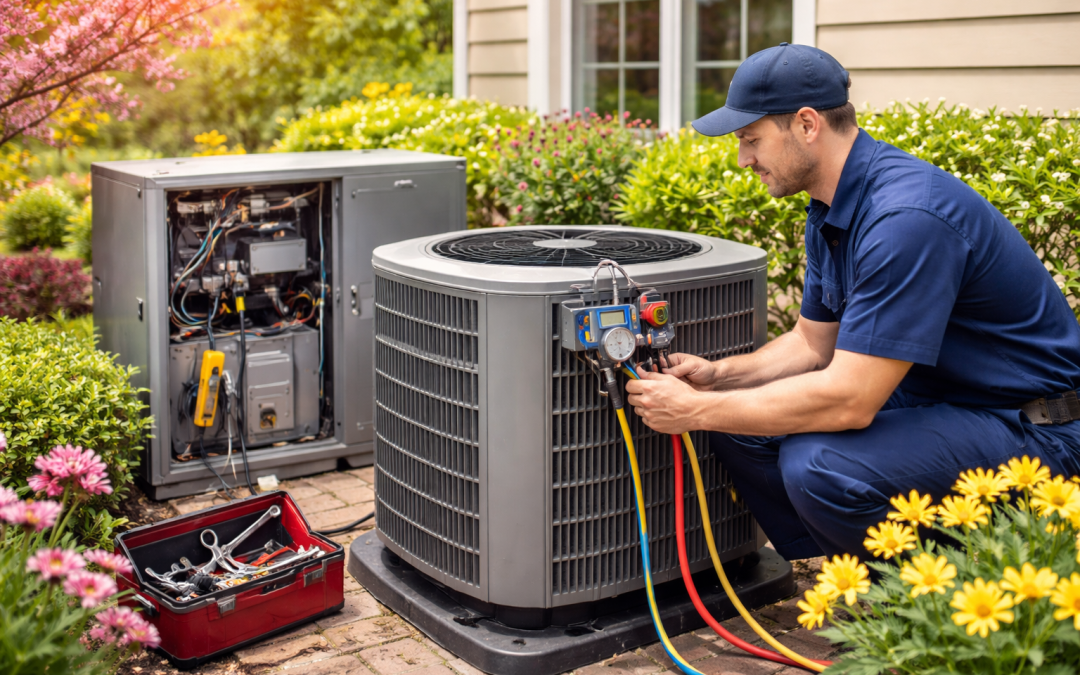
Santa Rosa’s spring season brings distinct challenges for homeowners managing their climate control systems. Between February and April, morning temperatures often drop to the mid-40s while afternoons can reach the mid-70s, forcing HVAC systems to switch between heating and cooling modes within the same day. This transitional period represents the optimal window for addressing both heating system maintenance after winter use and preparing air conditioning equipment for California’s demanding summer season. During this period, searches for “HVAC contractors near me” typically increase as homeowners plan preventive service. North HVAC Services has observed that homeowners who complete dual-system inspections during this shoulder season experience significantly fewer emergency breakdowns when temperatures peak in July and August.
Why Santa Rosa’s Spring Weather Demands Dual-System Attention
Sonoma County’s microclimate patterns create temperature variations that stress residential climate control equipment in ways unfamiliar to homeowners in more stable climates. March and April typically see overnight lows between 42°F and 48°F, followed by afternoon highs ranging from 68°F to 78°F. This 30-degree daily swing forces homeowners to run furnaces in early morning hours and switch to air conditioning by mid-afternoon.
How Temperature Swings Stress Both Heating and Cooling Systems:
- Heating components that operated continuously throughout winter face additional strain when cycled on and off repeatedly during spring’s fluctuating temperatures
- Cooling systems sitting dormant for months must restart suddenly under load rather than gradually ramping up usage
- The combination creates accelerated wear on electrical connections, motor bearings, and refrigerant seals
- Rapid transitions between heating and cooling modes increase mechanical stress on both systems simultaneously
Santa Rosa’s Unique Microclimate Challenges:
Weather patterns specific to different areas of the Santa Rosa compound exacerbate these challenges. Homes in the Fountaingrove hills experience different heating and cooling demands than properties in the Railroad Square area near downtown. Elevation changes, proximity to coastal fog patterns, and urban heat island effects all influence how individual systems perform during seasonal transitions.
North HVAC Services technicians account for these location-specific variations when evaluating system performance during spring inspections.
Why Spring Timing Matters for HVAC Service:
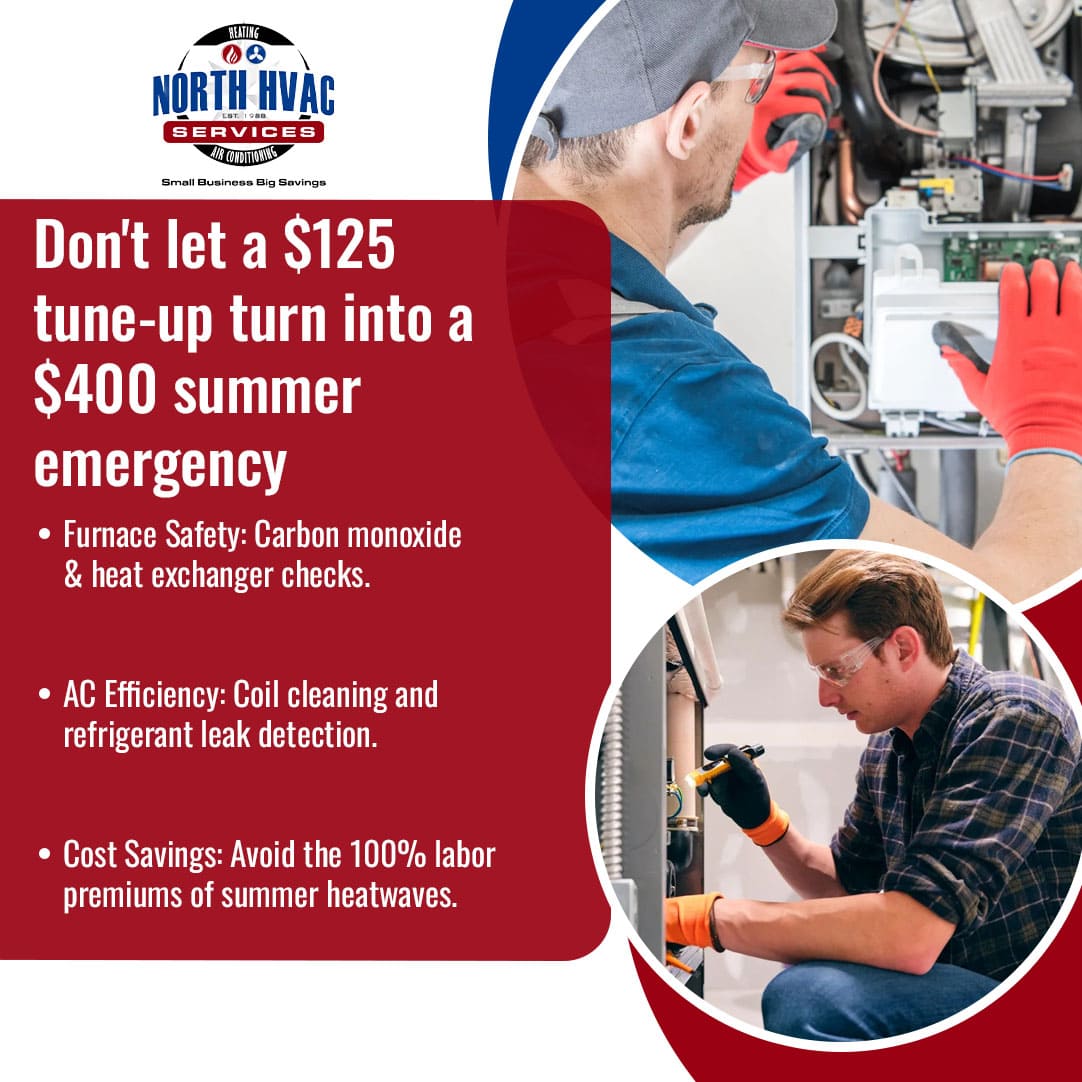
The narrow maintenance window before summer arrives makes spring timing critical. By late May, technician schedules fill with emergency repair calls as the first heat waves arrive. Homeowners who wait until June often face extended wait times for service appointments and limited equipment availability if replacement becomes necessary.
Heating and Air Conditioning: End-of-Winter Furnace Inspection Priorities
After months of continuous operation during Sonoma County’s heating season, furnace components accumulate wear that requires professional assessment before the system sits idle for summer. Spring inspections address several critical areas that determine both safety and performance for the coming year.
Heat Exchanger Integrity and Carbon Monoxide Safety
Heat exchangers–the metal chambers that transfer warmth from combustion gases to circulating air–develop stress cracks from repeated heating and cooling cycles. These cracks can allow carbon monoxide to enter living spaces, creating serious health risks that only become apparent through specialized testing equipment. Our factory-trained technicians at North HVAC Services use specialized combustion analysis equipment to detect heat exchanger issues before they create safety hazards.
According to the U.S. Department of Energy, furnace heat exchangers that leak mix combustion gases with house air, representing an important safety reason to have them inspected professionally. The DOE recommends cleaning heat exchangers and having technicians perform combustion-efficiency tests when considering system maintenance or replacement.
Critical Components That Degrade During Heating Season
Spring furnace inspections should evaluate several wear-prone components:
- Igniter condition and reliability – Hot surface igniters, which replaced standing pilot lights in modern furnaces, have finite lifespans measured in heating cycles. A weak igniter may still function during spring’s mild temperatures but fail completely when next season’s cold weather demands reliable starts. Identifying marginal igniters during spring inspections prevents mid-winter failures.
- Gas valve connections and burner cleanliness – Natural gas contains trace amounts of sulfur and other compounds that create residue buildup on burner surfaces. This buildup reduces combustion efficiency and can create irregular flame patterns that stress heat exchangers. Professional cleaning during spring maintenance restores optimal burn characteristics.
- Ductwork integrity and sealing – Spring provides an often-overlooked maintenance opportunity with attics and crawl spaces at moderate temperatures. Technicians can thoroughly inspect duct connections, sealing, and insulation that become difficult to access during extreme weather. Identifying air leaks or disconnected sections during the spring prevents efficiency losses throughout the entire year.
Essential HVAC Service Tasks for Sonoma County’s Spring Transition
Professional spring service addresses components critical to both heating and air conditioning operation. Thermostat calibration stands as the starting point, as sensors drift from their factory settings over time. A thermostat reading 72°F when the actual room temperature measures 70°F causes both heating and cooling systems to cycle incorrectly, wasting energy and reducing comfort.
Modern programmable thermostats require seasonal reprogramming to match changing schedules and temperature preferences. Many homeowners maintain winter settings well into spring, running heating systems longer than necessary or failing to activate cooling modes during afternoon warmth. Technicians verify programming logic and update schedules to match current seasonal needs.
| Spring Service Task |
Heating Benefit |
Cooling Benefit |
| Air filter replacement |
Removes winter dust accumulation |
Addresses spring pollen before cooling season |
| Condensate drain clearing |
Limited (furnace condensate in high-efficiency units) |
Prevents overflow when AC produces moisture |
| Electrical inspection |
Verifies igniter and blower connections |
Tests compressor and condenser fan circuits |
| Refrigerant verification |
Not applicable |
Identifies leaks before system operates under load |
Air Filter Replacement: Addressing Seasonal Contaminants
Air filter replacement during spring addresses two distinct contamination sources:
- Winter accumulation – Indoor dust from closed homes, dried skin particles, and combustion byproducts build up over months of heating system operation.
- Spring allergens – Santa Rosa’s diverse tree species, including oak, birch, and walnut, release significant pollen between March and May.
- Dual-season protection – A filter saturated with winter contaminants cannot capture spring pollen effectively, reducing both air quality and system efficiency.
Condensate Drain Line Maintenance
Condensate drain lines require attention before the humidity season arrives. Air conditioning systems remove moisture from indoor air, producing condensation that drains through dedicated pipes. During winter dormancy, these drain lines accumulate dust, biological growth, and debris that can cause blockages once the cooling operation resumes.
Consequences of neglected drain lines:
- Water backup that damages ceilings and walls
- Potential electrical component damage from overflow
- Reduced system efficiency and cooling performance
Electrical Connection Inspection
Electrical connection inspection protects both heating and cooling equipment. Thermal expansion and contraction from repeated use loosen wire connections and terminal screws. These loosened connections create electrical resistance that generates heat, potentially leading to component failure or fire risk.
What technicians verify during electrical inspection:
- Systematic tightening of all electrical terminations
- Wire insulation integrity throughout the system
- Proper connection security on both heating and cooling components
AC Maintenance: Pre-Season Cooling System Preparation Checklist
Outdoor condenser units accumulate substantial debris during the winter months when homeowners typically ignore these components. Leaves, seeds, dirt, and vegetation growth obstruct the aluminum fins that transfer heat from the refrigerant to the outdoor air. Even partial blockage reduces cooling capacity and forces compressors to work harder, increasing electricity consumption and accelerating wear.
Professional Condenser Cleaning
Professional condenser cleaning involves more than hosing off visible dirt. Technicians remove the unit’s protective grille to access coil surfaces from inside, using specialized coil cleaners and soft brushes that remove embedded debris without bending delicate fins. Straightening bent fins with proper tools restores airflow paths that casual washing cannot address.
Refrigerant Charge Verification
Refrigerant level verification represents a critical pre-season check that prevents costly damage. Air conditioning systems contain precisely measured refrigerant charges–too little causes inadequate cooling and potential compressor damage, while excess refrigerant reduces efficiency and stresses seals. Unlike automobile air conditioners that homeowners can recharge themselves, residential systems require EPA-certified technicians with proper gauges to measure subcooling and superheat values that determine correct charge levels.
Research conducted at Purdue University’s Herrick Laboratories found that approximately 50 to 67 percent of all air conditioners suffer from improper charge or airflow problems, causing them to operate 20 percent less efficiently than if they were properly installed or maintained. The same study, which was co-supported by the California Energy Commission and U.S. Department of Energy, demonstrated that refrigerant undercharging in the range of 12 to 19 percent can lead to an average reduction of 12.87 percent in cooling capacity and 7.6 percent in energy efficiency.
Refrigerant Leak Detection
Leak testing accompanies refrigerant verification, as systems losing charge indicate seal failures or mechanical damage. Technicians use electronic leak detectors or ultraviolet dye to identify even small leaks that would gradually reduce system performance throughout the summer. Repairing leaks before adding refrigerant prevents wasting expensive refrigerant and allows systems to maintain proper charge throughout the cooling season.
Compressor Health Assessment
Compressor functionality testing before the first heat wave identifies components approaching failure. Technicians measure starting amperage, running current, and capacitor values that indicate compressor health. Marginal compressors may start successfully during spring’s mild temperatures but fail when July’s heat demands maximum output. Identifying weak compressors during spring allows homeowners to plan replacements before emergency situations develop.
Fan Motor Inspection and Lubrication
Fan motor components require lubrication and inspection after sitting dormant through winter. Sealed bearings that appeared adequate in October may have deteriorated during months of inactivity. Blade balance affects vibration levels–imbalanced fans create noise and accelerate bearing wear. Technicians verify blade security, balance, and motor mounting integrity.
How Spring HVAC Maintenance Tune-Ups Prevent Emergency Summer Repairs
The financial difference between planned spring service and emergency summer repairs extends far beyond basic service call charges. During March and April, searches for HVAC contractors near you typically yield next-day or same-week appointment availability. By contrast, when Santa Rosa experiences its first 95°F day in June, service providers face multi-day backlogs of emergency calls from homes with non-functional cooling systems.
Emergency service rates reflect this demand reality. Standard diagnostic fees that might cost $125 during spring months often increase to $200-300 for same-day emergency calls during peak summer heat. Labor rates for weekend or after-hours service add 50-100% premiums to repair costs. Parts availability also becomes problematic–common components like capacitors or contactors that sit readily available in March may require ordering during summer’s peak demand, extending uncomfortable wait times.
Consider the cost comparison:
| Scenario |
Spring Planned Service |
Summer Emergency Repair |
| Diagnostic visit |
$95-125 |
$200-300 (emergency rate) |
| Capacitor replacement |
$150 total |
$325+ (parts shortage, premium labor) |
| Compressor replacement |
$2,800-3,200 (scheduled) |
$3,500-4,200 (emergency, limited availability) |
| Average wait time |
1-3 days |
3-7 days during heat waves |
Beyond immediate cost differences, spring maintenance identifies components approaching failure while they still function. A capacitor testing at 85% of rated capacity during April likely fails by July. Replacing it proactively during planned service costs significantly less than the emergency call, after-hours labor, and potential secondary damage that occurs when capacitors fail catastrophically under load.
Equipment availability advantages favor spring scheduling. Distributors maintain full inventory during shoulder seasons, allowing quick access to replacement parts ranging from basic contactors to complete condensing units. Summer demand creates regional shortages–the same compressor available overnight in April may require week-long backorders in July when every HVAC service provider in Northern California orders simultaneously.
Warranty protection represents another often-overlooked benefit of documented annual maintenance. Most equipment manufacturers require proof of annual professional service to maintain warranty coverage. Homeowners who skip spring furnace maintenance and AC maintenance risk voiding warranties on systems still within their coverage period. The detailed service report from spring visits provides documentation that protects warranty claims if components fail during covered periods.
North HVAC Services maintains extended spring scheduling availability specifically to help homeowners avoid summer emergencies.
Scheduling Strategy: When to Book Your Dual-System Service
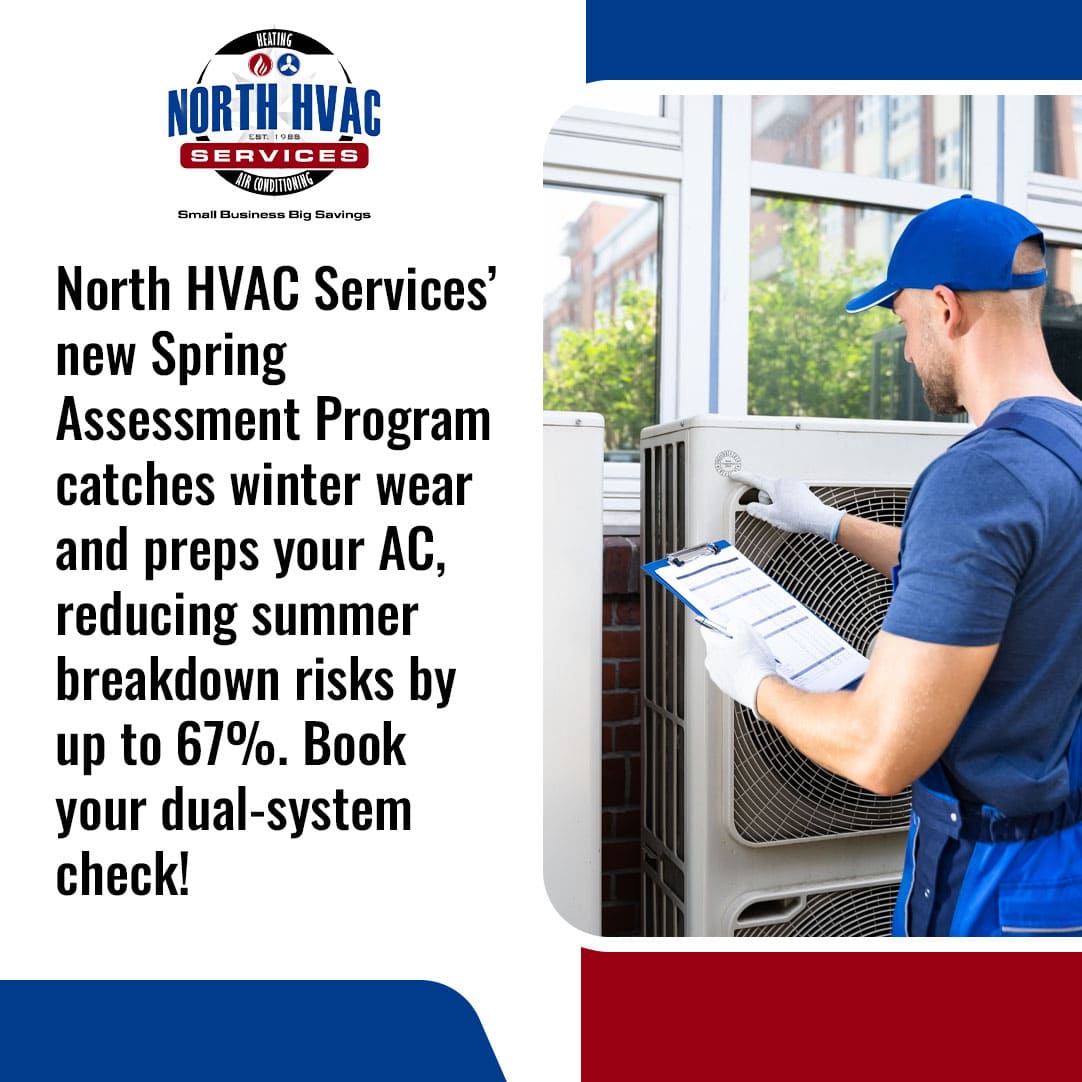
Late February through mid-April represents the ideal scheduling window for comprehensive spring transition service in Santa Rosa. Earlier scheduling in February captures homeowners before widespread awareness drives appointment backlogs, while extending into mid-April still provides sufficient time to address identified issues before summer heat arrives.
What to Expect During Your Spring Inspection
A complete spring transition inspection typically requires 2-3 hours for thorough evaluation of both heating and cooling systems. This duration allows technicians to complete all checklist items without rushing, test system operation under both heating and cooling modes, and discuss findings with homeowners. Properties with multiple zones, commercial-grade equipment, or older systems may require additional time.
Preparing Your Home for Service
Homeowners should prepare for service visits by clearing access to both indoor and outdoor equipment. Simple preparation steps help technicians work efficiently:
- Remove stored items blocking furnace access panels in closets or garages
- Trim vegetation around outdoor condenser units to maintain 24 inches of clearance
- Move patio furniture or outdoor obstacles away from the AC equipment
- Clear pathways to mechanical areas for safe technician access
Warning Signs That Require Immediate Attention
Several warning signs indicate immediate attention regardless of seasonal scheduling recommendations:
- Unusual odors from heating systems, particularly sulfur or burning smells
- Visible rust or corrosion on furnace heat exchangers
- Air conditioning refrigerant lines showing ice formation
- Loud grinding, squealing, or banging noises from either system
- Visible water leaks or standing water near indoor or outdoor equipment
- Thermostat displaying error codes or failing to control temperature
These symptoms suggest problems requiring urgent evaluation rather than waiting for routine spring service. Component failures don’t respect seasonal schedules–addressing warning signs immediately prevents minor issues from escalating into major repairs.
Benefits of Establishing a Service Relationship
HVAC service providers in Sonoma County recognize these seasonal patterns and adjust staffing accordingly. Homeowners who establish relationships with local contractors often receive priority scheduling and preferential service timing. Annual HVAC maintenance tune-ups create service histories that help technicians identify gradual changes in system performance, catching deterioration before failures occur.
Beat the Rush: Schedule Your Complete Spring HVAC Transition Service Today
Book your furnace maintenance and air conditioning spring service before Santa Rosa’s peak scheduling season arrives. At North HVAC Services, we perform complete seasonal inspections to wrap up winter heating use and prepare cooling equipment for summer temperatures. Our technicians inspect both systems, document completed work, and provide records that support warranty protection and long-term system tracking.
Scheduling early helps reduce the risk of mid-summer breakdowns and allows potential issues to be addressed before they become costly repairs. Homeowners who plan ahead are more likely to secure preferred appointment times and maintain consistent indoor comfort during the hottest months. It’s also the time when many start searching “HVAC contractors near me” to compare providers and lock in dependable service before demand increases.
Don’t wait until the first 90-degree day creates a service backlog that delays your comfort for days or weeks. Contact our team at (415) 845-6910 or email northhvacservices@gmail.com to schedule your spring transition service while prime appointment slots remain available. You can also request service through our contact page with details about your current system and any specific concerns you’ve noticed during recent operation.
Mar 11, 2026 | HVAC Maintenance
Most homeowners don’t think about HVAC service until something goes wrong, like a furnace failing in the middle of winter or an air conditioner quitting during a late-summer heat wave. When that happens, the cost and stress add up fast. Emergency repairs are significantly more expensive than routine care, and systems without regular maintenance tend to fail more often and operate less efficiently. Reliable HVAC service isn’t just preventive; it’s a smart way to protect comfort, avoid surprise breakdowns, and control long-term costs.
Understanding What You’re Paying For: The Maintenance Checklist
Professional HVAC maintenance involves comprehensive inspection, cleaning, and testing that typically requires 60-90 minutes to complete thoroughly. Understanding what you’re paying for helps you recognize the value of quality heating services in Santa Rosa, CA.
- System Inspection Components:
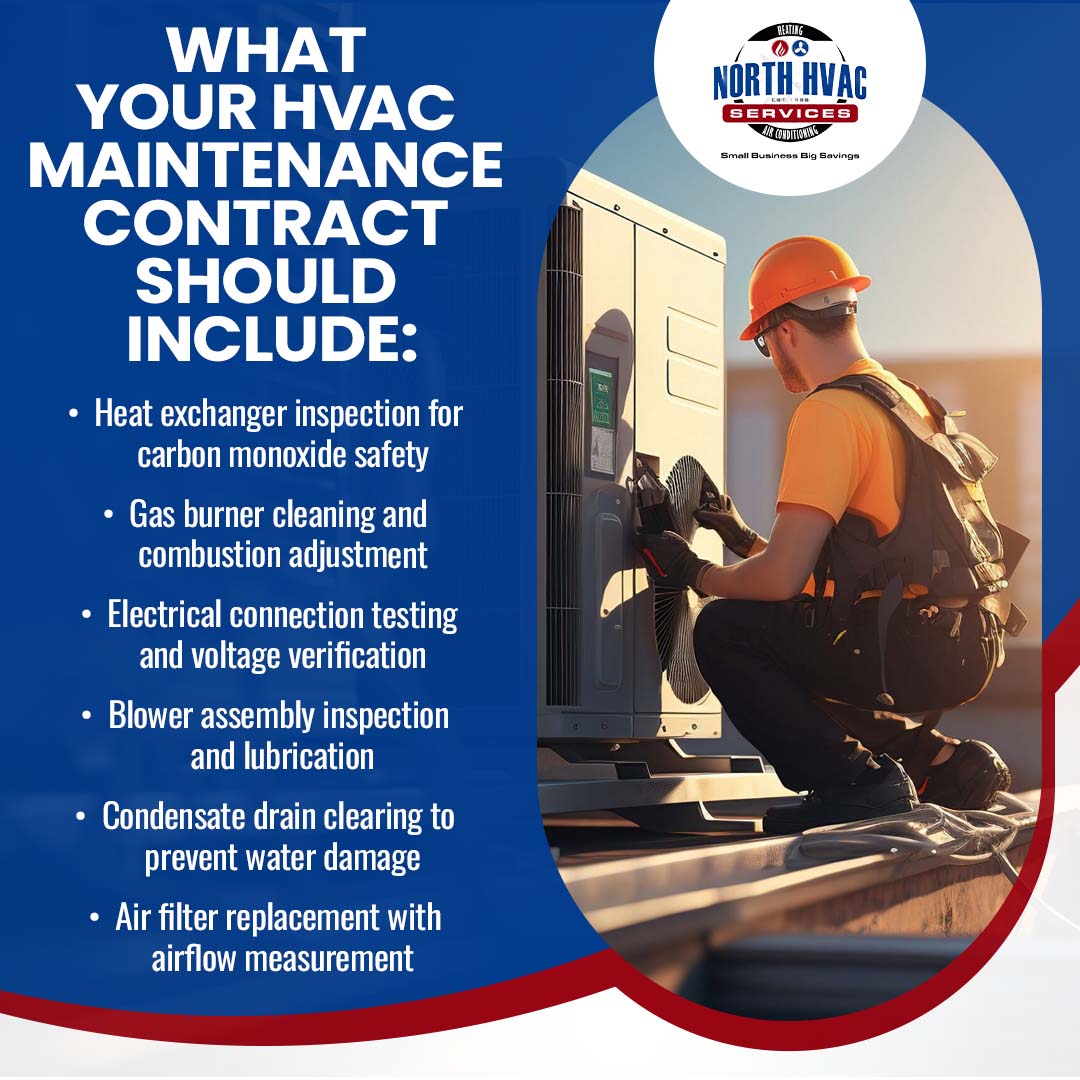
- Heat exchanger examination for cracks or corrosion that could cause carbon monoxide leaks
- Electrical connection testing, voltage checks, and terminal tightening
- Blower assembly inspection for wear, balance, and proper operation
- Ductwork inspection for leaks or damage affecting efficiency
- Cleaning and Maintenance Tasks:
- Gas burner cleaning and combustion adjustment
- Condensate drain clearing to prevent water damage and mold
- Air filter replacement and airflow measurement
- Blower component lubrication to reduce friction and noise
- Temperature differential measurement between the supply and return air
- Safety control testing to verify proper system shutdown protocols
- Thermostat calibration for accurate temperature control
- Combustion analysis for gas-fired equipment to confirm safe, efficient operation
The difference between basic tune-ups and complete maintenance shows up in diagnostic depth and testing equipment. Basic service might include visual inspection and filter replacement. Thorough maintenance uses diagnostic tools that reveal developing problems before they cause system failures.
- Sonoma County’s Unique Maintenance Needs:
- Dust accumulation from dry summers clogs components and reduces airflow
- Winter rain moisture corrodes electrical connections
- Wildfire smoke deposits residue on filters and coils, restricting efficiency
- Temperature fluctuations between coastal fog and inland heat stress system components
According to research published in Energy Reports, proper preventive maintenance reduces HVAC system breakdowns by 70-75%. Regular service identifies small issues before they become expensive failures, protecting homeowners from emergency repair situations and uncomfortable temperature extremes.
Breaking Down the Cost Comparison
Annual HVAC maintenance contracts in Northern California typically cost between $100 and $650 per year, depending on service scope and equipment type, according to Angi’s maintenance cost data. The national average for HVAC maintenance is $250, with most homeowners paying between $175-$350 for comprehensive service. This predictable investment contrasts sharply with unpredictable emergency repair expenses.
Common Emergency Repair Costs:
| Repair Type |
Cost Range |
Data Source |
| Blower motor replacement |
$500-$2,300 |
HomeGuide 2026 |
| Heat exchanger repair/replacement |
$1,000-$3,000 |
HomeGuide 2025 |
| Ignition system failure |
$300-$550 |
Industry average |
| Complete system replacement |
$5,000-$12,500 |
Industry average 2025 |
Five-Year Cost Comparison:
| Scenario |
Annual Cost |
5-Year Total |
Notes |
| With maintenance contract |
$150-$500 |
$750-$2,500 |
Predictable, scheduled expense |
| Single emergency repair |
N/A |
$500-$3,000 |
One major failure can exceed 5 years of maintenance |
| Unmaintained system |
Variable |
$2,000-$10,000+ |
Multiple repairs common, plus efficiency losses |
Energy Efficiency Impact:
The financial impact extends beyond repair bills. ENERGY STAR reports that the average home spends nearly $1,900 annually on energy bills, with approximately half dedicated to heating and cooling. The U.S. Department of Energy confirms that HVAC systems without regular maintenance can use considerably more energy than properly maintained systems.
Annual Energy Cost Impact:
| System Condition |
Annual Energy Cost
(Heating/Cooling) |
5-Year Total |
Efficiency Loss |
| Well-maintained system |
$950 |
$4,750 |
Baseline |
| Unmaintained system |
$1,187 |
$5,935 |
25% efficiency loss |
| Energy waste from neglect |
+$237/year |
+$1,185 |
Wasted energy |
Insurance and Warranty Protection:
Many home warranties require documented annual maintenance as a coverage condition. Without maintenance records, warranty claims for major component failures may be denied, leaving homeowners responsible for full replacement costs that could have been partially covered.
Regional pricing in Sonoma County reflects local labor costs and service demand, but the fundamental economics remain consistent – preventive maintenance costs substantially less than reactive repairs while delivering better system performance.
Adding Years to Your System’s Life
Equipment longevity differences between maintained and neglected systems create a significant financial impact. According to the National Association of Home Builders, regular maintenance can extend HVAC system life by up to 50%.
Expected System Lifespan:
| System Condition |
Expected Lifespan |
Premature Replacement Cost |
Annual Lost Value |
| Well-maintained systems |
15-20 years |
N/A |
N/A |
| Neglected systems |
10-12 years |
$5,000-$8,000 (6 years early) |
$800+ per year |
That six-year difference matters financially. A system requiring replacement at year 12 instead of year 18 means spending $5,000-$8,000 prematurely. Spread across the shortened lifespan, that represents over $800 annually in lost equipment value – far exceeding annual maintenance costs.
How Maintenance Prevents Premature Aging:
Clean systems require less effort to achieve desired temperatures. A furnace with clean burners and proper airflow reaches set points more quickly, reducing total run time and wear on critical components:
- Reduced strain: Motors, bearings, and electrical components experience less accumulated wear
- Early detection: Small problems get fixed before causing cascading failures
- Proper lubrication: Moving parts with correct clearances last dramatically longer
- Calibration maintenance: Systems operating within specifications avoid stress damage
Real-World Example:
A loose electrical connection caught during maintenance gets tightened in minutes. Left unaddressed, it can arc, overheat, and damage control boards, costing hundreds to replace. A slightly dirty blower wheel gets cleaned before the imbalance causes bearing failure, requiring motor replacement.
Sonoma County Climate Factors:
Local environmental conditions accelerate wear on unmaintained systems:
- Wildfire smoke particles lodge in coils and filters, restricting airflow
- Temperature swings of 30+ degrees between coastal and inland areas stress connections
- Fog and rain moisture corrode electrical components faster than drier climates
- Seasonal dust from dry periods clogs systems without regular cleaning
Maintenance History Value:
Systems with documented annual service provide tangible benefits:
- Better trade-in allowances from contractors at replacement time
- Manufacturers honor warranties more readily with proof of proper care
- Higher home resale value with documented HVAC maintenance records
- Reduced negotiation challenges during home inspections
Consider two 12-year-old furnaces in Santa Rosa. The maintained unit operates quietly, heats efficiently, and shows minor wear appropriate for its age. The unmaintained unit runs loudly, struggles to maintain temperature, and displays rust, corrosion, and component degradation, indicating imminent failure. One has multiple years of service remaining. The other faces costly replacement in the near term.
Beyond Cost Savings: The Convenience Factor
Financial benefits represent only part of the maintenance contract value. Practical advantages greatly improve the homeowner experience during system problems.
Priority Scheduling Advantages:
- Contract holders: Same-day or next-day service when issues arise
- Non-contract customers: Often wait 3-5 days during peak demand periods
- Critical timing: During December cold snaps or September heat waves, wait times create unsafe indoor temperatures
- Peak season protection: Holiday and extreme weather periods when service demand peaks
Predictable Budgeting Benefits:
- Fixed annual maintenance cost replaces unpredictable emergency bills
- Accurate budgeting without maintaining large emergency funds
- No surprise $1,500 repairs disrupting household finances
- Planned expenses rather than financial emergencies
Professional Relationship Value:
Working with a trusted HVAC company nearby through a maintenance contract provides ongoing benefits:
- Technician familiarity with your specific system’s characteristics and history
- Performance monitoring that notices subtle changes indicating developing problems
- Documented records tracking system health trends over the years
- Consistent quality versus searching for emergency contractors during crises
Peace of Mind Protection:
- Pre-winter system verification prevents holiday season failures
- Reduced anxiety about the aging system’s reliability
- Professional monitoring catches problems before complete failures
- Expert attention on a regular schedule rather than hoping the equipment continues working
October maintenance ensures your furnace operates reliably before temperatures drop. For aging systems, this regular professional oversight provides confidence that problems will be identified and addressed proactively.
What to Look for in a Maintenance Contract
Maintenance contracts vary substantially in scope and value. Being aware of the differences helps homeowners choose agreements that match their needs and budgets.
Contract Type Comparison:
| Contract Type |
What’s Included |
Approx: Annual Cost |
Best For |
| Basic |
One annual tune-up, inspection, filter replacement, minor adjustments |
$150-$300 |
Newer systems in good condition |
| Comprehensive |
Seasonal visits (heating + cooling), priority service, discounted repair rates |
$300-$500 |
Most Santa Rosa homeowners with standard equipment |
| Premium |
Multiple visits per year, parts coverage/discounts, emergency service inclusion |
$500-$1,000+ |
Older systems or complex equipment |
Red Flags to Avoid:
- Vague “inspection” language without specific service lists
- No clear response time guarantees for service calls
- Hidden fees or charges not disclosed upfront
- Automatic renewal without notification or consent
- Unrealistic promises or “lifetime” guarantees
Questions to Ask Before Signing:
- What specific tasks are included in each maintenance visit?
- Are there travel charges or diagnostic fees beyond the contract price?
- What response times can contract holders expect for service calls?
- How much are parts discounted, and what components are covered?
- What are the cancellation terms if I need to end the agreement?
- How do you handle scheduling conflicts or service delays?
Local Considerations for Sonoma County:
When choosing HVAC contractors near you, prioritize providers who understand regional challenges:
- Wildfire smoke filtration and air quality concerns
- Climate differences between coastal areas and inland valleys
- Seasonal maintenance timing for California’s unique weather patterns
- Local building codes and permit requirements
Verification Requirements:
- Confirm the California Contractors State License Board licensing
- Verify adequate liability and workers’ compensation insurance
- Check references and online reviews from local customers
- Request proof of manufacturer certifications for your equipment brand
Request written contract terms before committing. Review cancellation policies, service guarantees, and remedies if the company cannot provide service within stated timeframes. Clear documentation prevents misunderstandings and ensures both parties understand the agreement terms.
Making the Smart Investment Decision
The financial argument for maintenance contracts comes down to straightforward economics. A single emergency repair frequently exceeds five years of maintenance costs. An extended equipment lifespan adds thousands in avoided replacement expenses. Energy efficiency savings compound annually, reducing utility bills throughout the system’s life.
Reframe Your Perspective
View maintenance contracts as insurance policies rather than expenses. You’re protecting against much higher costs while ensuring reliable comfort year-round. Calculate your personal break-even point based on your system’s age and condition. Older equipment benefits more from maintenance contracts due to a higher failure risk.
Actionable Next Steps:
- Schedule pre-winter maintenance in October – ideal timing before heating season begins
- Request detailed proposals from multiple furnace maintenance providers to compare coverage
- Verify licensing through the California Contractors State License Board
- Confirm insurance coverage protects you during service visits
- Ask about promotions or seasonal discounts that reduce contract costs
Why Choose North HVAC Services:
Experience Serving Northern California Since 1988
North HVAC Services has served Marin and Sonoma County homeowners since 1988, specializing in maintenance agreements designed for Northern California’s unique challenges. As a Diamond Authorized Dealer for Mitsubishi heat pump equipment and an authorized factory dealer for Trane and Day & Night, we bring decades of experience to every maintenance visit.
Regional Expertise That Matters
Our maintenance programs address regional concerns that matter to Santa Rosa homeowners – wildfire smoke filtration, temperature variations between coastal and inland areas, and moisture management during winter months. North HVAC Services technicians are EPA certified and trained to service all manufacturers and models, providing the expertise needed to keep your system running efficiently year-round.
Preventive Maintenance Programs
We offer full-service heating solutions that include seasonal HVAC maintenance tune-ups with priority scheduling for contract holders. Our family-owned business approach means you work with the same knowledgeable team members who understand your system’s history and performance patterns. Learn more about our HVAC maintenance programs tailored specifically to Northern California conditions.
Priority Service When You Need It
North HVAC Services maintenance contracts include thorough inspections, cleaning, performance testing, and priority emergency service. Contract holders receive same-day or next-day scheduling during peak demand periods, protecting your family’s comfort when you need it most. Our reasonable pricing and quality craftsmanship have earned us hundreds of five-star reviews from satisfied customers throughout Sonoma and Marin Counties.
Get Started Today
Whether you’re protecting a new system or extending the life of older equipment, North HVAC Services provides the professional HVAC service in Sonoma County that your home deserves.
Contact us today at (415) 845-6910 to discuss maintenance options that fit your budget and your system’s specific needs.
Proactive homeownership means preventing problems rather than reacting to crises. Maintenance contracts provide that protection while saving money, extending equipment life, and ensuring your family’s comfort regardless of weather conditions outside. The small annual investment protects against major expenses while delivering better system performance and home comfort throughout every season.